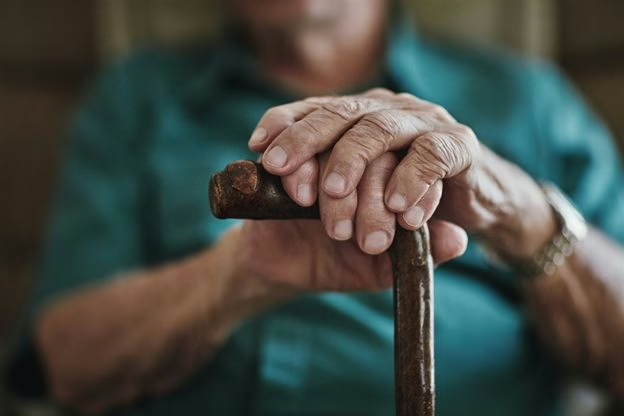


As technology advances and families fracture, our elderly are left behind—abandoned by systems that prize productivity over compassion
Human civilisation has witnessed innumerable changes since its inception. From hunting-gathering societies to modern industrialised nations, change has remained a constant and enduring feature of human existence. As societies advance and new technologies emerge, change becomes an inevitable force that shapes our world. With each innovation and shift in priorities, we redefine our way of life, making progress seem synonymous with speed and efficiency. Yet, beneath this transformative character of change lies a stark reality of people, most vulnerable and infirm, who often find themselves marginalised, their needs overlooked in the rush toward the future.
While change is often lauded and embraced—especially by the young and ambitious—it is a double-edged force; though it brings growth and opportunity, it can also displace, marginalise, and render invisible those who cannot keep pace, particularly the elderly, who find their needs disproportionally sidelined, and traditional support system disrupted.
As societies progress, one might expect a reasonable change in the way society cares for its ageing population. However, the reality is that the elderly have become invisible in the face of modernisation. While society races toward greater economic development, technological innovation, and individual success, the elderly are increasingly marginalised. The very institutions designed to nurture and protect them—families, healthcare systems, and communities—are failing in their most basic obligations. The rapid breakdown of traditional family structures, the rise of individualism, and the obsessive pursuit of economic growth have rendered elderly care not a priority but an afterthought.
In the modern world, where economic success and personal achievement are lauded above all else, the elderly are reduced to mere burdens. The nuclear family model has replaced the extended family, leaving elderly parents and grandparents isolated in a system that prioritises individual gain over collective responsibility. The care of the elderly, once considered a moral and social duty, is now viewed through a transactional, impersonal paradigm. Instead of being integrated into family life, the elderly are pushed to the margins, or sometimes relegated to care facilities or, worse, left to fend for themselves, abandoned to a life of loneliness, neglect, and emotional deprivation.
Technological advancements, which have revolutionised communication and daily life, have only deepened the chasm between generations. The very tools engineered to connect people are instead widening the generational divide, paradoxically leading to the undermining of human connections, leaving the elderly more disconnected than ever before. This exhibits how technology may, in some respects, be at odds with humanity, particularly in its impact on evolving elderly care.
In a society that values innovation and demands instant gratification, those who can no longer keep up with technological trends are left to suffer in silence, ignored by a system that moves at breakneck speed. The obsession with this tech-savvy instrumentation, coupled with modern consumer culture, has substantially altered the ‘art of relatedness’ and the ethos of family-centric ethics, once essential to elderly care.
The lack of elderly care is symptomatic of a deeper, more insidious flaw in our social fabric. It exposes the hollowness of modern progress, which is measured not by how we treat the most vulnerable, but by how much we can consume, achieve, and accumulate. A society that neglects its elderly is a society that has lost its humanity. The failure to provide care for the elderly is not just a policy failure; it is a moral failure, a reflection of a society that values progress at the expense of compassion, that prioritises economic growth over human dignity. Until we address this neglect, we cannot truly claim to have advanced.
The elderly are not disposable; they are the living memory of a society that is rapidly forgetting its roots. The failure to care for them speaks volumes about the true nature of the so-called progress we celebrate. So, in our restless pursuit of material well-being, it is crucial that reflexivity becomes the norm for every individual and the current paradigm of negligence and inattention of the elderly must shift towards valuing the inherent dignity of every individual, especially the old.
Amir Mohammad Wani is a PhD scholar specialising in Gerontological studies, with a focus on elderly abuse in Kashmir. Kamran Lone is pursuing an MA in Economics at the University of Kashmir.
Amir Mohammad Wani and Kamran Lone
am*********@***il.com