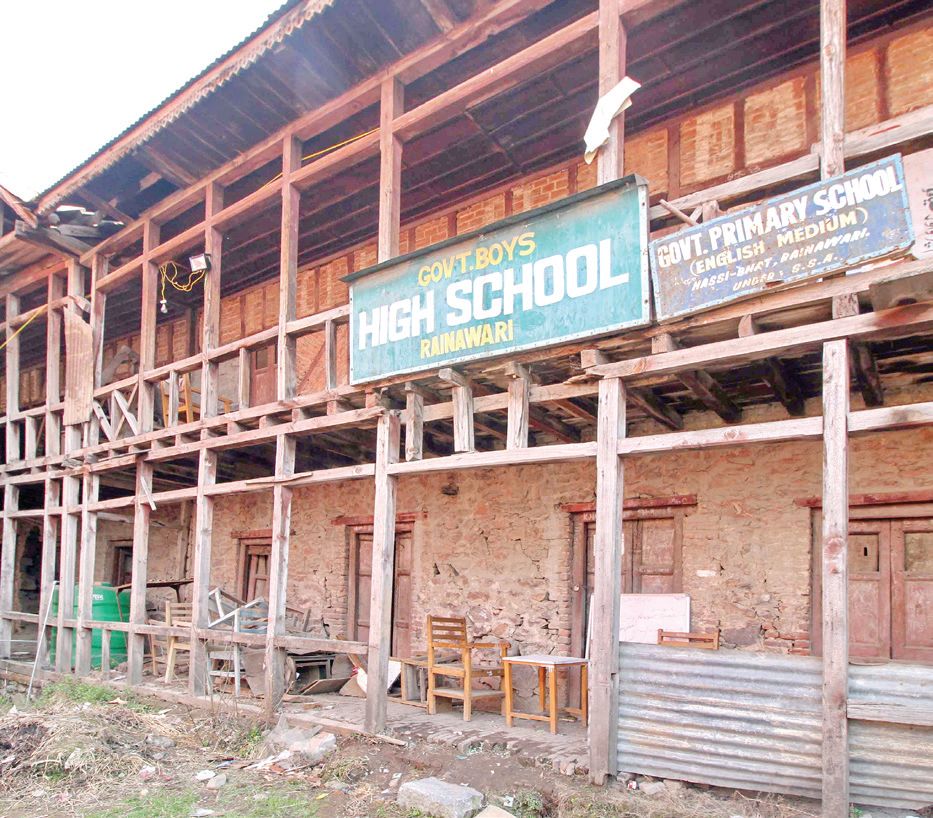


Amidst disparities in student performance, educators must take ownership and focus on foundational literacy and numeracy to elevate learning standards
Academic monitoring at elementary and secondary levels involves a systematic approach to identifying and tracking the progress of students in different areas of study. It is a crucial stage for both teachers and inspectors to ensure students are making adequate progress.
At the elementary level, literacy skills along with cognitive development are of utmost importance. Teachers in our J&K must understand that if they cannot help students at this level to gain letter recognition, sound correspondence, sight word reading, and reading comprehension skills—then what is the purpose of this government education system in J&K?
Of late, I was chosen as a member of the academic monitoring committee by the complex head. After visiting a few schools, some questions struck my mind based on observations at the ground level:
Why, in a village of the same habitation, similar financial strength of the people, similar qualifications of educators, and comparable literacy rates, is one elementary government school as competent as a private school, while other government schools lag far behind in writing, reading, and basic numeracy skills? The lack of effort is quite evident in these schools. The educators are well-versed in pedagogy, but the effort put in is miserable. How can we justify this? We earn our livelihood from these schools, yet our efforts are questionable.
Why does an educator often blame parental care in government schools? It’s often nothing but a cover for weaknesses. Let us do some arithmetic:
A child is admitted to a school at the age of three-plus and spends six hours daily with us (educators). Do we mean the child spends more time with their parents? A four-year-old sleeps for about thirteen hours. The simple arithmetic shows the child spends more conscious hours with teachers. This process continues until they reach the age of 14.
For God’s sake, if a student, after passing 8th grade, does not have letter recognition, sight word reading, or basic numeracy, whose fault is it? Who will accept this narrative of educators? Eleven years with us and still lacking basic word recognition, as highlighted recently by the ASER (Annual Status of Education Report).
During academic monitoring, I discussed this arithmetic with fellow educators, and they presented another narrative: the late distribution of textbooks by JK BOSE. But for a nursery-level child, what role does a textbook really play? Can’t we teach them basic reading and numeracy skills without it? Changing narratives can’t defend us anymore. Our reputation is at stake. People are now aware.
The School Education Department (SED) leaves no stone unturned in trying to improve the image of government schools in J&K. But the major responsibility lies with us—educators.
For small things like park maintenance, decorating schools, or filling a ditch in the school lawn, should we really wait for official approvals or funds? We can manage these minor tasks ourselves—if we truly own the schools. We can even spend from our own pockets if needed.
The RET scheme was a praiseworthy step by the government. But many of the teachers who were appointed under it did not do justice to their role. Imagine the beauty of teaching the children of your own village—you know their background, their family history, their needs. Still, the students in these schools score poorly in FLN (Foundational Literacy and Numeracy), word recognition, reading, and writing.
To improve the standards of government schools, sustained efforts from educators are required. Key areas include:
– Ownership of schools in all respects by educators.
– Regular Parent-Teacher Meetings to build a strong school-home connection.
– Stop building false narratives and instead focus on making the system result-oriented.
– Strong focus on foundational literacy and numeracy (FLN).
– Mentorship programs for new teachers to foster continuous improvement.
– Regular assessments to monitor student progress and identify gaps.
– External evaluations to ensure schools meet desired learning outcomes.
– A three-tier academic monitoring system: one by the complex head, another at the district level, and the third at the divisional level.
– Importantly, the monitoring teams must include top-notch educationists, not clerks.
– Use assessment data to reshuffle teachers immediately where necessary.
The writer is a teacher at Boys Secondary School, Narbal
Muntashir Kifayat
mu**************@***il.com