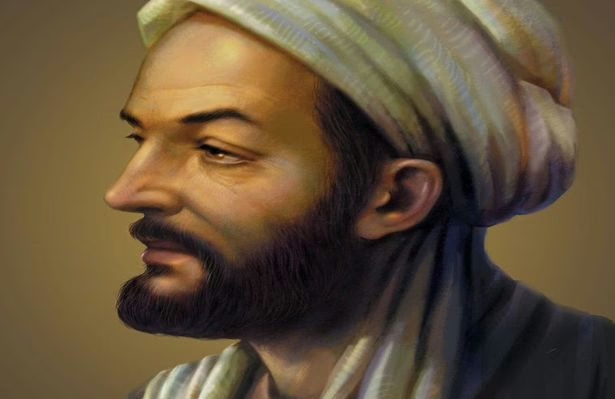


The future is not written in the stars, but in the choices you make: Abu Musa Jabir ibn Hayyan al-Bariqi
What if the genesis of modern chemistry—the periodic table, laboratory apparatus, and scientific methodology—originated not in Europe but in the intellect of an 8th-century polymath in Baghdad? Abu Musa Jabir Ibn Hayyan Al-Azdi, an innovative alchemist, philosopher, and scientist, transmuted alchemy into a structured empirical discipline, his legacy permeating laboratories, industries, and academia worldwide. Yet, his name remains obscured within dominant historical narratives, an unacknowledged architect of scientific progress.
There was an era when Muslim scholars, driven by epistemic rigor, forged an intellectual framework that became the substratum of scientific inquiry. Meticulously interwoven with empirical precision, systematic reasoning, and scholastic depth, this legacy transcended doctrinal and cultural boundaries, flourishing through institutions like the House of Wisdom and vast madrasa networks. Even today, its universality commands recognition, with scholars across disciplines and geographies affirming its enduring imprint.
Jabir ibn Hayyan, an erudite polymath, remains profoundly integral to modern chemistry, his seminal contributions serving as a critical juncture between arcane alchemical traditions and empirically grounded scientific inquiry. Through methodical experimentation and the discovery of fundamental chemical compounds—many of which retain contemporary utility—he engendered a paradigm shift in the discipline.
His scrupulous systematization of experimental methodologies and fastidious documentation established the epistemological substratum upon which the edifice of modern experimental chemistry was meticulously constructed.
Laboratory Innovations
He designed and refined apparatuses such as the alembic for distillation, which remains a prototype for modern distillation equipment. His development of techniques like crystallization, calcination, sublimation, purification, amalgamation, oxidation, evaporation, and filtration processes, significantly impacted the development of chemistry all over the world. are still integral to chemical processes.
Discovery and Use of Acids
Jabir is credited with preparing hydrochloric acid nitric acid, and aqua regia acids critical in industrial and laboratory applications today. His work with these substances advanced early chemical synthesis and metallurgy.
Classification of Substances
He categorized materials into “spirits” (volatile substances), metals, and non-malleable compounds, foreshadowing modern chemical taxonomy. This organizational approach influenced later systematic classifications, including the periodic table.
Emphasis on Experimentation and Documentation
Jabir’s insistence on systematic experimentation, reproducibility, and record-keeping established principles later formalized as the scientific method.
Empirical approach
He shifted focus from alchemical mysticism to evidence-based inquiry, paving the way for modern chemistry.
Jabir engineered an exceptionally precise scale capable of measuring weights up to 6,480 times smaller than a ratl 2.2 lbs. ( no textual proof)
Applied Chemistry
He developed early pharmaceuticals and chemical remedies, linking chemistry to healthcare—a precursor to modern pharmacology.
Industrial applications
Techniques like dye-making, glass production, and metal extraction were refined in his work, influencing early industrial chemistry.
In an age of clay crucibles and flickering flames, Jabir ibn Hayyan forged the tools of modern chemistry—distilling truth from mystery with crude alembics, scarce resources, and relentless curiosity. His legacy? Proof that genius thrives not in ease, but in the alchemy of perseverance. Jabir turned medieval limits into chemical revolutions. Imagine what you could transform.?
A Literary Corpus Blending Empirical Science with Philosophical Inquiry
Jabir ibn Hayyan’s intellectual corpus, an intricate amalgamation of practical experimentation and philosophical reflection, profoundly shaped the trajectory of scientific thought. His seminal works—Kitab al-Kimya (The Book of Chemistry/Alchemy), Kitab al-Sab’een (The Book of Seventy), Kitab al-Mawazin (The Book of Balances), Kitab al-Asrar (The Book of Secrets), and Kitab al-Rahma (The Book of Mercy)—laid the epistemological foundations of chemistry, pioneering an empirical methodology that would resonate across centuries.
Enduring Scholarly Recognition in Medieval and Modern Perspectives
Jabir’s profound influence has been acknowledged by both medieval and modern scholars, transcending geographical and cultural boundaries.
Medieval Acknowledgment
Albertus Magnus, the eminent medieval scholar, extolled Jabir’s contributions, asserting that alchemists such as Jabir had uncovered knowledge of immense practical utility.
Roger Bacon, a pivotal advocate of experimental science in the 13th century, directly attributed the advancement of the sciences, inherited from the Arabs, with Jabir as a central figure.
Paracelsus, the 16th-century Swiss physician-alchemist and progenitor of modern medicine, revered Jabir’s medicinal chemistry, affirming that “the true secrets of chemistry were first taught by the Arabs,” with Jabir as its preeminent luminary.
Modern Historical Recognition
E.J. Holmyard, in Alchemy (1957), underscored Jabir’s revolutionary contributions to chemical sciences.
George Sarton, in Introduction to the History of Science (1927), hailed Jabir as an unparalleled genius whose work underpinned the evolution of experimental chemistry.
William Newman, in The Summa Perfectionis of Pseudo-Geber (1991), elucidated the extensive European assimilation of Jabir’s methodologies, particularly his emphasis on quantification and laboratory precision.
Eric John Holmyard, in Makers of Chemistry (1931), contended that without Jabir’s foundational discoveries, the chemical revolution spearheaded by Lavoisier and Boyle might never have materialized.
Lawrence Principe, in The Secrets of Alchemy (2013), accentuated Jabir’s practical ingenuity, noting that his work on distillation and acids was not merely theoretical but applied science, with his alembic serving as the precursor to modern distillation apparatus.
Jim Al-Khalili, in The Golden Age of Arabic Science (2010), highlighted the enduring relevance of Jabir’s discoveries, particularly his synthesis of nitric and hydrochloric acids, which remain indispensable to contemporary chemical laboratories.
Nobel Laureate Ahmed Zewail lauded Jabir’s visionary integration of theoretical and experimental science, asserting that his methodologies laid the foundational bedrock for modern experimental chemistry.
Syed Nomanul Haq, in Names, Natures, and Things (1994), repositioned Jabir as a polymath whose intellectual breadth extended beyond chemistry into philosophy and epistemology.
Bill Bryson, in A Short History of Nearly Everything (2003), contrasted Europe’s intellectual stagnation during the Dark Ages with the scientific advancements of figures like Jabir ibn Hayyan, whose work in Baghdad ignited the embers of the Renaissance.
A Legacy Etched in Scientific History
Jabir ibn Hayyan, venerated by historians and scientists alike, stands as an indelible figure in the annals of chemistry. His profound impact was recognized by Ibn Khaldun, who positioned him as a seminal architect, and polymath, and his stature remains unequivocal in contemporary discourse, as attested by The Enduring Legacy of Muslim Civilization (4th Edition, UK, 2017).
Be next jabir who interrogate phenomena with ontological audacity, experiment through dauntless empiricism, and architect an epistemic future where scientific praxis synthesizes rather than bifurcates. Let the hermeneutic alembic of cognition catalyze chaos into epistemic lucidity—interrogate the occluded noumenal, metricize stochastic uncertainties, and transmogrify heuristic postulates into positivist certitude. Let your sanctums of inquiry resound with the staccato percussion of catalytic vessels counterpointed by the hush of noetic reflection, for revelatory epiphanies emerge from the conjugal nexus of Baconian observation and Blakean vision. Synchronize theorems to cosmic frequencies. Know this: the supreme transmutation is not of lead to gold, but of consciousness—science.
The writer works in the J&K education department
Rayeesulislam
ra************@***il.com