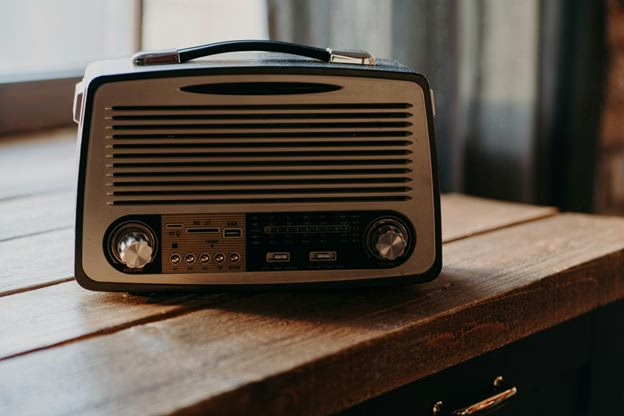


Reflecting on childhood memories of radio’s warmth amidst the noise of modern distractions
Back in the folds of my childhood, every morning as I awoke, one sound remained constant-woven into the fabric of my days, filling the spaces between dreams and reality. It was the Radio, humming softly in the background, a quiet yet powerful presence that felt as essential as the morning air.
Our home carried a different warmth as each program aired, a pause in time, a presence that settled into our hearts. Humsafar Marriage Counseling Program with Fayaz Ahmad Zaroo offered answers to questions we never dared to ask aloud. Gandhi Katha, with its deliberate, measured words, echoed a past that refused to be forgotten.
The afternoons belonged to my Mother, who, amidst her chores, would pause to listen to Bazmi Niswa’n, those distant voices carrying stories she understood in a language beyond words. Then came the Pahadi Program, with its familiar songs of home, followed by Zamindaar Baayan Hund Program, speaking to those whose lives were measured not by hours but by the turning of soil and the changing of seasons. And as evening stretched its arms, Sheharbeen arrived like a bridge, tying the distant to the familiar, bringing the world outside our small home into its very heart.
Bachun hund program (Pholwan toor) transformed our home into a playground of imagination, while Radio drama—the drama that filled the room with shadows and whispered stories—turned silence into a theatre, leaving echoes long after the radio fell silent.
Back then, we waited. For a single program, for a single voice, for a moment that felt like it belonged to us alone. That wait was never impatience- it was anticipation, a ritual that made time feel valuable. Today, we no longer wait. We have the world at our fingertips and entertainment on demand, yet nothing ever truly settles in the soul the way radio once did. We move from one distraction to another, consuming but never savouring, hearing but never truly listening.
The radio wasn’t just news or entertainment—it was a gathering, a shared presence in our home. It brought us closer and made us react together. There was beauty in that shared experience—in how stories weren’t just heard but discussed, how laughter and silence were felt as a family. Now, we sit in the same rooms, but with screens between us, lost in separate worlds. We now have more choices, more voices and more screens—but somehow, it doesn’t fill the silence in the same way.
And then, there was the art of listening. The kind of listening that did not rely on images forced us to imagine, feel, and understand. Radio trained us to pay attention, to hear the weight in a pause, the unsaid in a sigh. It made us present. Today, we live in a time where distractions are endless, where silence feels uncomfortable, and where patience is rare. And maybe, in the race to consume, we lost the ability to truly listen.
Perhaps the radio was never just a machine. Perhaps it was the heartbeat of a home, the thread that wove lives together, the keeper of moments that refuse to fade. It was more than a simple source of entertainment—it was an experience that lived in the spaces between the words, between the pauses, and in the silence after the stories ended. And maybe, if we close our eyes and listen- really listen- we might still hear it, not as a hum of static, but as a song of connection, waiting for us to remember.
In a world that now sings to the tune of endless notifications, where every moment demands to be filled with something new, there’s a quiet longing for those simpler times. Yes, we must stay updated, informed, and connected to the world around us—but in the rush of it all, let’s not forget the value of slowing down, of listening. The radio, with its magic, showed us that sometimes, the most powerful stories were told not through images or screens, but through the simple act of listening. And in that listening, we were not just passive recipients of sound. We were participants, connected in a shared experience that bound us together in a way no device, no matter how advanced, can replicate.
Maybe it’s time we go back-go back to our radios. Not as a replacement for the new, but as a reminder of the warmth we once found in shared experiences, in the comfort of voices that filled our homes with stories, with meaning. Maybe it’s time to remember the simplicity and power of truly listening—because sometimes, the most meaningful stories are those that are heard, not seen.
And in that silence, we might find what we’ve been missing all along.
The writer is a student of English Literature at Government Degree College (GDC) Baramulla
Ifrah Mushtaq
if******************@***il.com