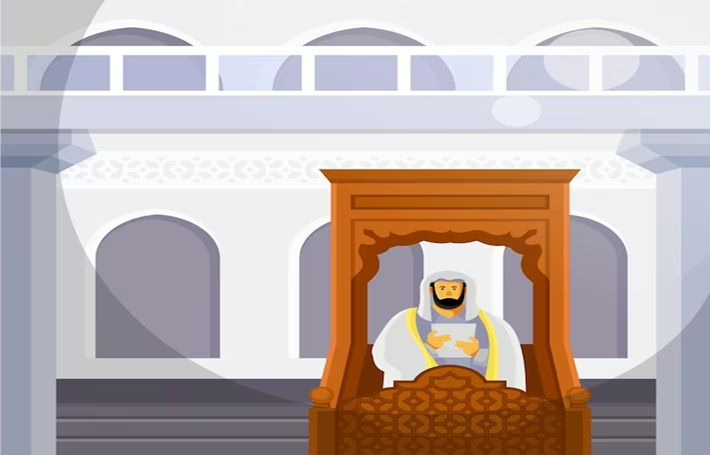


The Friday Khutba (sermon) holds a unique and sacred position in Islam. Historically, it has served as a platform for spiritual rejuvenation, moral guidance, and a reflection of the prevailing socio-political and economic circumstances of the community. The pulpit, therefore, is not just a religious podium but a beacon of enlightenment, encouraging the community to navigate their worldly challenges while upholding their spiritual principles. However, in many parts of the Muslim world today, the Khutbas seem to have drifted from addressing current affairs, often delving into repetitive and abstract theological discussions that fail to connect with the realities of the congregation. This detachment raises a provocative question: why are our Friday sermons so far removed from current affairs, and how can we reclaim the essence of the pulpit?
The true purpose of the Friday Khutba lies in its capacity to address the pressing needs of the Muslim Ummah (community). Prophet Muhammad (Peace Be Upon Him) used the Khutba to educate, inspire, and mobilize the community, addressing real issues such as justice, charity, leadership, and societal responsibilities. The Khutba was not limited to exhorting piety but was also a medium for public service announcements, community decisions, and even diplomatic guidance.
Historically, Khutbas during the Rashidun and subsequent caliphates reflected the challenges of the time, ranging from matters of governance to external threats. These sermons served as a call to action, urging Muslims to embody the principles of Islam in their daily lives and communal obligations.
The current disconnects in contemporary times, the Khutba has largely become ceremonial, with many sermons confined to generic exhortations about faith, worship, and personal morality. While these are undoubtedly important, this limited scope often neglects the pressing social, economic, and political challenges faced by the community. Why has this shift occurred?
Lack of awareness or preparation some imams may lack the requisite knowledge or skills to discuss contemporary issues effectively. Delivering a well-researched and impactful Khutba on current affairs requires preparation, critical thinking, and an understanding of both Islamic principles and modern realities—a combination not always present in those entrusted with the pulpit.
Disconnection from the audience, a significant number of imams fail to engage with their congregations or understand their challenges. This disconnect creates a gap between the pulpit and the pews, rendering the Khutba irrelevant to the lived experiences of the attendees.
As a consequence, of cultural and historical myopia, some preachers focus excessively on historical anecdotes and abstract theological debates, sidelining the application of Islamic principles to contemporary challenges. While historical narratives are valuable, their relevance diminishes when not linked to current contexts.
The consequences of irrelevant Khutbas have caused detachment that has far-reaching implications. The pulpit, instead of being a source of guidance and empowerment, becomes a ritualistic formality. As a result, the youth are disengaged. Young Muslims, grappling with identity crises, societal pressures, and global challenges, find little solace or direction in sermons that fail to address their realities.
The community is fragmented, and the lack of guidance on contemporary issues exacerbates disunity within the Muslim Ummah, leaving individuals to navigate challenges in isolation.
Moral and social decline ensues without relevant and timely guidance and societal problems such as corruption, substance abuse, domestic violence, and economic exploitation continue unabated.
Islam is perceived as irrelevant for non-Muslims and even some Muslims, the faith appears disconnected from the modern world, reinforcing stereotypes about its incompatibility with contemporary life.
Reviving the essence of the pulpit
“To reclaim the pulpit as a platform of relevance and empowerment, several steps must be undertaken:
- Training and Empowering Imams: Imams must be equipped with the tools to address contemporary issues. This involves comprehensive training in Islamic jurisprudence, socio-political analysis, public speaking, and audience engagement. Institutions responsible for imam training should prioritize equipping them with the knowledge and confidence to address diverse topics.
- Encouraging Intellectual Freedom: Authorities overseeing mosques should encourage intellectual freedom and allow Khutbas to reflect the concerns of the community. While oversight is necessary to prevent misuse, it should not stifle the dynamism of the pulpit.
- Engaging the Congregation: Imams should actively engage with their congregations, seeking input on the issues they face. Regular feedback mechanisms can ensure that the Khutba remains relevant and impactful.
- Integrating Current Affairs: The pulpit should address pressing issues such as climate change, poverty, political corruption, mental health, and technological ethics. By relating these challenges to Islamic principles, the Khutba can inspire actionable solutions rooted in faith.
- Leveraging Technology: In an age of digital connectivity, imams can supplement the Khutba with online discussions, blogs, and videos that delve deeper into topics of interest. This multi-platform approach ensures that the message reaches a wider audience.
- Focusing on Actionable Solutions: Sermons should not merely diagnose problems but also propose actionable, faith-based solutions. Whether addressing unemployment, education, or societal harmony, the Khutba should inspire individuals to make tangible changes.
- Promoting Inclusivity: The pulpit should serve the entire community, addressing the concerns of women, youth, and marginalized groups. Inclusivity ensures that the Khutba resonates with a diverse audience.
The Role of the Congregation
While imams play a pivotal role, the congregation must also demand relevance and engagement from their Khutbas. Communities should support and encourage imams to address pressing issues, creating a culture where the pulpit becomes a shared space for learning and growth.
The Friday Khutba is more than a ritual; it is a responsibility. The pulpit should not shy away from addressing the realities of the world, for Islam is a faith that encompasses all aspects of life. Reviving the essence of the Khutba means reclaiming it as a platform of relevance, inspiration, and action. By bridging the gap between faith and reality, the Khutba can once again become the guiding light it was meant to be, empowering Muslims to navigate their challenges while upholding the principles of Islam. Let us transform our sermons into catalysts for change, making them as vibrant and dynamic as the faith they represent.
The writer is a Consultant Surgeon and a policy analyst at Mubarak Hospital Srinagar, and a Certified National and International Expert on Healthcare Quality and Accreditation. A postgraduate in Islamic Studies, he is actively involved in positive perception management of moral, social and religious issues.