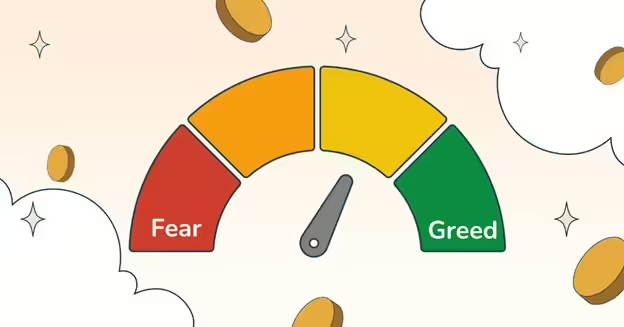


The Fear and Greed Index is a valuable tool for understanding market sentiment, capturing the emotions driving stock market activity. In India, this index has become increasingly relevant, as it allows traders and investors to gauge whether fear or greed is influencing market moves. Paired with insights from the Market Mood Index today, the Fear and Greed Index can help investors make more informed, strategic decisions.
Understanding the Fear and Greed Index
The Fear and Greed Index assesses investor sentiment, ranging from extreme fear to extreme greed on a scale from 0 to 100. Lower scores indicate fear, while higher scores reflect growing greed. This index captures investor psychology, with fear generally leading to risk-averse behaviour and greed encouraging risk-taking. Extreme values often signal a market reversal; intense fear may create buying opportunities, while extreme greed might indicate an overvalued market.
Key components of India’s Fear and Greed Index
Several components are factored into India’s Fear and Greed Index to gauge sentiment effectively:
- Market momentum: Compares current stock prices to historical averages, detecting uptrends or downtrends in the market.
- Volatility: Increased volatility usually points to fear, while lower volatility suggests stability, often associated with greed.
- Put-call ratio: Measures the ratio of put options to call options, revealing if investors are hedging (fear) or optimistic (greed).
- Market breadth: Tracks the ratio of advancing stocks to declining stocks, with a high breadth reflecting optimism and low breadth signalling caution.
- Stock price strength: Indicates the number of stocks reaching new highs versus new lows, showing overall market movement strength or weakness.
These components are combined to calculate a single score, providing a comprehensive view of sentiment in the Indian market.
Using the Fear and Greed Index in India for strategic decisions
Understanding the Fear and Greed Index allows investors to time their trades strategically. By observing shifts in sentiment, traders can decide when to enter or exit positions based on current market conditions.
Identifying overbought or oversold markets
A high score on India’s Fear and Greed Index indicates a strong market with heightened investor optimism. While this can signal short-term buying opportunities, it may also suggest that prices are overvalued. Conversely, a low score reflects caution and potential undervaluation, which could present attractive buying opportunities for long-term investors willing to navigate short-term volatility.
Timing entry and exit points
The index provides insight into when to enter or exit positions. High greed levels may signal a good time to take profits or reduce exposure, while high fear levels could suggest a favourable entry point. Pairing this information with other indicators can help traders make calculated moves.
Supporting risk management
Fear and greed play a critical role in managing trading risks. When the index reflects high greed, market volatility is often lower, though the risk of a correction may increase. Conversely, elevated fear levels often come with high volatility, potentially benefiting investors seeking to buy at discounted prices. Adjusting risk strategies based on the index can help traders avoid excessive risk exposure.
Comparing India’s Fear and Greed Index with the Market Mood Index
The Market Mood Index today is another sentiment tool that provides insight into current market behaviour, specifically within the Indian market. While the Fear and Greed Index is widely used for global markets, the Market Mood Index is focused on India.
- Geographic focus: The Fear and Greed Index is primarily based on global market components, while the Market Mood Index reflects India-specific sentiment, considering factors such as local trading volumes and domestic news.
- Component variation: While both indices gauge investor sentiment, the Market Mood Index often includes additional elements related to local economic data, making it more attuned to India’s financial landscape.
Both indices offer valuable insights; investors with a focus on India might find the Market Mood Index today more relevant, while those following global markets can benefit from the broader scope of the Fear and Greed Index.
Practical tips for using India’s Fear and Greed Index
To make the most of the Fear and Greed Index, consider the following strategies:
- Check daily sentiment: Regularly reviewing the index helps traders remain aware of current market emotions, allowing them to adapt their positions.
- Set alerts for extreme values: Some trading platforms allow investors to set alerts for high or low sentiment levels, enabling quick responses.
- Combine with other indicators: Use the index alongside technical indicators like moving averages or RSI for a well-rounded analysis.
- Avoid overreliance on sentiment: While valuable, the index should be balanced with other analytical tools to ensure informed, rational decisions.
Key considerations for using the Fear and Greed Index
- Watch for extreme values: Extreme fear or greed levels often precede corrections, creating risks and opportunities.
- Balance with analysis: The index is useful but should be complemented with technical and fundamental analysis.
- Account for broader influences: Global events and local economic data can impact sentiment. Use the index in the context of these factors.
- Tailor to your strategy: Adjust your use of the index based on whether you focus on short-term or long-term goals.
Conclusion
India’s Fear and Greed Index is an invaluable tool for traders and investors, offering insights into the prevailing market sentiment. By tracking changes in this index and combining it with insights from the Market Mood Index today, investors can better time their moves and manage risks. Integrating sentiment analysis into your trading strategy supports balanced, informed decision-making, helping to navigate the market with greater confidence. Whether you are a short-term trader or a long-term investor, using these tools effectively can lead to more strategic and insightful investment choices.