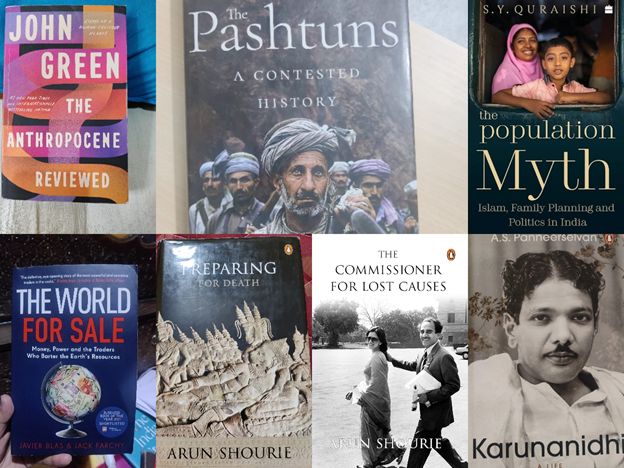


These books provide a diverse range of perspectives, each offering valuable insights into their respective subjects
My personal ratings for some books, which I went through in the last couple of years (The ratings are a combined metric of readability, comprehensibility, urgency of the issues touched, ground-level research, erudition, and perspicacity of the author), are as follows:
“The Population Myth: Islam, Family Planning, and Politics in India” by Dr. S.Y. Quraishi
Highly readable and engaging, rich with facts, and untiring corroboration of every point with facts from Indian legal jurisprudence, Islamic Jurisprudence, and prevalent practices in the West. The book deliberates on population dynamics at length using data from Population censuses, Home Ministry, Education Ministry, Health Ministry, Social Welfare, and Minority affairs ministries. However, the book, written with the conscious purpose of dispelling widely perpetrated and concretized myths about Islam and the 14.23 per cent of Muslims of the country, gets reduced to a stereotypical Muslim Indian book and not as a widely read and attention-arresting book that it deserved to be. Had it come from the pen of an author from any other religion but Islam, its impact could have been far better and long-lasting. I give the book a rating of 3.5 out of 5.
“The Anthropocene Reviewed” by John Green
On any day, I will rate “The Anthropocene Reviewed: Essays on a human-centered planet” by John Green as one of the best books on topics from the origins of the universe to human-driven climate change set on the scale of the geological timeframe. Divided into short, readable chapters/essays, the erudition and understanding of the author are on display in the book. From Soda machines to malaria, Haley’s Comet to the use of Air Conditioners, the book has everything in it. Loved the simplicity and range of the book. Highly recommended. 5 out of 5.
“The Commissioner for Lost Causes” by Arun Shourie
Without investigative journalism having become fashionable yet back in the day, all that the author did in those days was ‘investigative’ in character, with intricate layers of evidence backing it up. The book meanders steadily through its 616 pages on issues like the heartless Blindings of Bhagalpur, the emergency, press repression, and the JP movement, corruption in AR Antulay’s trust as Chief Minister of Maharashtra, the widespread and incipient women trafficking in the Chambal-Gwalior belt on Madhya Pradesh-Rajasthan border, the forgeries, and the full-scale nature of the Bofors scandal (with a political tilt). While the book is just encyclopedic and allegorical on the concepts of Journalistic ethics, the importance of evidence, independence of mind, and the use of intellect, it waxes unnecessarily eloquent on the pleasures and pressures of working in the Indian Express as Chief Editor during late Ramnath Goenka’s time. For me, the most important lesson from the book is the necessity of having 2 or more career options at hand at a time. Arun Shourie, as a vigilant human being, has elegantly underlined the issue. Kudos. He is a master wordsmith. 4 stars out of 5.
“Preparing for Death” by Arun Shourie
I have a personal liking for the author’s writings. Over the last 2 decades, I might have read and followed each one of his debates, books, and engagements. Very few people match his phrase and verve. His polemics are full of substance, and his facts are incisive and cogent. The book perhaps stems a lot from his personal insecurities, but his arguments are redolent with reason and rationale. Even though the book is unnecessarily long, the erudition and experiences of the author come forth in the book. He derives a lot of his passionate points about the issue of death from the lives of Buddha, Ramakrishna Paramahansa, Ramana Maharshi, Gandhiji, Vinoba Bhave, and some Tibetan scholars. It has made the book very rich and poignant betwixt. Discounting every merit, I seriously felt that the book could have been made 100 pages shorter. 3.5 stars out of 5.
“The World for Sale” by Javier Blas & Jack Farchy
Loved the book. Its painstaking details, the outstretched care for precision, and the sheer extent of research are there for self-manifestation. The authors have worked seriously hard in putting the brittle pieces of a very covert, collapsible, and complex world together into one brilliant product, the book. The capacity of the exploitation of commodities like Oil, Coal, Metals like Aluminium, Copper, Cobalt, Iron, etc., is astounding. Highly recommend the book to anyone and everyone who wants to know and understand the underlings of our planet.
“Karunanidhi: A Life” by A.S. Paneerselvan
For me, the details were quite difficult to remember, especially the names and the sobriquets in Tamil. The commitment to the social justice of Kalaignar shines through the book. His life’s events are depicted in a micro-detailed manner. But the abuse of the name ‘biography’ is highly evident. Hagiographic techniques used by the author to discuss the knotty and controversial issues, both personal and public, related to the life of the leader are inferior in content and execution. An author needs to never become a claque or a loyalist, especially the one who is the Reader’s Editor of The Hindu. That renders the book average by any yardstick. 3 stars for this book.
Three stars to the book “Pashtuns: A Contested History” by Tilak Devasher
I would have loved to give it a half-star more, but for the drags, including its countless facts and tap-root genealogies and ethnicities involved, I encountered it while reading it. Very rich in detail for the first 10 chapters. One gets to learn about the tribal interplay in general and Pashtun subrosa intra-play in particular. There are numerous positive aspects, especially the chequered complex history of the imagined community of Pashtuns. It makes one understand the Pashtunwali (code of Pashtuns), the loya jirgas (Pashtun assemblies), the dispute over the Durand Line, Treaty of Gandamak (1879), Khan Abdul Gaffar Khan’s complaints about the exclusion of Pashtuns during India’s freedom struggle, the repeated hypocrisy of Pakistan in mollycoddling the Pashtun tribe, and the unequal tapestry of various ethnicities in Afghanistan, etc. Explained succinctly in the book are the porous nature of the Durand Line, the composition of Federally Administered Tribal Areas (FATA), and the Pakistani state’s failure to navigate through the alleyways of Pashtun sociopsychology. Later, the book cogently delves into the hijacking of the Taliban, an indigenous movement, by Pakistan for its geostrategy. In the second half, the book follows a run-of-the-mill commentary, often with a certain degree of pulpit involved. More importantly, the book is very dense, almost unreadable. On this count, it could have been made less boring. For me, it was hard to keep my attention on the nitty-gritty of many events. To be honest, there is nothing unique in its later half, except what we usually get from any armchair theosophist’s penning.
The writer can be reached at mo*************@***il.com