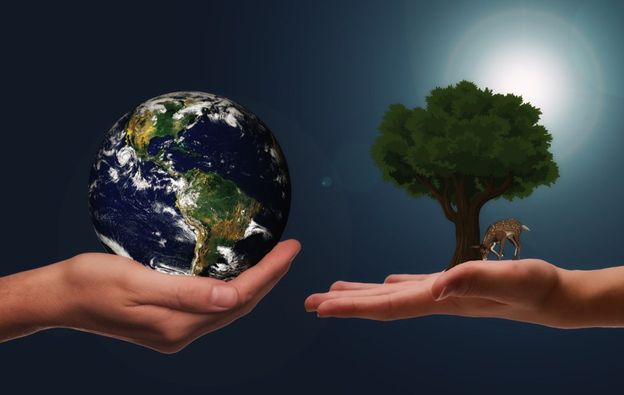


Sole responsibility lies on individuals to be mentally prepared to gauge the hazards and contribute in order to address the eco concerns
The nationwide campaign has been started by Prime Minister which has catapulted mass awareness to nudge the individual and community action to protect and preserve the environment The slogan for a sustainable ideal lifestyle for the environment is the need of the hour because environmental degradation and climate change are rampantly affecting ecosystem across the globe. If we fail to take timely preventive measures, it will have far-reaching consequences on the 800 million to 3 billion population.
Due to chronic water scarcity and droughts by an uptick of 2 Degrees Celsius above normal as a result of global warming, an estimated impact on the economy at the global level will experience a loss of up to 18% of GDP by 2050. An eco-sensitive stance on individual and community behavior alone can have a vital impact on the improvement of the environment and climate.
According to the United Nations Environment Programme (UNEP), if 1 out of 8 billion people worldwide adopt environment-friendly behaviour in their daily lives, global carbon emissions will see a dip of up to 20 percent. UNDP 2020 in its report mentions under the title ‘Human Development and the Anthropocene’, humans wield more power over the planet than ever before, In the wake of Covid-19, recordbreaking temperatures and spiraling inequality, it is time to use that power to redefine what we mean by progress, where our carbon and consumption footprints are no longer hidden. India is the first country to include LIFE in its nationally determined contributions report as the country will put forward and propagate a healthy and sustainable way of living based on its traditions and the values of conservation and moderation, including through a mass movement for life as a key to combating climate change.
Mission Life seeks to translate the vision of life into measurable impact. It is designed with the objective to mobilise at least one billion Indians and other global citizens to take individual and collective action for protecting and conserving the environment in the period 2022-2028. Within India, at least 80 percent of all villages and urban local bodies are aimed to become environment-friendly by 2028. It is possible only by the active participation of citizens at the individual and community levels. Mission Life envisions three core shifts in our collective approach towards sustainability.
1. Change in demand: It demands nudging individuals across the world to practice simple yet efficient environment-friendly actions in their daily lives.
2. Change in supply: A change in largescale demands is expected to gradually nudge industries and markets to respond and tailor supply and procurement as per the revised demands.
3. Change in policy: By influencing the demand and supply dynamics of India and the rest of the world. The long-term vision of Mission Life is to trigger shifts in large-scale industrial and government policies that can support both sustainable consumption and production.
The Mission Life program has chalked out a comprehensive and non-exhaustive list of 75 individual life actions which need to be prioritised so that on the ground, we can realise its vision. The nodal departments need to rope in PRIs, Urban Local Bodies, Block Development Offices and schools for this noble mission to save energy in scientific and traditional ways. Water crisis and pollution can be easily checked and controlled by sustainable efforts by one and all in society. Nobody can absolve from civic obligations. The single-use plastic is a big threat which was noticed by PCBs across the country. The biodegradable containers must be popularised in the markets. Sustainable food systems should be adopted. The year 2023 is dedicated to millets as these have sustainable food value in life. Organic foods and compost-based foods will help us improve the eco-concerns.
We must reduce waste in daily activities under Swachhata action by reusing livestock waste, animal husbandry waste and agriculture waste into biogas plants. The segregation of dry and wet waste at homes will have an encouraging impact on improving the lifestyle. Mission Life encourages a healthy lifestyle by using the millets in foods and indigenous herbs and medicinal plants for nutrition and well-being. A healthy lifestyle includes the conservation of biodiversity at the community level, plants medicinal plants, and planting as a mission to rejuvenate the ecosystem.
If we play a sensible role, it is estimated that 1 billion Indians from 2022-23 to 2027-28 will transform the present scenario and its impact on life and actions can be significant. Our small efforts in daily life will prove a boon for life. Switching off the car/scooter engines at traffic lights, railways lights, crossings and big jams can save up to 22.5 billion kwh of energy. Turning off running taps when not in active use can save up to 9 trillion liters of water.Using cloth bags instead of plastic bags while shopping can save up to 375 million tonnes of solid waste from entering landfill. Discarding non-functioning gadgets in an e-recycling unit can recycle up to 0.75 million of e-waste. Composting waste food at home can save up to 15 billion tons of food from going to landfills. In a nutshell, the sole responsibility is on individuals to be mentally prepared to gauge the hazards and contribute in order to address the eco concerns.
The writer can be reached at ir**********@***il.com