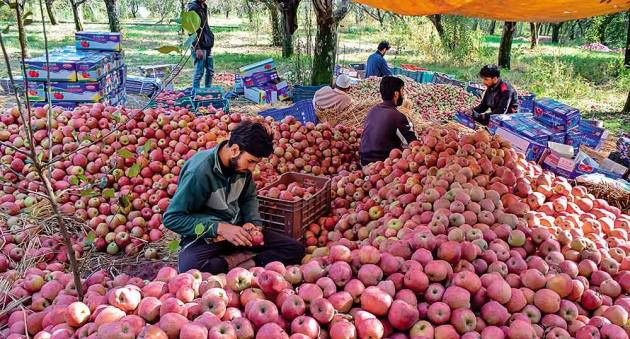


For generations, the apple orchards of Kashmir have been more than agricultural fields. They have been the heartbeat of the Valley’s rural economy, a symbol of patience, prosperity and the intimate relationship between people and nature. From the orchards of Shopian and Pulwama to the famous apple-growing belts of Sopore, Baramulla, Anantnag and Kupwara, the apple has remained the backbone of thousands of families. Today, Kashmir’s apple industry is facing a serious crisis. The orchards that once brought economic security and social stability are now surrounded by uncertainty.
Dr Ratan Bhattacharjee
“One apple a day keeps the doctor away.” This adage probably is changing in Kashmir. Apple is becoming a costly fruit in Kashmir in the near future.
For generations, the apple orchards of Kashmir have been more than agricultural fields. They have been the heartbeat of the Valley’s rural economy, a symbol of patience, prosperity and the intimate relationship between people and nature. The sight of endless rows of apple trees covering the slopes of Kashmir has long represented beauty, hope and hard work. From the orchards of Shopian and Pulwama to the famous apple-growing belts of Sopore, Baramulla, Anantnag and Kupwara, the apple has remained the backbone of thousands of families. It has supported farmers, labourers, transporters, traders and countless others whose livelihoods depend upon this delicate fruit.
However, today, Kashmir’s apple industry is facing a serious crisis. The orchards that once brought economic security and social stability are now surrounded by uncertainty.
The apple economy of Kashmir occupies a unique position in India’s horticultural landscape. Unlike many traditional crops, apple cultivation has transformed rural life in the Valley. But climate change, unpredictable weather patterns, increasing production costs, market challenges, changing consumer preferences and competition from other regions have created unprecedented difficulties for apple growers. The crisis of the Kashmir apple orchard is not merely an agricultural problem; it is a human story involving generations of farmers whose hopes and struggles are deeply connected with the fate of the Valley’s most valuable crop.
For small and marginal farmers, an orchard is not simply a piece of land—it is an inheritance passed from one generation to another. Families have invested years of labour in planting trees, maintaining orchards and waiting patiently for the fruits of their efforts. An apple tree demands care throughout the year. Pruning in winter, protecting blossoms in spring, managing pests during summer and harvesting in autumn require continuous attention. Every apple carries the story of months of labour.
But nature, which has always been a partner of Kashmir’s farmers, has become increasingly unpredictable.
Traditional apple varieties require specific climatic conditions, especially adequate winter chill and favourable spring temperatures. Rising temperatures, irregular snowfall and sudden weather changes have disturbed this natural cycle. In recent years, farmers have witnessed early flowering followed by unexpected cold waves, damaging delicate blossoms and reducing production. Excessive rainfall during harvesting season has also affected fruit quality, creating further financial losses.
The traditional rhythm of Kashmir’s seasons is slowly changing. Winters are becoming less predictable, and snowfall, which once covered the mountains and replenished water resources, has become uncertain. For an orchard farmer, this uncertainty is deeply frightening because agriculture depends upon a calendar written by nature. When nature changes the calendar, the farmer pays the price.
Another major challenge is the rising cost of cultivation. Apple farming today requires significant investment in fertilisers, pesticides, labour, irrigation, packaging material and transportation. Small farmers often struggle to manage these expenses. While the cost of production continues to rise, the price received by growers does not always increase proportionately. Many farmers find themselves caught between expensive inputs and uncertain returns.
The journey of a Kashmiri apple from orchard to market is long and complicated. After harvesting, apples must be carefully sorted, packed and transported. Any delay can affect quality and reduce market value. Transportation costs, storage charges and middlemen often reduce the income that finally reaches the farmer. The grower who spends an entire year nurturing the crop may have limited control over the final price.
Market competition has added another layer of difficulty. Apple growers in Kashmir now face competition from Himachal Pradesh, Uttarakhand and other apple-producing regions where modern techniques and improved infrastructure have strengthened production. Imported varieties and changing consumer choices have also influenced market dynamics. Kashmir’s traditional identity as the home of premium apples remains strong, but maintaining that reputation requires continuous innovation.
One of the most significant changes in recent years has been the shift from traditional apple varieties to high-density plantations. Many experts believe that high-density apple cultivation can increase productivity, improve quality and help farmers compete in national and international markets. These modern orchards use advanced planting methods, improved varieties and scientific management techniques.
However, the transition is not easy for every farmer. High-density plantations require investment, technical knowledge and long-term planning. Small farmers who depend on annual income often find it difficult to make such changes without adequate support. Therefore, modernisation must be inclusive, ensuring that even ordinary orchard owners can benefit from technological progress.
The crisis in Kashmir’s apple orchards also has a social dimension. In many villages, apple farming supports entire communities. During harvesting season, thousands of seasonal workers find employment in picking, packaging and transportation. When orchards suffer, the impact spreads beyond farmers to labourers, shopkeepers, truck drivers and local businesses. A decline in apple production affects the economic health of the entire region.
The emotional connection between Kashmiris and apple orchards cannot be measured only in financial terms. Orchards are part of the cultural landscape of the Valley. They are places where families gather, where children grow up, where memories are created. For many farmers, selling an ancestral orchard is not merely a business decision; it is an emotional loss. The trees planted by grandparents carry the history of families.
Yet the crisis also presents an opportunity for transformation. Kashmir’s apple industry has the potential to become stronger through scientific farming, better infrastructure, improved storage facilities and direct links between farmers and markets. Cold storage facilities can help growers avoid distress sales immediately after harvest. Better transportation networks can reduce losses. Farmer cooperatives can increase bargaining power and ensure fair prices.
Education and awareness will also play a crucial role. Farmers need access to modern agricultural knowledge, weather information, disease management techniques and market trends. Universities, research institutions and government agencies must work closely with orchard communities to develop solutions suited to Kashmir’s unique environment.
The future of Kashmir’s apple economy depends on balancing tradition with innovation. The wisdom of generations of farmers must be combined with modern scientific methods. Traditional knowledge about soil, seasons and orchard care remains valuable, but it must evolve alongside changing environmental realities.
There is also a larger environmental lesson hidden in the crisis. The suffering of Kashmir’s apple orchards is a reminder that climate change is no longer a distant global concern. It is affecting ordinary people in specific landscapes today. A farmer in a Himalayan village is experiencing the consequences of changing weather patterns just as much as coastal communities facing rising seas or cities facing extreme temperatures.
Protecting the apple orchards of Kashmir therefore requires a broader commitment to environmental responsibility. Sustainable agricultural practices, water conservation, biodiversity protection and climate-resilient farming methods are essential for the survival of future generations.
The apple tree itself offers a powerful metaphor. It survives harsh winters, waits patiently through changing seasons and finally offers fruit after months of silent effort. Kashmir’s orchard farmers share the same qualities. Despite difficulties, they continue to nurture their trees with hope. Their struggle is not simply about producing apples; it is about protecting a way of life.
The crisis in Kashmir’s apple orchards should not be viewed only as a regional agricultural issue. It is a national concern because the apple economy represents the dignity and livelihood of thousands of hardworking families. Every basket of Kashmir apples reaching a market carries the labour of farmers who have faced uncertainty yet continued their commitment to the land.
The solution will require cooperation among farmers, scientists, policymakers, traders and consumers. Fair pricing, modern technology, climate adaptation and better market access can help restore confidence among growers. The golden fruit of Kashmir deserves a future as bright as its past.
The orchards of Kashmir have witnessed changing centuries, political transformations and social challenges. They have survived because farmers have remained connected to the soil with extraordinary patience. Today they face perhaps one of their greatest challenges. But with collective effort, innovation and respect for the people who cultivate them, the apple orchards can once again bloom with confidence.
The fragrance of Kashmir’s apple blossoms has long been a symbol of beauty and abundance. Ensuring that this fragrance continues for future generations is not merely an economic responsibility—it is a tribute to the farmers whose hands have preserved the Valley’s golden heritage.
International Tagore Awardee, multilingual columnist and writer of fiction, Dr Ratan Bhattacharjee is a former Affiliate Faculty, Virginia Commonwealth University, and Founder President, Kolkata Indian American Society.
pr********************@***il.com