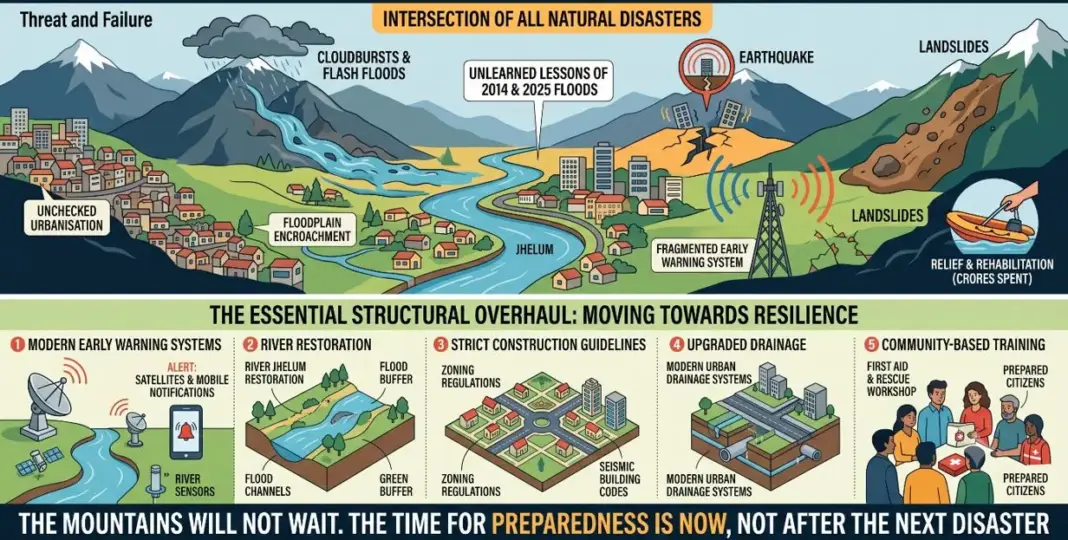


From cloudbursts and flash floods to earthquakes and landslides, the region has witnessed devastating disasters for decades, yet the lessons of 2014 and 2025 remain unlearned. While the government spends crores on relief and rehabilitation, experts warn that fragmented early warning systems, unchecked urbanisation, and encroachment on floodplains continue to leave Kashmir dangerously vulnerable. A structural overhaul — modern early warning systems, river restoration, strict construction guidelines, upgraded drainage, and community-based training — is long overdue. The mountains will not wait for us to act; the time for preparedness is now, not after the next disaster strikes.
Ulfat Tahir Mir
A disaster, in simple terms, is any sudden event, natural or human-induced, that overwhelms a community’s ability to cope, causing widespread loss of life, property, and livelihood. Earthquakes, floods, cloudbursts, landslides, and avalanches all fall under this umbrella, and Kashmir is unfortunate enough to sit at the intersection of nearly all of them.
The region lies in a high seismic zone, is criss-crossed by rivers fed by glaciers and snowmelt, and is built across steep, unstable slopes prone to landslides. Add to this rapid and often unplanned urbanisation, construction on floodplains and wetlands, and deforestation of fragile mountain catchments, and you have a landscape where even a moderate weather event can spiral into a major catastrophe. Climate change has not created these vulnerabilities; it has simply turned up the intensity, making the rare both more frequent and more violent.
On August 14, 2025, a cloudburst hit the village of Chasoti in Kishtwar district, resulting in one of the deadliest disasters in many years for the region and surrounding areas, including Jammu and Kashmir. This was not an isolated incident but rather the beginning of a series of flash floods and cloudbursts caused by rain from the monsoon season that occurred in multiple districts of Jammu and Kashmir including Doda, Kishtwar, Samba, Kathua, Reasi, Jammu City and even certain portions of the Kashmir Valley with record levels of flooding being experienced along many of the rivers including the Tawi River and the Chenab River.
This severe flooding caused millions of dollars in damages to homes, fields, and infrastructure. Similar to the floods experienced in 2014 when Srinagar, the state’s summer capital, was completely flooded, this year’s flooding would once again leave the region underwater and without much preparation.
A Region Built On Fragile Ground
Being located in this area has always made Kashmir susceptible to natural disasters because of the geography, steep mountains, fast-moving rivers, and weak soils. Climate change has made the time frame between such disasters much shorter; rare occurrences have become almost commonplace. Previously, long periods of dry weather were now followed by extreme weather conditions such as heavy rains, and rivers rose much more quickly than our memory can recall. The drainage systems (such as storm drains) can no longer handle the amount of water entering them, causing failures.
The 2025 monsoon season was an example of this happening. Cloudbursts and flash floods ripped through mountain towns, valleys, and high-altitude villages across Jammu and Kashmir and Ladakh, which was a disaster, as noted by the Lowy Institute.
The Preparedness Gap
What makes these disasters especially painful is that the warning signs have become very familiar. Experts say that ten years after the 2014 floods, which were meant to be a wake-up call, Kashmir is still very underprepared and is at risk of another major disaster. Experts have called for a two-pronged approach: to upgrade early warning systems and flood prevention methods, as well as to address urbanisation and flooding-related illegal encroachment on floodplains.
Local communities are acutely aware of the lack of urban drainage and disaster preparation. One old Jammu shopkeeper described the experience of living with mountains above and rivers below during the heavy rains of 2015: “There is no way to get away when it rains heavily.”
The aftermath has become the same grim scenario that has occurred before in every major flood disaster in the region. After the 2025 floods, relief agencies have used the same approach to providing services, concentrating on ration kits, ready meals, drinking water, hygiene kits and winterisation for displaced people. Aid agencies are very frank about what this means: there is a need for all of us to invest in preparedness to reduce our future risks and to protect the populations who are vulnerable today, but money is still being spent on relief rather than prevention.
Signs Of A Shift
Although there were still remnants of destruction throughout, this has led to an increased opportunity for a more robust approach to rebuilding. After the disasters of 2025, Urban Planning underwent a new analysis with respect to floodplains and wetlands and had new drainage systems constructed, but more importantly, new guidelines were established for new construction, at a minimum, at least according to regulation. There has also been an increase in the focus on environmental rehabilitation, including forests, watersheds and soil systems.
One of the best aspects of the future change in people’s lives is the gradual shift in how individuals and families prepare for the next disaster at the community level, including: training for emergency first aid, evacuation and establishment of a local response to a disaster; farmers developing new strategies to adapt to the new climate and agricultural environment; etc. This is indicative of the more global perspective of disaster researchers that resilience is “engineers’ and city officials’ responsibility”, and it is also the responsibility of all those individuals who deal with risk in their daily lives.
What Needs To Change
The path forward for Kashmir is not mysterious; it has been outlined repeatedly by experts, only to be set aside until the next disaster forces the conversation again. It is now imperative that Early Warning Systems are updated to allow remote valley communities sufficient warning to evacuate before the onslaught of a cloudburst or flash flood. The encroachment of floodplains, including buildings and communities that have encroached into the physical water courses of the river, which are essential to carrying the volume of water that occurs during heavy periods of rain, must be addressed with law enforcement, as opposed to policy discussion only.
The investment required to provide drainage systems within the City of Srinagar, the cities of Jammu, and villages/towns throughout the region must be increased to take into account the large volume of rain that is occurring in Kashmir, now viewed as “normal.”
The Structural Overhaul Kashmir Needs
Beyond policy statements and post-disaster relief, what Kashmir needs is a set of hard, structural changes, the kind that take years to build but decades to regret not having.
The use of new technologies and approaches could help prevent future tragedies due to natural disasters such as flash floods, wildfires, landslides and extreme heat. These include:
- An early warning system for flash floods based on modern early warning systems and connected networks of real-time data collected by automated rain gauges, river level sensors, and Weather Radar that can provide immediate notification of rain and river level conditions directly to mobile phones and community loudspeakers within minutes of any detected incident, allowing residents to evacuate safely before disaster strikes
- Restoring Rivers, Streams and Wetlands: Rivers have become narrow because of human encroachment, and we have filled wetlands that, historically, could absorb excess rainwater and overflow from flooding streams or rivers.
- Construction: Enforcement of Hurricane Construction Guidelines and Extra Building Codes. Building construction in vulnerable or flood-prone areas should be limited to the following guidelines:
- i) No building on a floodplain;
- ii) Building on rivers and steeply inclined unstable slopes must not be permitted;
- Existing illegal buildings must be relocated to a safe distance from a floodplain; 5. New buildings must have a hurricane-resistant design;
- All new buildings must be built to construction codes and regulations.
- Upgraded drainage infrastructure. Urban drainage systems in Srinagar, Jammu, and smaller towns were designed for a rainfall pattern that no longer exists. They need re-engineering for the intensity of cloudbursts now considered routine, alongside stormwater channels and retention basins that can handle sudden surges.
- Slope stabilisation and afforestation. Landslide-prone highways and settlements need retaining walls, slope drainage, and large-scale reforestation of denuded catchments, which would also reduce the speed at which rainwater reaches rivers below.
- Community-based response systems. Every village and neighbourhood needs trained local response teams, marked evacuation routes, and accessible shelters stocked with emergency supplies, building on the kind of first-aid and evacuation training that has already begun spreading through schools and villages since 2025.
None of these measures is exotic or untested; they form the backbone of disaster resilience programmes in regions from Japan to the Indian state of Gujarat. What Kashmir has lacked is not knowledge of what to do, but the political will and sustained funding to actually do it.
The Mountains Will Not Wait
The mountains will not stop moving, and neither will the rivers, the cloudbursts, or the landslides that come with them. Kashmir has lived through this lesson before, in 2014, and again through the long, punishing summer of 2025. Each time, the same conclusions are reached: better warning systems, better drainage, better land-use planning, stronger community preparedness.
The question is whether those lessons will be acted upon before the next monsoon or filed away again until the waters rise once more. For a region this beautiful and this fragile, preparedness is not a bureaucratic checkbox; it is the difference between a hard season and a tragedy.
mi*************@***il.com