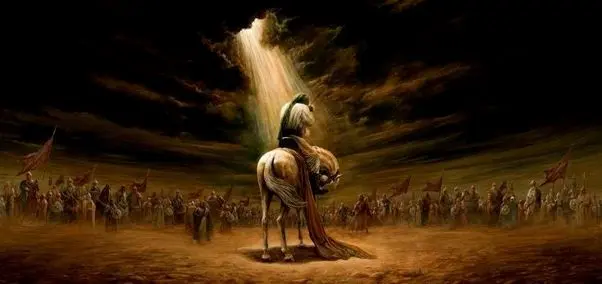


The Battle of Karbala is one of the greatest tragedies that human history has witnessed. It is not merely an account of victory and defeat; rather, it recounts the stories of truthfulness versus hypocrisy, justice versus injustice, bravery versus cowardice, and loyalty versus disloyalty. Muslims all over the world commemorate the legacy of Imam Hussain (RA) and his family on the 10th of Muharram every year.
Mohd Ishq Shah
The Battle of Karbala is one of the greatest tragedies that human history has witnessed to date. It is not merely an account of victory and defeat; rather, it recounts the stories of truthfulness versus hypocrisy, honesty versus dishonesty, justice versus injustice, bravery versus cowardice, and loyalty versus disloyalty. Muslims all over the world commemorate the legacy of Imam Hussain and his family and companions on the 10th of Muharram every year. This day refreshes our minds with the memories of that war, which resulted in the defeat of Yazid and the martyrdom of Hazrat Imam Hussain (RA). This is the day that revolutionised the Muslim world, which otherwise had been facing despair and gloom after the death of Prophet Muhammad (PBUH) and his four companions—Abu Bakr, Umar, Uthman, and Ali (RA).
The history of Karbala reveals that Yazid had intended to change the rule of Tawhid and Sunnah into a monarchical rule, wherein he could rule the land as per his own wishes and not according to the Qur’an and Sunnah. Taking bay’ah (allegiance) from Hussain was not just a matter of rule; it was an ill design to misuse power and position. Although the precondition of the allegiance between Imam Hassan and Mu’awiya was that Mu’awiya must not make it a rule of the dynasty and rather the rule of Shari’ah must prevail, Hassan had the intention that there should not be any more bloodshed after the assassination of Hazrat Ali (RA).
Background
The Battle of Karbala was fought on 10 October 680 CE (10 Muharram in the year 61 AH of the Islamic calendar) between the army of the second Umayyad caliph Yazid I (r. 680–683) and a small army led by Husayn ibn Ali, the grandson of the Islamic Prophet Muhammad, at Karbala, Sawad (modern-day southern Iraq).
After the third caliph Uthman’s assassination by rebels in 656, the rebels and the townspeople of Medina declared Ali, a cousin and son-in-law of the Prophet Muhammad, as caliph. Some of Muhammad’s companions, including Talha ibn Ubayd Allah, Zubayr ibn al-Awwam, Mu’awiya ibn Abi Sufyan (then governor of Syria), and Muhammad’s widow A’isha, refused to recognise Ali. They called for revenge against Uthman’s killers and the election of a new caliph through shura (consultation). These events precipitated the First Fitna (First Muslim Civil War).
When Ali was assassinated by Abd al-Rahman ibn Muljam, a Kharijite, in 661, his eldest son Hasan succeeded him but soon signed a peace treaty with Mu’awiya to avoid further bloodshed. In the treaty, Hasan was to hand over power to Mu’awiya on the condition that Mu’awiya would be a just ruler and would not establish a dynasty. After the death of Hasan in 670, his younger brother Husayn became the head of the Banu Hashim clan, to which the Prophet Muhammad (PBUH) also belonged. Though his father’s supporters in Kufa gave him their allegiance, he abided by the peace treaty between Hasan and Mu’awiya as long as the latter was alive.
The Battle of Karbala occurred within the crisis resulting from the succession of Yazid I. In 676, Mu’awiya nominated his son Yazid as successor—a move labelled by the historian Wilfred as a breach of the Hasan–Mu’awiya treaty. With no precedence in Islamic history, hereditary succession aroused opposition from several quarters. Mu’awiya summoned a shura in Damascus and persuaded representatives from many provinces to agree to his plan by diplomacy and bribes. He then ordered Marwan ibn al-Hakam, then the governor of Medina, where Husayn and several other influential Muslims resided, to announce the decision. Marwan faced resistance, especially from Husayn, Abd Allah ibn al-Zubayr, Abd Allah ibn Umar, and Abd al-Rahman ibn Abi Bakr—the sons of Muhammad’s prominent companions, all of whom, by virtue of their descent, could also lay claim to the caliphal title.
Mu’awiya went to Medina and pressed the four dissenters to accede. He threatened some of them with death, but they still refused to support him. Nonetheless, Mu’awiya convinced the people of Mecca that the four had pledged their allegiance and received allegiance from them for Yazid. On his return to Damascus, he secured allegiance from the people of Medina as well. There was no further overt protest against the plan for Yazid’s succession.
According to the historians Fitzpatrick and Walker, Yazid’s succession—considered an “anomaly in Islamic history”—transformed the government from a consultative form to a monarchy. Before his death in April 680, Mu’awiya cautioned Yazid that Hussain and Ibn al-Zubayr might challenge his rule and instructed him to defeat them if they did. Yazid was further advised to treat Hussain with caution and not to spill his blood, since he was the grandson of Muhammad. (Source: Wikipedia)
Theme
The message that emerges from this greatest tragedy is that Imam Hussain fought for the dignity of faith and upheld the basic principles of Islam. His fight, although imposed upon him, was not for the establishment of any sect, community, group, or party. The message he passed on to the rest of the world is that we should always stand by truth, honesty, justice, and accountability.
Why do Muslims fail to understand the historical reality that Imam Hassan (RA) signed a peace treaty with Mu’awiya not for his own sake, but only for the sake of the public, so that any further bloodshed could be avoided and loss of life prevented? Even Imam Hussain abided by that treaty. The hostility arose only when Yazid demanded allegiance from Imam Hussain so that he could establish his hegemony. Imam Hussain refused his proposal only for the sake of Islam and the Ummah. There is no scope for any doubt on the credibility of any of the companions of the Prophet (PBUH).
There are various accounts about why Mu’awiya (RA) appointed Yazid as a successor in such a hasty manner. Dr Israr (RA), a renowned scholar of the 20th century, maintains that Amir Mu’awiya can be blamed for his choice of appointing his son as a caliph in the sense that it was not done in a consultative way and its notion was only dynastic. However, to challenge his intention would be to raise a finger at the teachings of the Prophet (SAW). Hence, it can be called a miscalculation, but not an intentional fault.
Conclusion
Karbala is a discourse that transcends sectarianism, communalism, and party systems. Karbala has left a legacy of truthfulness, honesty, dedication, devotion, and valour. These moral values are not confined to any particular religion, sect, community, or party; rather, they are valid throughout the whole universe and applicable to all of humanity. There is no question of doubting the credibility of any of the companions of the Prophet (PBUH). It was only a divine plan to test the characters; otherwise, it was predestined, and the Prophet (PBUH) was revealed about it during the journey of Mi’raj.
is*******@***il.com