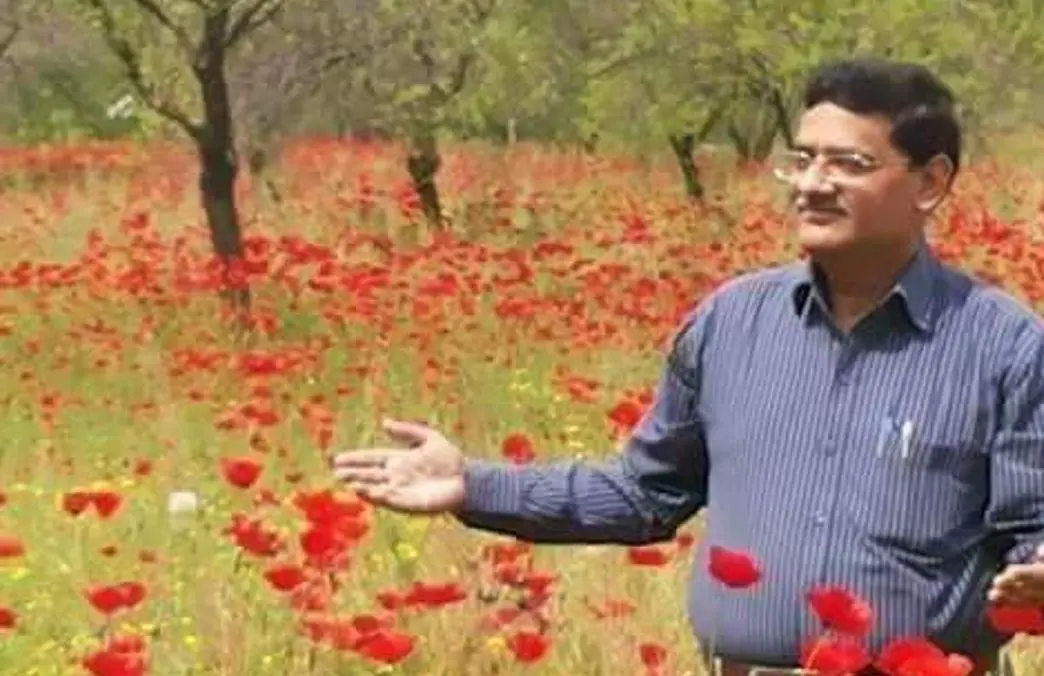


Om Prakash Sharma Vidyarthi has spent 15 years doing something unfashionably concrete. He walks people up to a tree and teaches them its name. Not the Latin binomial, though he knows that too, but the Dogri, the Kashmiri, the Pahari. The name their grandmother used.
Eyram Hamid Khan
In a country where forests are often discussed in the abstract — hectares lost, carbon counted, policies drafted — Om Prakash Sharma Vidyarthi has spent 15 years doing something unfashionably concrete. He walks people up to a tree and teaches them its name. Not the Latin binomial, though he knows that too, but the Dogri, the Kashmiri, the Pahari. The name their grandmother used.
This Tuesday at Environment Park Raika in Jammu, Vidyarthi held the 1,700th session of _Tree Talk_, the outdoor programme he launched on Dec. 19, 2010. Forest guard trainees and tourists stood around him as cicadas drummed in the branches. He pointed to a _Gmelina arborea_ and began, not with photosynthesis, but with synonyms.
“_Chitti Kaseer_ in Dogri,” he said. “_Bhadrparni, Shriparni, Kashmari_ in Sanskrit. _Ghamad_ in Hindi. _Gomari_ in Assamese. White Teak in English.” He explained its light wood for combs and sitars, its shade for tea gardens, its fruit used in Ayurveda for hair fall, appetite, blood disorders, respiratory trouble, and menstrual bleeding. One tree, a dozen relationships.
That is Vidyarthi’s method. He treats plant blindness — the modern habit of seeing greenery as a green blur — with language. If you cannot name something, you will not notice when it disappears.
Vidyarthi, 66, is an unusual combination: an Indian Forest Service officer who won the Sahitya Akademi Award. Born Jan. 23, 1960, in the hills of Ramnagar, he grew up listening to Dogri poets like his uncle Om Sharma ‘Jindradi’ and Parmanand Almast. He took M.Sc. in Botany, did bryophyte research, joined the Kashmir Administrative Service as Tehsildar, and entered the IFS in 1987.
At the forest academy, his field botany won five awards, including the K.P. Sagreiya Shreshtha Vaniki Puruskar. A trek to Rupin Pass at 16,660 feet, past white rhododendrons in snow, produced his poem _‘Khidki Mein Simta Jungle’_ — the jungle framed in a window. The line became his creed: the forest is not elsewhere. It is at the edge of your town, your street, your vocabulary.
Across 33 years of service, culminating as Principal Chief Conservator of Forests, J&K, he wrote more than 55 books in Dogri, Hindi, English, and bilingual editions. In 2002 his Dogri travelogue _Trip Trip Chete_ won the Sahitya Akademi Award, making him the first and only IFS officer to receive India’s highest literary honour. Other works — _Duggar di Vanaspati_, _Forest Flora of Kashmir_, _Vidyarthi’s Dictionary of Plants & Animals_ — fuse taxonomy with cultural memory.
His most subversive act may be linguistic. Vidyarthi has coined over 3,000 Dogri scientific terms: _Chapasam_ for environment, _Trakkal_ for pollution, _Jal-thalentu_ for amphibian, _Saltair_ and _Jantair_ for flora and fauna. Those terms are now in Government of India glossaries from 2017 and 2023, and in J&K Academy of Art, Culture and Languages dictionaries.
The consequence is not academic. It is democratic. Biodiversity Management Committees can draft People’s Biodiversity Registers in Dogri. A farmer describing a herb does not need to translate himself into English first. A schoolchild can conduct a tree census without a glossary. When science speaks the mother tongue, villagers become custodians, not spectators.
_Tree Talk_ applies that principle. Since 2010, Vidyarthi has run 1,702 sessions across J&K, Ladakh, Delhi, Bengaluru, Hyderabad, Dehradun, Chicago, and New York. He estimates 6,000+ vernacular plant names revived, and thousands of students trained as “citizen taxonomists.” No slides. No auditoriums. Anecdotes, eco-lyrics, and tree tales in the open air.
At Raika, after the _Gmelina_, he moved to sound. The male cicadas above were _Chremistica ribhoi_, the “World Cup cicada” endemic to Meghalaya’s Ribhoi district. It emerges every four years, aligned with the FIFA World Cup. In Dogri it is _Charere_; in Kashmiri, _Dashponpur_. Birds eat it. Kerala’s Silent Valley is named for the absence of such insects.
Then he listed medicines: the eight _Ashtvarga_ plants — _Meda, Mahameda, Kakoli, Kshirkakoli, Jeevak, Rishbhak, Riddhi, Vriddhi_ — and the five _Dashmool_ trees _Ghamari, Bael, Shyonaka, Agnimantha, Arni_, plus five bushy herbs _Gokhru, Brihat Kantikari, Laghu Kantikari, Shalparni, Prishnparni_. He urged that they be added to nursery germplasm and Van Mahotsava plantations. These species, revered by sages and Ayurveda, are declining. Naming them is the first step to growing them back.
Vidyarthi has pushed biodiversity beyond identification into nutrition and livelihood. In 2015 he organized India’s first Forest Food Festival at IHM Srinagar. Editions in 2023 and 2024 served _Chiu pakoda, Taju chai, Tarad parantha, Hippophae sauce,_ and _Bichhu Booti soup_, mainstreaming wild edibles like aloe vera, moringa, amla, _Hovenia_, and rhododendron. The point: forests feed, and women collectors can earn.
At the 1699th _Tree Talk_ — Fig Diversity Day with IGNCA Jammu and INTACH Jammu — he discussed _Ficus elastica_, the rubber fig woven into Meghalaya’s living root bridges. He cited Hally War, awarded the Padma Shri in 2026 for that work. Ecology, in Vidyarthi’s telling, is food, medicine, architecture, and song.
He is not only a popularizer. As a taxonomist he has recorded new plant taxa for J&K: _Ilex excelsa, Daphniphyllum himalense, Bischofia javanica, Chionanthus ramiflorus,_ and _Machilus gamblei_, adding to India’s floristic records. He has documented sacred groves and heritage trees, arguing that cultural anchors are as vital as legal protections.
Since retiring in January 2020, he has remained on the J&K Biodiversity Council and J&K Wildlife Board. With Dr. Arun Bansal he has released over 30 environmental songs on YouTube. His first Dogri environment book, _Chapasmi Surakhya_, won the Lakshmi Shivnath Award in 1991.
The Himalayas are warming. Medicinal plant habitats are shifting uphill or vanishing. J&K is rebuilding its economy, tourism, and civil life after decades of disruption. Conservation cannot be a memo from Delhi. It must be local, linguistic, and lived.
Secretary Culture Brij Mohan, present at the 1700th session, said _Tree Talk_ had “revitalized local health and food traditions.” The metric Vidyarthi uses is simpler: more people can name the tree outside their house.
He did not set out to create a movement. He set out to cure plant blindness, one name at a time. In doing so, he gave a region back its vocabulary for nature, and a reason to keep that nature alive. India’s climate commitments and afforestation targets are essential architectures of policy. Yet policies do not conserve what a populace cannot perceive. The gap between legal protection and lived recognition is where biodiversity is lost. A forest known only as “green cover” invites abstraction; a forest known as _Ghamari, Bael, Chitti Kaseer_ invites attachment. Conservation, at its most durable, is not compliance but cognition. It begins when taxonomy becomes intimacy, and belonging becomes the antecedent of biology.
ey**********@***il.com