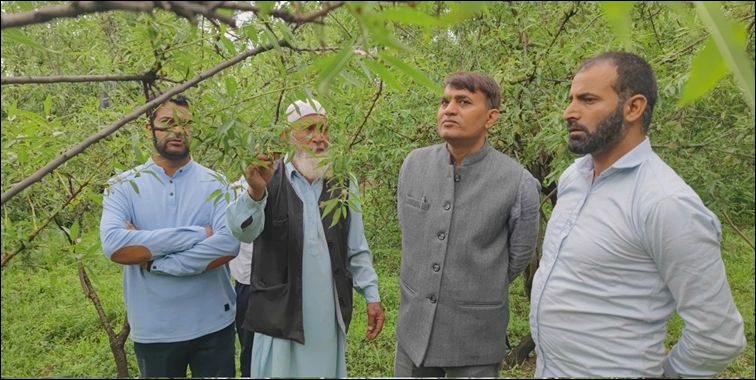


Traditional varieties are disappearing. Pre-1947 irrigation canals lie neglected. Water is scarce despite nature’s abundance. Officials rarely visit fields. Leaf miner and blast disease rage unchecked. Research stays in labs, not farms. Educated youth turn to farming – then are abandoned by the system. Kashmir’s backbone is breaking. Promises won’t save harvests. Implementation will.
Suhail Gaznavi
Agriculture and horticulture have long been the backbone of Kashmir’s economy, sustaining thousands of families and shaping the Valley’s cultural and economic identity. Unlike many other regions of the country, Kashmir has a limited industrial base and relatively few large private companies capable of generating substantial employment. As a result, farming, horticulture, and allied activities remain the primary source of income and livelihood for a significant portion of the population. Despite the immense potential of this sector, farmers today face a growing number of challenges that threaten both their livelihoods and the future of agriculture in the region.
One of the most significant concerns is the gradual decline of traditional Kashmiri apple varieties. For generations, these indigenous cultivars formed the foundation of Kashmir’s horticultural success. Today, however, many orchardists are replacing them with imported high-density and foreign varieties. While these modern cultivars may offer certain commercial benefits, the disappearance of traditional varieties poses serious risks to biodiversity, climate resilience, and the preservation of Kashmir’s unique horticultural heritage.
Water scarcity presents another major challenge. This is particularly alarming in a region historically known for its abundant water resources. The issue is not merely the availability of water but the absence of modern infrastructure for its conservation and distribution. Many irrigation canals currently serving farmers date back to the pre-1947 era and have undergone little modernisation. Several traditional water bodies and irrigation channels have also suffered neglect or encroachment over the years. In the face of changing climatic conditions and increasing pressure on water resources, the lack of reservoirs, rainwater harvesting systems, and efficient irrigation networks is affecting agricultural productivity.
Equally troubling is the disconnect between farmers and the departments responsible for supporting them. Farmers frequently complain that officials from the agriculture and horticulture departments rarely visit fields and orchards to assess ground realities. Extension services, which are meant to bridge the gap between scientific knowledge and practical farming, often fail to reach those who need them most. As a result, cultivators are left to manage complex challenges without adequate technical guidance.
In horticulture, insect pests such as the leaf miner continue to damage orchards and reduce productivity. The leaf miner is an insect whose larvae feed inside leaves, creating winding tunnels that affect plant health and photosynthetic activity. Paddy growers, meanwhile, regularly face outbreaks of blast disease, a destructive fungal infection caused by Magnaporthe oryzae, which can significantly reduce rice yields if not detected and managed in time. Despite the recurring nature of these problems, there is little visible field-level monitoring, research, or timely intervention. Farmers often become aware of infestations and diseases only after substantial damage has already occurred.
The need for research and innovation has never been greater. Agricultural institutions around the world continuously develop crop varieties that offer higher yields, greater disease resistance, and improved adaptability to changing environmental conditions. Kashmir requires similar research focused on local needs. Improved paddy varieties, better pest management strategies, and climate-resilient crops could substantially enhance productivity and reduce losses. Unfortunately, such advancements often remain confined to research stations and fail to reach ordinary farmers.
Farmer education and training also deserve urgent attention. Modern agriculture increasingly depends on scientific cultivation methods, efficient water management, integrated pest control, and the effective use of technology. Yet access to such knowledge remains limited. Training programmes and exposure visits frequently benefit only a small group of selected individuals, while the overwhelming majority of farmers receive little or no practical guidance. Sustainable agricultural development requires that every farmer, irrespective of location, has access to information and training that can improve productivity and income.
Another important development in Kashmir’s rural economy is the increasing participation of educated youth in agriculture and horticulture. Faced with limited opportunities in the private sector and intense competition for government jobs, many graduates and professionally qualified young people are turning towards farming as a source of livelihood. Their entry into the sector should be viewed as an opportunity. Educated youth can introduce innovation, entrepreneurship, scientific thinking, and modern management practices into agriculture.
However, many of these young farmers soon encounter disappointment. Despite their willingness to invest time, resources, and energy, they often receive little technical support or institutional guidance. Training opportunities are limited, mentorship programmes are scarce, and access to expert advice remains inadequate. Instead of encouraging this new generation of cultivators, the existing system frequently leaves them to navigate challenges on their own. If agriculture is to emerge as a viable and attractive profession for educated youth, dedicated programmes focusing on training, mentorship, market access, and technological support must be established.
The challenges facing Kashmir’s agriculture are not merely administrative concerns; they also raise important questions of public policy and governance. Agriculture remains the primary source of livelihood for a large section of the population, and public institutions have a responsibility to ensure that farmers receive meaningful support. The protection of irrigation canals, water bodies, and agricultural land from encroachment should be treated as a developmental priority. Likewise, public funds allocated for agricultural research, extension services, and farmer welfare should translate into tangible benefits at the grassroots level.
Agricultural development cannot be achieved through occasional seminars, ceremonial events, or photo opportunities. Real progress requires regular field visits, scientific monitoring of crops, timely intervention during disease outbreaks, and meaningful engagement with farmers. Research institutions must work closely with cultivators to identify local challenges and develop practical solutions. Accountability mechanisms should also be strengthened to ensure that government schemes and programmes achieve their intended objectives.
Kashmir stands at a critical juncture. Protecting traditional crop varieties, modernising irrigation infrastructure, strengthening research institutions, improving extension services, and empowering educated young farmers are no longer optional priorities—they are necessities. The Valley possesses fertile land, favourable climatic conditions, and a hardworking farming community. What it needs now is vision, commitment, and effective implementation.
If traditional crops continue to disappear, irrigation systems remain neglected, and farmers are left without adequate support, Kashmir risks not only an agricultural decline but also the erosion of a way of life that has sustained its people for generations. The future of agriculture and horticulture in the Valley depends on moving beyond promises and publicity towards genuine reform, innovation, and accountability. The time for meaningful action is now.
The writer is an advocate at the Jammu & Kashmir and Ladakh High Court, Srinagar
su*********@***il.com