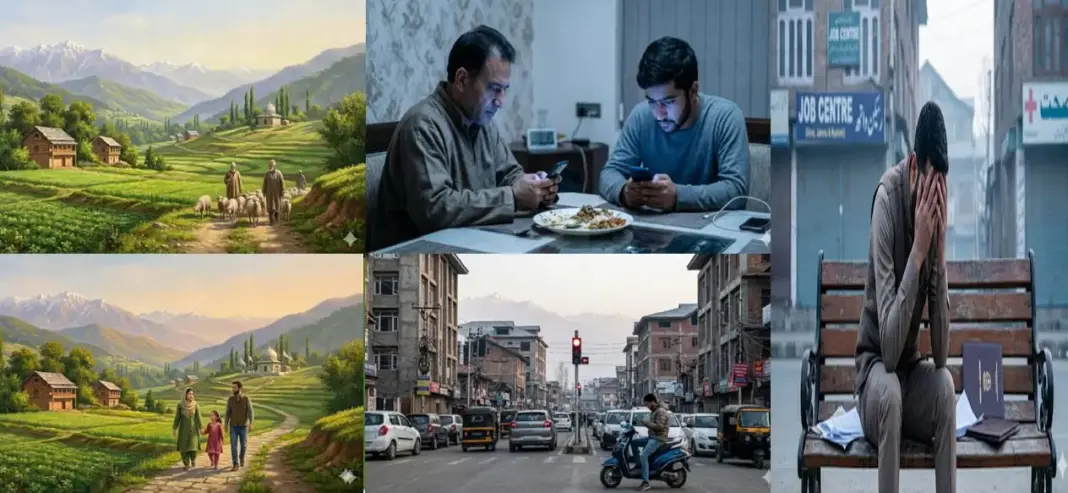


The Valley once earned the title of Peer Waer not because it possessed shrines alone, but because spirituality was visible in behaviour. The real question is no longer whether Kashmir was once called the land of saints. The real question is whether it still deserves to be.
Shabir Ahmad Ganaie
There was a time when Kashmir was known as Peer Waer — the land of saints. The phrase was not merely poetic. It reflected a civilisational identity shaped by spirituality, humility, compassion, modesty, and social dignity. For centuries, the Valley nurtured saints, sufis, scholars, poets, and reformers who cultivated a culture rooted in ethical restraint and coexistence. The Rishi-Sufi tradition emphasised simplicity, service, and humanity. Historical accounts often described Kashmiris as soft-spoken, emotionally sensitive, hospitable, and deeply conscious of moral conduct.
Kashmir’s past was never free from suffering or injustice. No society is morally perfect. Yet there once existed stronger community bonds, deeper emotional accountability, and a clearer distinction between right and wrong.
That is why the present reality feels so unsettling.
Almost every week now brings another disturbing headline.
A husband kills his wife.
A father assaults his daughter.
A son attacks his own mother.
An innocent child becomes the victim of unspeakable brutality.
The recent horrific killing of a minor girl in Budgam once again forced society to confront a painful question many whisper privately but hesitate to ask publicly:
What is happening to us?
How did a society once associated with spirituality and emotional sensitivity become so fractured from within?
The answer cannot be reduced to a single cause. What Kashmir is experiencing is not merely a law-and-order crisis. It is a deeper social, psychological, moral, and institutional unravelling unfolding simultaneously.
The first signs of that unravelling are visible inside homes.
Many children today grow up with smartphones before they grow up with emotional guidance. Families often live together physically while remaining emotionally absent from one another. At dinner tables, silence is increasingly filled by glowing screens. Parents burdened by financial stress and digital distraction frequently fail to notice the loneliness and anxiety quietly growing within their children.
Communication inside homes has weakened. So has emotional intimacy and moral guidance.
A society cannot produce emotionally healthy citizens when its homes themselves become emotionally fragile.
The second failure lies in education.
Schools and colleges continue producing degree holders, but not necessarily responsible human beings. Success is increasingly measured through salaries, status, and outward achievement, while character formation is treated as secondary. Students spend years studying science, commerce, medicine, and technology, yet many receive little meaningful guidance about empathy, ethics, emotional intelligence, or civic conduct.
An educated society is not automatically a morally conscious society.
Religious institutions, too, must engage in honest introspection.
Kashmir still has mosques, shrines, sermons, and religious gatherings. Yet many people increasingly feel that society is becoming more performatively religious while growing less ethically sensitive. The issue is not religiosity itself, but the widening gap between ritual practice and moral conduct.
Religion cannot remain confined to symbolic expression while violence, addiction, corruption, domestic abuse, and cruelty continue spreading through society. The true purpose of spirituality is ethical transformation.
When faith no longer shapes behaviour, society begins to lose its moral centre.
Another major force accelerating this decline is digital toxicity.
Social media has altered human behaviour across the world, but its effects are particularly visible among the youth. Constant exposure to outrage, vulgarity, online abuse, sensationalism, and attention-seeking culture has steadily weakened emotional sensitivity. Many young people now consume hours of shallow and aggressive content every day — a world where shock attracts more attention than wisdom, and visibility matters more than integrity.
People scroll past scenes of violence with the same emotional detachment with which they scroll through entertainment.
A society once known for lowering its gaze in modesty is gradually becoming accustomed to consuming brutality before breakfast. That emotional numbness is dangerous.
The growing drug crisis has further intensified this decline. Mental health professionals have also expressed concern over rising levels of depression, anxiety, aggression, and emotional instability across the Valley.
Yet mental health continues to carry social stigma. Many families still hide emotional suffering rather than addressing it openly. Silence is mistaken for strength until that silence turns destructive.
Economic uncertainty has deepened the crisis further.
An entire generation raised on promises of education and success now finds itself trapped between qualifications and shrinking opportunities. Educated unemployment has produced frustration, anxiety, and emotional exhaustion among many young people.
Equally worrying is the weakening of collective accountability.
Traditional Kashmiri society once possessed strong informal moral structures. Mohallas, elders, neighbours, teachers, and extended families played an active role in correcting behaviour and preserving social discipline.
Today, hyper-individualism and social fragmentation are steadily weakening those systems. Communities react loudly for a few days after a tragedy, then quickly move on. Public outrage has become intense but short-lived.
And yet, despite all this darkness, declaring Kashmir morally finished would be unfair and intellectually dishonest.
Thousands of Kashmiris still quietly uphold compassion, honesty, dignity, and humanity every single day. Parents continue sacrificing for their children. Teachers still educate with sincerity. Doctors still serve patients with dedication. Ordinary people still display remarkable humanity during moments of crisis and suffering.
The moral collapse is not complete.
But the warning signs are unmistakable.
Civilisations rarely collapse in a single dramatic moment. They decay gradually when brutality becomes routine, when morality becomes performance, when institutions lose credibility, and when human suffering no longer shocks society deeply enough.
Kashmir cannot preserve its identity merely through nostalgia, emotional slogans, or symbolic religiosity. A society proves its moral worth through the way it treats its women, children, elderly, poor, and vulnerable.
The Valley once earned the title of Peer Waer not because it possessed shrines alone, but because spirituality was visible in behaviour, compassion, humility, and humanity.
If Kashmir truly wishes to reclaim that moral spirit, the answer will not come from temporary outrage after every tragedy. It will come from stronger homes, better parenting, ethical education, responsible religious leadership, mental health awareness, community accountability, and a justice system capable of inspiring public trust.
Above all, it will require the courage to honestly confront what society is becoming.
The greatest crisis before Kashmir today is not merely political or economic.
It is moral.
The real question is no longer whether Kashmir was once called the land of saints.
The real question is whether it still deserves to be.
The writer is a researcher in South Asian history, specialising in socio-political dynamics, minority experiences, and marginalised voices. His work critically examines contested narratives and seeks to highlight overlooked perspectives within the region’s historical discourse.
sh**************@***il.com