

746 lakh saplings planted; forest land diversion declined sharply after 2020; plantation survival rate over 51%
SRINAGAR: Chief Secretary Atal Dulloo on Thursday reviewed the progress of afforestation and ecological restoration projects across Jammu and Kashmir under the Compensatory Afforestation Fund Management and Planning Authority (CAMPA). He emphasized the importance of sustainable forest restoration, scientific monitoring, and protecting vulnerable forest landscapes throughout the Union Territory.
The review took place during the 27th meeting of the J&K CAMPA Steering Committee, attended by senior officials including Additional Chief Secretary (ACS) Finance, Commissioner Secretary Forests, PCCF (HoF), Chief Wildlife Warden, CEO CAMPA, and other department heads.
Dulloo directed the Forest Department to digitize forest maps and boundary markers for better demarcation and protection. He stressed improving the survival rate of plantations, linking contractor payments to the survival of planting materials, and increasing field staff presence, especially Rangers, to safeguard forests and promote green cover.
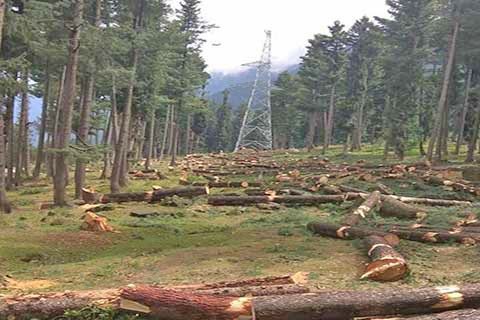
The Chief Secretary reviewed trends in forest land diversion and afforestation efforts. Data revealed that forest land diversion for non-forestry purposes declined sharply after 2020, while the area under afforestation and ecological restoration nearly doubled, reflecting the administration’s focus on conservation.
Additional Chief Secretary Shailendra Kumar highlighted efforts to recreate missing forest records akin to revenue data and advocated phased payments linked to plant survival, ensuring accountability. Commissioner Secretary Sheetal Nanda underscored the department’s sustained plantation efforts and established monitoring mechanisms to ensure effective implementation.
Since 2010-11, CAMPA has treated over 1,06,023 hectares of degraded forests through afforestation, natural regeneration, and ecological restoration. Nearly 746.65 lakh saplings have been planted across forest divisions, indicating ongoing expansion of plantation activities.
PCCF Sarvesh Rai reported that during the 2025-26 financial year, approximately 2,952 hectares were treated under various CAMPA initiatives. Efforts included fencing over 12.65 lakh feet, sowing and dibbling in 19.32 lakh patches, raising 68.70 lakh saplings in nurseries, and maintaining over 164 lakh nursery plants. Soil and moisture conservation activities included executing 37,001 cubic meters of soil works, constructing water harvesting structures and check dams, and installing boundary pillars for forest protection.
CEO CAMPA K. S. Jayachandran informed that plantation activities surged after 2020, with over 67 lakh saplings planted in 2020-21 alone, surpassing the previous average of 46.6 lakh annually. In 2025-26, over 40.35 lakh saplings and planting bags were used for afforestation. Soil and water conservation efforts included constructing over 1,732 water harvesting structures and 30,927 cubic meters of rubble stone masonry for slope stabilization, helping improve water retention and groundwater recharge.
Protection measures have been strengthened, with over 374.78 lakh feet of fencing and 1,47,623 boundary pillars installed across the region. The report also detailed catchment area treatments and biodiversity management in hydroelectric project zones such as Pakal Dul, Kiru, Kwar, Ratle, and Shahpur Kandi, involving afforestation, slope stabilization, wildlife habitat improvement, fire prevention, and eco-development activities.
Wildlife conservation infrastructure has been enhanced with the expansion of rescue centers, biodiversity parks, visitor centers, anti-poaching facilities, and habitat improvements, especially in ecologically sensitive areas like Kishtwar High Altitude National Park.
Field-level management infrastructure has been bolstered through the construction of 42 Range Offices, 56 Block Offices, 22 check posts, and various huts to improve monitoring and protection.
Monitoring of CAMPA projects is conducted through geo-tagging, public disclosures on e-Green Watch portals, inspections, and third-party evaluations. The FY 2022-23 third-party assessment recorded an overall plantation survival rate of over 51 percent.
While acknowledging the achievements, Dulloo emphasized the need to further enhance plantation survival, scientific monitoring, and community participation. He called for a focus on sustainable ecological restoration, protecting degraded forests, and building durable ecological assets to ensure long-term environmental resilience in Jammu and Kashmir.