

India is not merely facing economic or political challenges—it is facing a crisis of intellectual direction. Universities produce degrees, but not always thinkers. Political debates generate noise but not wisdom. The real struggle of civilisation is not simply a struggle for political authority; it is fundamentally a struggle for intellectual power.
Javid M Rumi
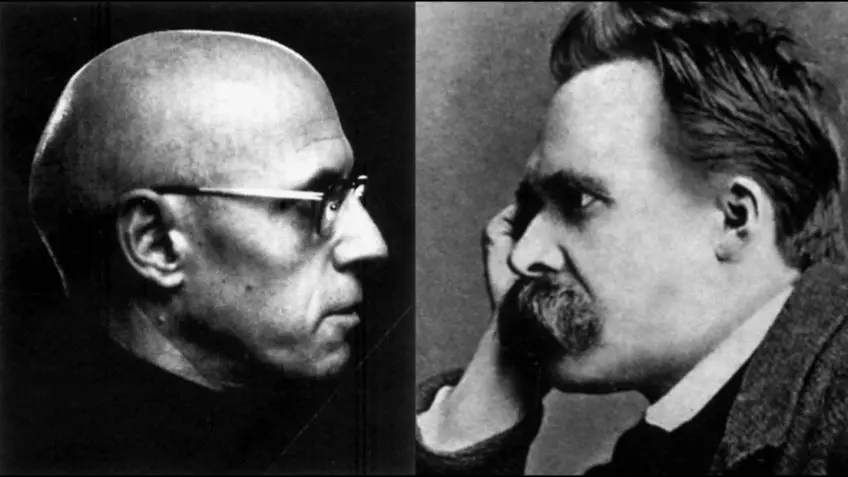
The modern world is not governed merely by armies, wealth, or political slogans. It is governed by ideas. Behind every institution, every law, every educational structure, and every social morality, there exists an invisible architecture of thought. The real struggle of civilisation, therefore, is not simply a struggle for political authority; it is fundamentally a struggle for intellectual power. In understanding this hidden structure of power, two philosophers of modern Europe remain profoundly relevant even today: Michel Foucault and Friedrich Nietzsche.
Though separated by time and temperament, both philosophers attempted to uncover the deeper forces that shape human societies. Nietzsche examined the psychology of power and the creation of values, while Foucault investigated the relationship between power, knowledge, and institutions. Together, they provide an important philosophical framework for understanding the contemporary Indian condition — a society standing between tradition and modernity, democracy and bureaucracy, spirituality and technology, freedom and conformity.
India today is not merely facing economic or political challenges; it is facing a crisis of intellectual direction. Institutions exist, but the philosophical spirit behind institutions often appears weak. Universities produce degrees, but not always thinkers. Political debates generate noise but not wisdom. Social media amplifies opinions but rarely deep reflection. In such an atmosphere, the philosophical insights of Nietzsche and Foucault become remarkably significant.
Nietzsche’s philosophy begins with a bold recognition: human civilisation is shaped by the “will to power.” This idea is often misunderstood as mere political domination or physical control. In reality, Nietzsche meant something far deeper. For him, power is the creative energy through which individuals overcome weakness, mediocrity, and intellectual stagnation. True power is not tyranny over others; it is mastery over oneself. A civilisation declines when it loses its creative and intellectual vitality.
In many ways, Nietzsche was criticising societies that encouraged conformity instead of greatness. He feared the rise of what he called the “herd mentality” — a condition in which people stop thinking independently and merely follow accepted opinions. Such societies become spiritually weak because they discourage originality, courage, and philosophical depth.
This concern appears deeply relevant to contemporary India. Despite possessing one of the richest intellectual traditions in human history — from the Upanishads to Buddha, from Shankara to Iqbal, from Ambedkar to Gandhi — modern public discourse often appears trapped between blind imitation and shallow reaction. Intellectual independence is increasingly replaced either by ideological rigidity or by passive consumerism. Nietzsche would perhaps ask: Has modern society produced free minds, or merely efficient followers?
For Nietzsche, the task of civilisation is to create individuals capable of revaluating values — thinkers who possess the courage to question inherited assumptions. Such individuals do not merely repeat tradition; they reinterpret it creatively. They are not enemies of society but its highest possibility. Every great civilisation survives through the intellectual strength of such minds.
Foucault approaches power from a different but equally profound angle. Unlike traditional political thinkers who saw power mainly in kings, governments, or laws, Foucault argued that power exists everywhere — in schools, hospitals, prisons, universities, media, language, and even social behaviour. Power is not always violent or visible; often it is subtle, silent, and disciplinary.
According to Foucault, modern institutions shape human beings by defining what is considered “normal,” “educated,” “moral,” or “acceptable.” Knowledge itself becomes connected to power. Those who control discourse often shape public consciousness. Thus, education is never entirely neutral; media is never entirely innocent; institutions are never completely detached from structures of authority.
This insight carries extraordinary relevance for India today. Modern Indian society is increasingly shaped by systems of surveillance, digital influence, ideological polarisation, bureaucratic regulation, and media narratives. Information circulates rapidly, yet wisdom appears scarce. Citizens are informed constantly but rarely encouraged to think philosophically about the nature of truth itself.
Foucault would ask uncomfortable questions: Who controls knowledge? Which voices are amplified and which are silenced? How do institutions shape obedience? How does society produce conformity while speaking the language of freedom?
These questions are especially important in a democracy. Democracy cannot survive merely through elections; it requires intellectually conscious citizens capable of critical reflection. Without independent thinking, democracy slowly transforms into emotional mass politics. A nation may become technologically advanced yet philosophically hollow.
The convergence of Nietzsche and Foucault becomes extremely powerful at this point. Nietzsche emphasises the creation of intellectually strong individuals, while Foucault exposes the invisible systems that shape and regulate human consciousness. Together they teach an essential lesson: a healthy society requires both intellectual courage and critical awareness.
India’s future, therefore, depends not only on economic growth but on the revival of intellectual seriousness. Social institutions function meaningfully only when guided by thoughtful and ethically conscious minds. When institutions lose philosophical depth, they gradually become mechanical structures driven by routine, fear, or ideology.
Consider the condition of education. In many places, learning has become heavily examination-oriented. Students often memorise information without developing intellectual independence. Degrees multiply, but philosophical imagination declines. Nietzsche would describe this as the triumph of mediocrity over creativity. Foucault would interpret it as a disciplinary system producing obedient individuals rather than liberated thinkers.
Yet India’s civilisational heritage offers a different possibility. Ancient Indian philosophical traditions encouraged questioning, dialogue, introspection, and debate. The Upanishadic student did not merely receive answers; he was trained to inquire into the nature of existence itself. Buddha challenged ritualistic rigidity through rational introspection. The great Sufi and Bhakti traditions transformed spirituality into ethical humanism. Such traditions reveal that Indian civilisation historically respected intellectual courage.
The tragedy of modernity is that societies often inherit the symbols of civilisation but forget its intellectual spirit.
In the contemporary Indian context, intellectual power should not mean elitism or domination. It should mean the capacity to think deeply, ethically, and independently about society. Intellectual leadership is not merely academic achievement; it is moral and philosophical responsibility. A genuine intellectual does not inflame divisions for popularity. Rather, he illuminates complexities, questions assumptions, and expands public consciousness.
Unfortunately, the modern public sphere often rewards instant reaction more than reflection. Social media culture encourages speed instead of depth. Political identity frequently overshadows philosophical inquiry. Public discourse becomes emotionally charged but intellectually weak. Nietzsche warned against such cultural decline long before the digital age. He believed that societies obsessed with comfort and conformity eventually lose their creative greatness.
Foucault, meanwhile, reminds us that modern systems of communication can also become systems of control. Public opinion is not always spontaneous; it is often shaped by networks of influence, institutional narratives, and ideological repetition. Therefore, intellectual freedom requires constant vigilance.
This does not imply cynicism or hopelessness. On the contrary, both philosophers believed that human beings possess the capacity for transformation. Nietzsche called for the emergence of higher individuals capable of self-overcoming. Foucault encouraged the critique of established systems so that new possibilities of freedom could emerge.
For India, this means cultivating a culture where independent thinking is not feared but respected. Universities should become spaces of philosophical dialogue rather than merely centres of credential production. Intellectual disagreement should not automatically become hostility. A mature civilisation grows stronger through debate, not weaker.
Moreover, the role of intellectuals in society must be reconsidered. An intellectual is not simply a commentator or ideological supporter. The true intellectual stands between power and truth. Sometimes he supports institutions; sometimes he critiques them. His responsibility is neither blind opposition nor blind loyalty, but intellectual honesty.
India today possesses immense demographic energy, technological progress, and cultural depth. Yet these strengths require philosophical direction. A society driven only by economic ambition may become materially successful but spiritually fragmented. The deepest crises of humanity are rarely technological; they are moral and intellectual.
Nietzsche’s idea of self-overcoming can inspire individuals to transcend intellectual laziness and passive conformity. Foucault’s analysis of institutions can help citizens recognise how systems shape consciousness. Together, these philosophers encourage a society that values both creativity and critique.
Their relevance becomes even more important in an age dominated by artificial intelligence, digital algorithms, and information overload. The danger today is not merely censorship; it is intellectual distraction. People may possess unlimited access to information yet remain incapable of reflection. The greatest challenge of the modern age is therefore not acquiring knowledge, but developing wisdom.
India’s civilisational future will ultimately depend upon whether it can produce intellectually courageous citizens capable of balancing tradition with critical inquiry. Civilisations decline not when they lose wealth, but when they lose the ability to think deeply about themselves.
In this sense, Nietzsche and Foucault are not merely European philosophers speaking from another century. They become mirrors through which contemporary India can examine its own intellectual condition. Nietzsche reminds us that greatness requires creative courage. Foucault reminds us that freedom requires critical awareness. One speaks of inner strength; the other of institutional consciousness. Together, they reveal that intellectual power is the foundation upon which all enduring societies are built.
A nation truly advances not when it merely constructs roads, markets, or digital networks, but when it cultivates minds capable of wisdom, ethical reflection, and philosophical depth. Political systems may govern temporarily, but ideas govern history.
The future of India, therefore, will not be decided only in parliaments or markets. It will also be decided in classrooms, libraries, conversations, and the silent struggle of individuals who refuse to surrender their capacity to think independently. Such intellectual courage remains the highest form of power — not the power to dominate humanity, but the power to awaken it.
The writer is a philosophy student
ja*************@***il.com