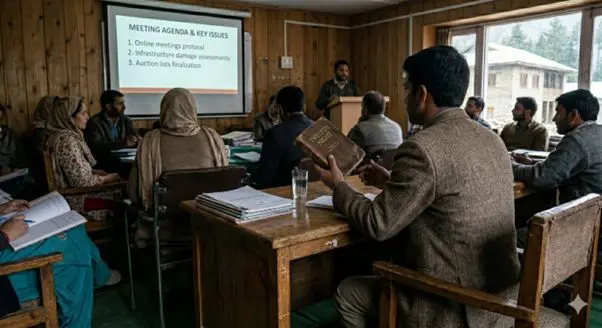


Online meetings, damage assessments, auction lists, student rallies, photo documentation, and endless circulars. They did not allow great minds to enter the room. They simply changed the norm of our labour. The rain it raineth every day—orders, meetings, photographs, banners. Not water. Just noise. I washed off only my own dreams. I became the very person I never wished to be: a steward of nonsense, smiling at cruelty.
Dr Ghulam Mohammad Khan
I am a college teacher in northern Kashmir – quietly excited. Excited because English literature has seeped into me like slow rain into dry earth. Quiet because, whenever I wished to voice that thrill, something intervened: my own fumbling tongue, the students’ raw youth, the slog of back-to-back classes, and most often, the incorrigible, soul-eating hand of administration. So the excitement turned silent, like a lute locked in its case. Then came Twelfth Night. At the start of the session, with fresh literature majors, the administrative medley grew so jarring that I lost the whole music of teaching, especially that rapt time when heart and mind would drown in this famous Shakespearean transvestite comedy. I had imagined new techniques, fresh paths to simplify that beautiful chaos. I would also dream, as ever, of my students’ faces lighting up with a new literary truth. But as Feste warns, “Foolery, sir, does walk about the orb like the sun; it shines everywhere.” Here, the foolery of paperwork and policy eclipsed even the sun of my quiet joy.
Preparing this romance for the class was deeply satisfying. Finishing those preparations felt like devouring the sweetest dish, the one you crave after a long, hard day. I even groomed myself for the classroom. The confidence that Shakespeare’s taste gave me could not help but polish my appearance, like a player before his stage. But this joy lasted barely a moment. I could neither give my students the sublime sweetness of Shakespeare as I had dreamed, nor finish the unit on Twelfth Night during that full session. Nobody cared. Not the system. Not even the students; they were already used to this numbness. As Viola says in the play, “O time, thou must untangle this, not I.” But time did nothing. I carried the pain of never teaching the way I had always imagined.
The first day began sunny. Then it slowly turned cloudy. I walked into the classroom with Shakespeare reigning in my heart. Twelfth Night clouded the firmament of my mind, ready to downpour. I anticipated a rich harvest. But I hadn’t even begun. A colleague burst in, trailing a group of students with a banner. He didn’t wait for my word. He took the stage. He announced a hundred-day government initiative on drug awareness. He spoke at length. I lost interest. When he finally ended, and all the necessary photos were shot, my class was over. I felt like a desperate Viola. I had made myself the “willow cabin” at literature’s “gate.” I had carved my love on every tree. Yet somehow, as she laments, I “never told my love.” The gates remained shut. The downpour never came.
The session unfolded in scattered bits and scraps of literature. I found almost no time to weave coherence. I could not shape my devotion, the devotion it truly deserved. The whole session forced all of us to follow instructions. I did not know how others felt under that duress. But the general unease at the workplace was palpable. Meetings never ended, and in them, I ended up with so many responsibilities. Nobody had asked me a single question about these during my interview for this job. Slowly, I could see Shakespeare disappearing. He faded like a morning mist in the haze of my mind.
Then came the so-called great opportunities: online meetings with the district’s top administrators. Share your valuable suggestions, they said. Get the licence documents of the college vehicle rectified. Identify damaged and unserviceable stock. Prepare a wonderful auction list. Ensure a list of students participating in a big contest to raise awareness in some other district. Accompany them for days. Ensure the whole spectacle is documented. Forward it to the great headquarters of change. Ensure we invite all and sundry to our auditorium and conference halls. Listen to them even when they cannot talk, let alone make sense. And for that, we force our students like a herd of cattle to such places. Make them hear the hollow noise.
During all this, I could feel the deserted Shakespeare deserting me. He walked out like a betrayed lover. And then I found myself slowly turning. I became Malvolia – in yellow stockings of shame. Cross-gartered in helplessness. Do you remember what Malvolio says? “I will be proud, I will read political authors, I will baffle Sir Toby, I will wash off gross acquaintance, I will be point-devise the very man.” But I could not be proud. I could not baffle anyone. I washed off only my own dreams. I became the very person I never wished to be: a steward of nonsense, smiling at cruelty. As Feste told Malvolio, “And thus the whirligig of time brings in his revenges.” Only here, time avenged itself on me. Not on the system. Not on those who stole my Shakespeare. Just on me and on my silent, stranded love for Twelfth Night.
What was even more painful? Nobody bothered. Not about Shakespeare. Not about Newton, Linnaeus, Darwin, Aristotle, Durkheim, Keynes, Mendeleev, Dewey, or Ghalib. Nobody cared now. Not the administration. Not those who paid us for what we were actually meant to do. They did not allow great minds to enter the room. They simply changed the norm of our labour. And they did not mind paying us for that. Slowly, the teacher began internalising this pattern. Students might have sensed something. But they always seemed too young to notice the deep rot. Not until they become graduates. Not until they realise they have learnt nothing significant at all. By then, the damage is done. Those who expressed a little reluctance to the new rules? They are increasingly getting categorised at the workplace. Labelled. Sidelined. Made into problems.
I remember some colleagues across three or four institutions I have served. They would recall, quietly, how they had slowly forgotten reading. Forgot to buy books. Forgotten writing papers. Some, during conversations, would let it surface. They were so used to this numbness that they relished it. They had become like Malvolio after his torment; not wiser, only harder. Do you remember what Olivia says? “Alas, poor fool, how have they baffled thee!” But here, the fool is not one. The fool is many. And the baffling never ends. As Feste sings, “The rain it raineth every day.” Only this rain is not water. It is indifference. It falls on everyone; on Darwin, on Ghalib, on the student, on the teacher. And nobody even thinks to bring an umbrella.
Once, I had a great opportunity. I was invited to interact with the district administrator. This man now also enjoys great command over a higher education institution. I walked in with a sliver of hope. But soon I was puzzled. The administrator wanted to “tinker” with student mentality. Not inside the classroom. Outside. Through community awareness rallies. Through learning skills. He called conventional classroom teaching a waste of time. Here, I started to miss Shakespeare more. The absence ached like a pulled tooth. The administrator went on. He explained how simple our job was. How easy. And how hefty the salary we drew. He smiled as he spoke. I felt small. I wanted to quote Shakespeare. From Twelfth Night. I wanted to say, “Some are born great, some achieve greatness, and some have greatness thrust upon ‘em.” I wanted to ask him: Which one are you? But the words did not come. Shakespeare was turning silent inside me. His voice had shrunk to a dry stream. I remembered Malvolio reading that very letter, foolishly believing he could rise. But I was no Malvolio. I was just a teacher clutching at a ghost. The administrator did not wait for my reply. He moved on to the next agenda. And I sat there, holding my silent Shakespeare like a dead leaf. As Feste says, “Nothing that is so is so.” The administrator believed he was reforming education. I believed I was teaching. Both of us were wrong. Only one of us carried the loss.
The system cared so little about classes. It now refused teachers for subjects where student enrolment is low. Think of the paper wasted. Trust me. Reams and reams of it. All to justify whether a teacher is needed, whether a subject is even justified. The cost of that wasted paper could easily afford the teacher’s salary. I mean the literal wasted paper. But they do not worry about what is taught. Across hundreds of institutions. Thousands and thousands of young minds wait. They wait for the perfect chisel of the teacher-craftsman. They wait to be given some shape. Instead, they are wasted in bulk. Like rotten wood. Because they never receive the perfect touch. The perfect carving of the carpenter in time. No one notices. The wood rots quietly. And yet, the system never forgets to send you a calendar. An interminable calendar of activities. It chokes my Shakespeare out of the full session. Every single time.
I remember what Feste says in Twelfth Night: “There is no darkness but ignorance.” But here, the darkness is not ignorance alone. It is deliberate. It is planned. It comes printed on official letterheads. It arrives with stamps and signatures. The calendar grows like a weed. It wraps around every hour. It strangles the sonnets. It suffocates the comedies. By the time I reach my classroom, Shakespeare is already a corpse in my throat. And the young minds? Still waiting. Still rotting. Still uncarved. As Malvolio cries from his prison, “I am as well in my wits, fool, as thou art.” But I am no longer sure. Perhaps the fool is the one who still hopes to teach Twelfth Night under this calendar’s shadow. Perhaps the darkness has already won.
Now the session has ended. The play Twelfth Night never got a proper start. And, unfortunately, no end at all. I have forgotten all the beautiful comments on this play by Hazlitt. C. L. Barber and Jan Kott. All gone. I have forgotten the amazing subplot, the gulling of Malvolio, the duel of wits, the sweet madness of Viola. At the beginning of the session, I began like the play’s own wonderful opening. “If music be the food of love, play on,” I whispered to myself. I wanted to play on. I wanted to feast my students on that music. But the music died. Not because I stopped playing. Because the administration kept turning off the instruments. My session ended exactly like the play’s final song. Feste stands alone. The revelry is over. He sings, “The rain it raineth every day.” Here, it rained every day. Not water. Orders. Circulars. Meetings. Photographs. Banners. Rallies. The administration’s orders rained without mercy. They choked my Shakespeare out of the session. Every day, a new downpour. By the end, there was no Orsino left in me. No Viola. No Olivia. Only Feste, wandering, singing, carrying a quiet grief. The rain still rains. The classroom is empty. The play is lost. And I am left holding a soggy copy of Twelfth Night, wondering if music ever was the food of love or only a rumour that died before the first verse.
The writer is an Assistant Professor at HKM, GDC Bandipora
gl******@***il.com