

Twenty-three million views and climbing. A philosophy lecturer who wrote no magnum opus, founded no school, yet his voice became a rope thrown across thirty years. Listening to him was not merely liberating or informative. It felt like eavesdropping on a secret conversation.
Dr Ghulam Mohammad Khan, Dr Mubashir Hamid Mir
It was a bright, sun-drenched spring afternoon, the kind that tricks you into believing beauty is eternal. We sat on a weathered bench in our college at the hilltop, gazing down at the verdant, majestic Wullar Lake, its shining waters cradled by a world bursting with newborn green. The air smelled of damp earth and wild mint. Then, without warning, the name Michael Sugrue erupted into our conversation, like a single kernel of corn suddenly bursting into hot, fragrant popcorn on a flame. In an instant, the languor of the afternoon shattered. The presence of that great American lecturer, who once paced the halls of Columbia, Princeton, Chicago, and Ave Maria University, teaching history and philosophy with an almost forgotten ferocity, seized hold of us entirely. It felt almost numinous, speaking of a teacher who never chased academic fame through trendsetting books or bullet-point theories. He wrote no magnum opus, founded no school. And yet, as we talked louder on that bench, we realised: his true genius erupted in the spoken word. In the 1992 videotaped series Great Minds of the Western Intellectual Tradition, Sugrue wielded language like a blade and a balm at once. His coherence was not dry logic but a kind of music, each sentence pressing forward with the urgency of a man who knew that ideas, if not gripped immediately, might slip away forever. And there, under the spring sun with the vast lake glinting below, his voice felt less like a memory and more like a warning.
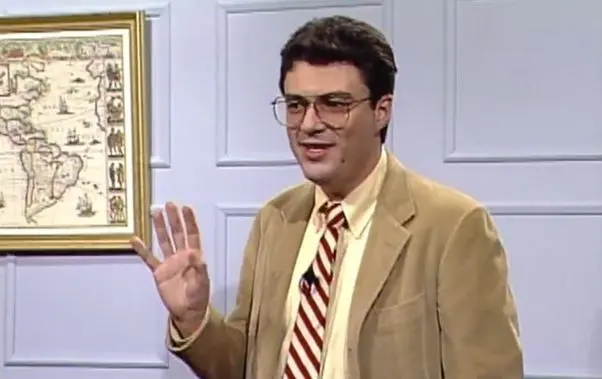
It was during the Covid lockdown that his daughter Genevieve Sugrue began uploading his old videotaped lectures to YouTube. What happened next felt less like gradual growth and more like a lit fuse. His fame spread with the speed and hunger of a brushfire: twenty-three million views and climbing. To put that in perspective, philosophy lectures, unlike pop album streams, rarely command such staggering attention. And yet here he was, this handsome, soft-spoken American, dressed in a simple jacket, yet speaking as if every second mattered. He moved with lazy elegance, a slow turn here, a patient gesture there, while the philosophical lexicon poured from him in a seamless, hypnotic flood: Plato’s forms, Marcus Aurelius’ inner citadel, Kant’s stern categorical imperative, Kierkegaard’s leap of faith. It seemed, at moments, less like a man lecturing and more like a beautifully programmed human machine. That was Sugrue. Not a robot. A wounded healer with a flawless script. And in the hollow silence of lockdown, when millions sat alone in their rooms, starving for meaning, his voice became a kind of rope thrown across thirty years, straight into our trembling hands.
His gait. The unhurried, almost meditative way he moved across the podium, as if each step were a deliberate syllable in a sentence too important to rush. His dressing sense: a simple jacket, a muted tie, no flash, no academic armour. And his hands, those long, expressive fingers that traced ideas in the air like a conductor shaping silence into sound. The flow of his words was nothing less than astonishing: not rehearsed, but channelled, as if someone were typing perfect prose directly into his mind, and his mouth simply translated the script into warm, resonant speech. You could almost hear the keystrokes of thought before each sentence emerged, flawless and alive. We sat there on the hilltop, the spring breeze suddenly feeling like a held breath, and we talked and talked about everything we loved in this man. His infectious demeanour, that quiet smile, that boyish wonder beneath the erudition, was itself a philosophy made flesh. Simplicity, yes. But not the simplicity of ignorance. The simplicity of a soul that had wrestled with Kant’s categories and Kierkegaard’s dread and emerged not broken, but lucid. As intriguing as he was charming. As urgent as he was calm.
And then one of us whispered what we deeply felt: His soul must have been dipped, for years, in the deep dye of philosophy, in absolute, aching solitude. Not the solitude of loneliness, but the kind where a man sits alone with Plato’s Republic until dawn, or walks an empty beach reciting Marcus Aurelius to the waves. That was the dye. That was the slow, invisible soaking that gave us, decades later, this man who could stand before a camera and make twenty-three million strangers feel seen. Dr. Sugrue walks to and fro across the lecture hall podium not with dramatic gestures or theatrical pacing, but with a small, almost hypnotic oscillation. Few actions. Many, many words. They pour out of him like beads from a flawless machine: perfectly round, identical in polish, yet each one distinct in its weight. No stutter. No false start. No groping for a phrase. The small movement, that quiet, enigmatic to-and-fro, becomes a kind of ritual. His perfection feels mechanical at first glance: the nonstop flow, the seamless syntax, the eerie absence of hesitation. But then the depth hits you. The originality. The conceptual clarity is so razor-sharp it could split a hair. That is purely, achingly human. The flow astounds; the natural fit of each word to the next impresses. But what truly silences you is his power of contextualization. He does not merely explain Kant or Hegel, Burke or Hobbes, Locke or Schopenhauer. He places them. He shows you the invisible threads, historical, emotional, spiritual, that connect one tormented genius to another across centuries. Literature, the Bible, the entire restless current of Western culture: he speaks of them with the consistency of a man who has memorised the greatest written passages ever composed, and then learned to breathe them back into the world as if they were his own heartbeat.
Alone in the night, we discussed this, huddled over flickering screens while the pandemic howled outside our windows. Listening to Sugrue was not merely liberating or informative. It felt like eavesdropping on a secret conversation. Here was someone who did not just know the philosophers; he had sat with them in their solitude. He knew the silences between their systems, the wounds that drove their questions, the historical spaces that connected their progression like stepping stones across an abyss. He once leaned into the camera and said, almost gently: “The great philosophers are not monuments. They are arguments you haven’t finished having yet.” That is why he sounds better, far deeper than Alain de Botton’s School of Life, which sometimes prettifies wisdom into consolation. Sugrue offers no consolation. He offers a fire. And in the dark of that lonely night, we were grateful to burn.
His life, in the end, became a lesson that no textbook could teach. In those legendary 1990s lectures, spanning three thousand years of Western intellectual history, he stood before us handsome, poised, seemingly immortal, his voice a river of perfect clarity. But then came 2011. The diagnosis: metastatic cancer. The subsequent chemotherapy, with its slow, unsparing erosion. And the handsome philosopher began to decline, his body slowly giving up, his energy fading, until the man on the podium could no longer be compared to the radiant figure of those videotaped afternoons. This is when Plato’s lecturer became the student of suffering. This is when Michael Sugrue, facing his own fragility, said something that cuts deeper than any syllogism: “Being sick teaches you, you’re not in control, you’re not in charge… And you have to learn to play at the hand you’re dealt.” Not a resignation. A terrible, liberating truth. We looked out at Wullar Lake, now golden in the slanted afternoon light, and for a moment no one spoke. Because we understood: we hadn’t just been discussing a lecturer. We had been glimpsing a way of being human.
Such a great soul needs to be heard. Not merely listened to – heard, the way a great book is read in silence, with trembling attention. Talking about those legends of philosophy, Sugrue becomes one of them. He belongs to that lineage. Not because he wrote a system, but because he lived the question. To be sure of this, he needs to be heard. Not as a relic. As a voice still burning. Because if a man dying of cancer can stand before a camera and say, “You are not in control,” with a smile instead of a scream, then perhaps we, sitting on our hilltop or in our locked-down rooms, can learn to hold our own small deaths with the same terrible grace. Listen to him; his lectures are absolutely wonderful. Not for answers. For the courage to keep asking.
The writers are Assistant Professors at HKM Govt Degree College, Bandipora