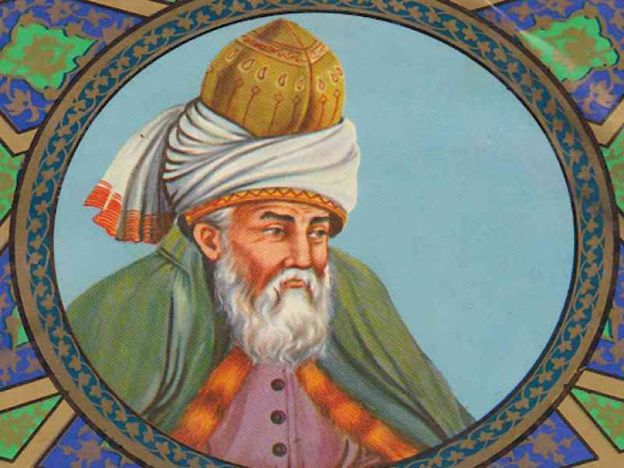


Rumi called it the language of God; Pinter made it a mirror of human tension. Across centuries and cultures, true understanding begins not in sound, but in stillness.
By Rather Nasir
Noise surrounds us every day …headlines flash across screens, phones buzz constantly, and voices collide at every turn. In such a world, silence is often seen as empty, something we feel we must fill. Yet, across time, some of the greatest thinkers and artists have shown that silence is far from hollow. It can reveal, connect, and shape our understanding of life.
Among these voices, Rumi, the 13th-century Sufi poet, and Harold Pinter, the 20th-century English playwright and Nobel laureate, stand out. They lived centuries apart, in very different cultures, but both recognised the extraordinary power of silence. For Rumi, it was a doorway to the divine; for Pinter, a pause could speak more than words ever could. Silence, in both cases, does not hide …. it reveals.
Rumi saw silence as the highest form of presence. He wrote, “Silence is the language of God; all else is poor translation.” Words have limits, he believed, but the quiet heart can hear truths beyond expression. In his great work, the Masnavi, he compares silence to a wooden horse for travellers at sea …. plain and unassuming, yet essential for the journey. What may seem empty becomes a vessel, guiding the seeker towards something deeper.
When Rumi pauses in his poetry, he is opening doors, not leaving gaps. “Keep silence,” he urges, “that you may hear Him speaking / Words unutterable by tongue in speech.” Silence is not stillness; it is an active communion, a bridge between the finite and the infinite. And in this quiet, there is a true companionship…
Harold Pinter, on the other hand, approached silence very differently. Where Rumi’s quiet nurtures and opens, Pinter’s pauses unsettle and confront. On stage, silence is alive, full of what remains unsaid, revealing tensions and unspoken truths between people. As Pinter wrote in The Caretaker, “I don’t know what to say, but I do know what I feel” …. a line heavy with the weight of the spaces between words. While Rumi’s silence lifts the soul, Pinter’s exposes the hidden currents of human relationships, showing that quiet can be both gentle and piercing.
Together, Rumi and Pinter show us that silence is versatile. It can elevate the spirit, reveal the divine, or uncover truths that words cannot reach. Rumi’s silence is a doorway; Pinter’s is a mirror. In either case, silence is never empty …. it is alive with meaning, whether gentle, confronting, or reflective.
Rumi reminds us in the Masnavi:
Keep silence, that you may hear from that Sun
Things inexpressible in books and discourses.
Keep silence, that the Spirit may speak to you;
Give up swimming and enter the ark of Noah…
Pinter, too, shows us that silence always communicates …. sometimes more than words ever could. Shared silence, whether in poetry, theatre, or life, opens space for understanding, presence, and connection. To embrace silence is not to withdraw from life; it is to enter it more fully, listening with the heart as well as the ears.
P.S.
Tracing silence across poetry and theatre shows a simple truth: it sharpens our listening, steadies the spirit, and unsettles complacency. Whether gentle or confronting, silence invites presence. So, if you are too tired to speak, sit beside another ….. for silence itself can be shared, fluent, complete, and enough….
I am reminded of Sufi mystic poet, Mehar Ali; Who says about silence… koi Misal nahi hay Dolan di … Chup kar ay Maher Ali ethe ja nahi hay Bolan Di… No example has been given of my Beloved … Sit quietly here, and don’t speak,” Maher.
The writer is a teacher at BHSS Kangan