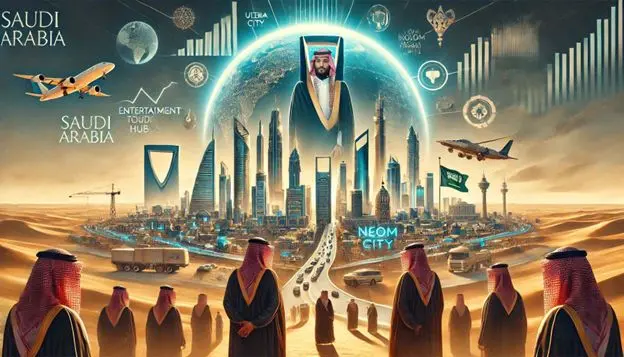


As the Kingdom embraces economic diversification and global entertainment, questions arise about preserving Islamic values and maintaining its role as the spiritual heart of Islam amid cultural shifts and social reforms
By Prof Hamid Naseem Rafiabadi (Hamid Naseem Rafiabadi)
Saudi Arabia, as the custodian of the Two Holy Mosques and the spiritual heart of the Muslim world, occupies a position of profound reverence and responsibility. This status is not merely political or geographical—it is deeply spiritual. The Kingdom’s policies are closely observed by Muslims across the globe, who view it not only as a national state but as a beacon of Islamic values, a symbol of unity, and a standard-bearer of the faith of nearly two billion adherents worldwide.
In 2016, Saudi Arabia launched Vision 2030, a comprehensive plan to diversify its economy, reduce its dependence on oil, and open up to global tourism, culture, and entertainment. Spearheaded by Crown Prince Mohammed bin Salman, the initiative includes ambitious economic reforms, urban development projects, and a dramatic expansion of the Kingdom’s entertainment industry. While these developments are commendable from a purely economic perspective, they have raised critical concerns about the cultural and spiritual direction of the Kingdom.
One of the most visible aspects of Vision 2030 has been the Kingdom’s foray into global entertainment. The establishment of the General Entertainment Authority (GEA) has led to a proliferation of concerts, music festivals, cinema openings, and comedy shows. Events such as the MDL Beast music festival in Riyadh have drawn international headlines, attracting artists from around the world and positioning Saudi Arabia as an emerging entertainment hub. The momentum continues: this year, Saudi Arabia is set to host the world’s largest comedy festival in Riyadh’s Boulevard City, from September 26 to October 9, 2025. Featuring over 50 international comedians, including Kevin Hart, Russell Peters, and Pete Davidson, the event underscores the Kingdom’s commitment to becoming a global cultural destination.
However, this dramatic cultural shift has been met with unease from large segments of the Muslim community, both inside the Kingdom and across the globe. Many Muslims fear that such developments may dilute the religious identity of the land that houses Islam’s holiest sites. Questions are being asked: How does a festival headlined by entertainers known for explicit content align with the values of a nation built on Tawḥīd (pure monotheism)? How can spiritual sanctity coexist with events that, in some cases, promote behaviour contrary to Islamic teachings?
Of particular concern is the reported introduction of controlled alcohol sales in designated tourist zones, such as luxury hotels and resorts. According to multiple reports, including from The Times, these zones will permit the sale of wine, beer, and cider—but not spirits or hard liquor. While the government emphasises that these measures are meant to cater to international visitors and will remain tightly regulated, the policy has sparked controversy among many in the Muslim world. Islamic law is unequivocal in its prohibition of alcohol. Even the perception of normalising its consumption—especially in the land of the Two Holy Mosques—risks not only violating religious principles but also undermining the Kingdom’s image as the spiritual leader of the Ummah. Though Saudi authorities have reiterated that major international events like the 2034 FIFA World Cup will remain alcohol-free, the introduction of any form of ḥarām (forbidden) substances raises moral red flags for devout Muslims.
Moreover, reports—denied by authorities but widely circulated—about the presence of drugs and inappropriate behaviour at past entertainment events have only deepened public anxiety. Regardless of their accuracy, such narratives damage the moral credibility that the Kingdom has historically maintained. From an economic standpoint, Vision 2030 seeks to make Saudi Arabia more competitive, self-reliant, and integrated into the global economy. Tourism and entertainment are lucrative industries, and the desire to position Saudi Arabia as a modern, cosmopolitan nation is understandable. However, modernisation does not have to equate to Westernisation—nor should it come at the cost of compromising core Islamic values.
In fairness, the Saudi government appears to be aware of these tensions. In response to public concern, efforts have been made to promote home-grown talent and culturally appropriate content. For instance, Riyadh Season 2025 will reportedly emphasise local artists from Saudi Arabia and the Gulf, with a focus on events that are more aligned with the Kingdom’s traditional and religious values. This represents a positive step, but one that must be sustained and expanded if Saudi Arabia is to preserve its spiritual integrity.
The spiritual responsibility borne by Saudi Arabia cannot be overstated. As the birthplace of Islam and the site of the Hajj and Umrah pilgrimages, the Kingdom is not merely another Muslim-majority nation—it is the heart of Islam. Decisions made by its leadership ripple far beyond its borders. Cultural choices made in Riyadh, Jeddah, or Mecca are felt in Jakarta, Cairo, Istanbul, and Johannesburg. The global Muslim community expects Saudi Arabia to be not only an economic leader but also a moral compass. In an age marked by cultural confusion and moral relativism, the Kingdom is uniquely positioned to chart a path of ethical modernisation—one that harmonises progress with principle, ambition with accountability, and reform with reverence.
The introduction of activities that contradict Islamic teachings—whether related to dress codes, entertainment content, or the consumption of forbidden substances—risks alienating the very population that looks to the Kingdom for religious and spiritual guidance. It also threatens to erode the moral authority that Saudi Arabia has long enjoyed among Muslim nations.
Muslims around the world continue to pray for the Kingdom’s success, stability, and steadfastness. There is widespread admiration for Saudi Arabia’s support of Islamic causes, humanitarian initiatives, and its long-standing commitment to Tawḥīd. Yet, recent developments have caused a sense of disillusionment, as many wonder whether modernisation is being pursued at the expense of spiritual values.
Saudi Arabia now stands at a critical crossroads. Vision 2030 can—and must—succeed. But for it to do so in a way that earns the lasting respect and trust of the Ummah, it must remain anchored in the teachings of the Qur’an and the Sunnah of the Prophet Muhammad (SAW). The road to progress must not bypass the path of piety. In the final analysis, the question is not whether Saudi Arabia should modernise, but how it chooses to do so. The world’s eyes are on the Kingdom—not just to see skyscrapers rise, but to see whether it can rise as a model of principled development rooted in Islamic ethics.
—Dr Hamidullah Marazi (also known as Hamid Naseem Rafiabadi) is a distinguished contemporary Islamic scholar whose work significantly contributes to the dialogue between Islamic philosophy and modern Western thought. He is the author of several books. Through a rigorous comparative methodology and an emphasis on epistemological integrity grounded in Tawhid (the oneness of God), Marazi critiques secular paradigms and advocates for an integrative intellectual tradition. His scholarship not only critiques Western thought but also calls for mutual enrichment between traditions, emphasising Islamic metaphysics, ethics, and educational reform as central to contemporary challenges.
ha*********@***il.com