

This article explores how the Neolithic Revolution transformed human civilisation by shaping social hierarchies, gender roles, and conflicts that continue to influence modern society. It also calls for reflection on how we grow justice alongside food.
Centuries ago, the world was living in peace and tranquillity. People of the times, living as hunter-gatherers, were roaming freely and surviving on foraging, root vegetables and fruits. There was hardly anything treasured that had the potential to create dissensions and rift among them. Everything at their disposal was natural and had no intrinsic value. They had little concept of modern realities, which in turn allowed them to live a healthy, peaceful life. These societies were largely egalitarian, operating through shared access to food and territory. The mobility in hunter-gatherer societies meant that power was difficult to concentrate. Conflict, when it occurred, was limited, sporadic, and often ritualistic.
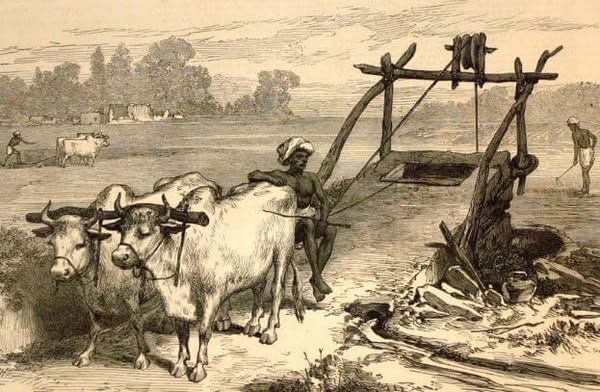
However, as human civilisation transcended into agrarian advancement, we see society’s fundamentals changed. The change led to the transition, and the transition saw a new face of society. Exactly in this vein, when humans first began cultivating crops some 10,000 years ago, it marked a revolutionary shift in human history. With the birth of agriculture, human civilisation stopped chasing food and instead started growing it. The Neolithic Revolution, as this transition is called, was a great leap forward in the advancement and transformation of society.
The Neolithic Revolution did not just change how human civilisation ate and lived; it reshaped society, power, and ultimately, the contours of civilisation itself. Before the onset of agriculture, people hardly had any concept of ownership. The beginning of agriculture resulted in permanent settlements as it tied people to land—and land, over time, became a valuable, precious entity and thereby worth killing for. With the beginning of agriculture came human settlements, food surpluses, and the eventual rise of states. Land became capital and a worthy possession. For nomads, land was a passage, while for settlers, it became a possession. From that moment onward, land was not just space—it was value. The more land one controlled, the more food and power they possessed.
The pattern repeated across civilisations: agriculture begot settlement; settlement begot surplus; surplus created inequality; inequality incited control; control invited conflict; and conflict led to war. Unlike nomadic people, who shared resources, farming societies accumulated wealth in the form of agricultural produce. And where there was wealth, there were those who wanted to take it—either through exploitation or occupation.
This shift, subtle but seismic, restructured social organisation and gave birth to the concept of states. For the first time, people began to own land, defend land, and expand territory—setting the stage for control, coercion, and ultimately, conflict. With fixed territory came territoriality. The early states began to view outsiders as threats not just to their states but also to their stored wealth and land; an example may be observed in the Indus Valley, where fortified granaries suggest conflict preparedness among urbanised agricultural societies.
History, thus, points out that as agriculture scaled up, wars were fought over agricultural produce and land—capital that produced all that human civilisation wanted. These wars were not mere skirmishes between two peoples or tribes; they were state-sponsored conquests fought by state-regulated armies for territorial expansion and control of resources.
Over the course of time, agriculture and the state became co-dependent, and war became a necessity. The newly established states maintained their power and hegemony on the basis of agricultural production. The early states, as argued by James C. Scott, were ‘coercive machines’ built on grain—easy to tax and hard to hoard or hide. Cultivated crops were taxed, and the state derived its major source of income from agriculture. The agricultural revenue enabled the state, as in the case of the Mauryans and Mughals, to maintain a large standing army that was used to expand its power, establish control over more land, and thereby exact more tribute and tax. The army was even paid through revenue assignments.
With the scaling up of agriculture, empires sought not just to rule people but to expand to distant territories by annexing fertile lands. Agricultural systems thus enabled logistical sophistication, provisioning of large armies, and bureaucratic management of conquered territories. Agricultural income provided the material base to the states for building and maintaining their power and hegemony—both attained through the maxim of war.
The transition from the hunting and gathering society to an agricultural one is not visualised in the form of political conflict alone but also in social conflict. We see a lot of things that look modern to us—for example, social inequality. It is, however, a fundamental process and large-scale issue that ties back to the origin of agriculture.
Social hierarchies emerged within agrarian communities. Control and ownership over land and food led to class divisions, gender inequality, and elite rule—conditions ripe for internal strife, rebellion, and the use of force as a tool of governance. This reorganisation of access to resources led to the first visible class distinctions. Those who controlled land and surplus food became the ruling elite—powerful; those who laboured became dependent and weak. Society, in economic terminology, got divided into haves and have-nots. Haves became dominant, powerful, and a source of exploitation for the have-nots. Hierarchies solidified not just around economic roles, but around power, lineage, and status. The seeds of conflict between the ‘have’ and ‘have-not’ categories of society were sown.
The beginning of cultivation did not only restructure economies; it also restructured gender relations. In pre-agricultural societies, women significantly participated and contributed to food gathering. The advent of cultivation marked a pivotal shift in gender dynamics. Women experienced a growing dichotomy between their indispensable roles in subsistence and their diminishing social and economic status within emerging agrarian societies. With agriculture, physical strength gained new economic importance in plough-based farming systems, pushing women to the margins of production and public decision-making. It ultimately gave space to patriarchy in society. The home, once a shared domestic space, became a site of gendered labour and, in the long run, a conflicting battleground.
These inequalities did not remain confined to the family and the state’s economy—they spilled into society at large. Agrarian societies, for all their achievements, were riddled with tension. The concentration of wealth and power in the hands of a few created widespread resentment among the many. Rebellions became a recurring feature of early states—from peasant revolts to caste-based stratification in early Indian societies.
To contain unrest, these societies—the haves—began developing instruments of control: standing armies, fortified cities, taxation systems, and religious ideologies that justified the social order. Violence, both overt and institutional, became central to governance to contain any conflict. The plough and the sword, it seems, were never far apart.
What emerges is that while agriculture undoubtedly laid the groundwork for settled life, cities, and complex societies, it also institutionalised forms of oppression that continue to shape the modern world. The very structures that define civilisation—social hierarchy, elite domination, gender inequality, and the use of coercion—were not deviations that came later; they were built into the earliest agrarian societies.
Yet, mainstream history often presents agriculture as a peaceful and productive turning point, overlooking the violence and inequality it simultaneously entrenched. Today, the echoes of these hierarchies remain loud. Land inequality drives dispossession and unrest in the modern world. Caste and class divisions are still at large and reflect ancient agrarian dependencies. Gender roles rooted in early farming practices persist in family structures and labour markets.
The prerequisite, thus, is to see agriculture not merely as a technological innovation but as a rupture in civilisational development. We do not need to return to some lost simplicity; we, however, need to muse on the structures inherited by us. This calls us to ask not only how we grow food, but how we grow justice. Not only how we survive, but how we choose to live—and who holds the power to shape that life. This contemplation, urgent and uncomfortable, lies at the heart of any vision for a more just future.
The writer is an Assistant Professor at the Chandigarh University
Dr Showket Ahmad Mandloo
sh************@***il.com