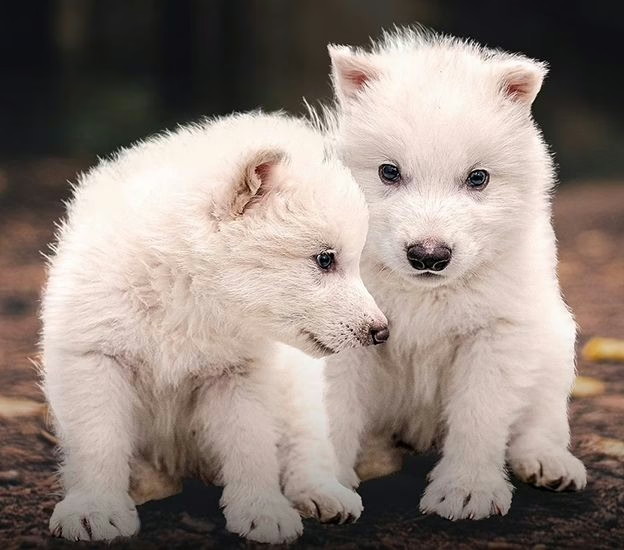


With 14 gene edits and 99% gray wolf DNA, does this 13,000-year-old species truly walk again? Experts warn: ‘We’re reviving ghosts without habitats’
Colossal Biosciences claims to have de-extincted the dire wolf, which went extinct approximately 13,000 years ago. The company also asserts plans to revive other extinct species, such as the Tasmanian tiger, once native to Australia; the dodo bird of Mauritius; and the woolly mammoth, which was comparable in size to modern elephants and inhabited snowy regions around 4,000 years ago.
According to the company, the dire wolf was their first successful attempt at de-extinction. This species, popularised by the TV show Game of Thrones, inspired the naming of two dire wolves born through the company’s efforts: Romulus and Remus. This project was conducted at a secret location in America. The five-month-old cubs are unaware that they were born into an era where no other members of their species exist. Alongside them is a third dire wolf, a female named Khaleesi by the company.
While the initial news is fascinating, many have raised questions. Some have refuted the claims, suggesting that the dire wolf has not been resurrected but is instead a genetically engineered version of the common wolf. Let’s delve into how this was accomplished.
In 1854, near the Ohio River in America, humans discovered dire wolf fossils for the first time. In 1858, American scientist Joseph Leidy classified this animal under the genus Canis, giving it the scientific name Canis dirus, which translates to “scary dog.” In 1918, scientist John Merriam studied dire wolf fossils and argued that this animal was vastly different and should not be classified under the Canis family, proposing a different genus. At that time, his statement was considered incorrect. For the next 100 years, people continued to believe that the dire wolf was closely related to gray wolves and modern wolves.
However, a 2021 study published in Nature completely changed our understanding of dire wolves. The study found that dire wolves are different from modern wolves. About 5.7 million years ago, they diverged from the species of wolves. The same study found that dire wolves lived in North America alongside gray wolves and coyotes, but there was no interbreeding among them; no genes were interlinked. Around 13,000 years ago, all dire wolves became extinct, while gray wolves remained. The exact cause of their extinction is unknown, but it is believed that dire wolves were hunted by larger animals, and as their prey became extinct, they too became extinct. Another theory suggests that their inability to interbreed like gray wolves prevented them from adapting to environmental changes. Compared to modern wolves, dire wolves were 25% larger. Although their heads were longer and bigger, and their jaws more powerful, they were not as massive as depicted in Game of Thrones.
Now, regarding the company’s claim of de-extincting the dire wolf, broadly speaking, there are three methods to achieve this:
- Back-breeding: This method ensures that the offspring carry the lost traits of extinct species. A real-life example is the Quagga Project. In 1987, scientists initiated the Quagga Project to selectively breed animals resembling the extinct quagga. The question arises: Is the dire wolf project similar to the Quagga Project?
- Cloning: This involves precise genetic mapping of an animal, which can be synthesised through cloning. However, to do so, a healthy cell of the extinct species is needed. The nucleus of the cell is removed and inserted into the egg of a closely related living species, which is very challenging. In 1996, the cloning of “Dolly the sheep” was a landmark in genetic cloning history.
- Genetic engineering: This is the newest and most promising method. Scientists use fossils of extinct animals, as fossils can preserve DNA for thousands of years. Scientists carefully identify the genes and compare them with those of closely related living species to create accurately traited extinct species. This process is extremely challenging due to the difficulty in obtaining accurate gene maps from ancient fossils and editing their DNA.
In 2021, American billionaire Ben Lamm and renowned scientist George Church founded a company called Colossal Biosciences with the sole goal of de-extincting species. Their flagship projects include bringing back the woolly mammoth, which went extinct 4,000 years ago, the Tasmanian tiger, and the dodo bird. The preservation of DNA for thousands of years serves as a powerful reminder that the Creator, who gave life, can also restore it after death.
In 2023, they selected the dire wolf for the de-extinction process. They used a 13,000-year-old tooth fossil and a 70,000-year-old skull. After selecting the DNA, they performed gene editing using CRISPR technology. Forty-five embryos were implanted into two dogs; only two embryos developed. On October 1, 2024, two puppies were born via C-section and named Romulus and Remus. On January 30, 2025, Khaleesi, a female dire wolf, was born. Imagine these dire wolves, once trained by their parents in the wild, now have no parents and must spend their entire lives in a highly controlled environment, vastly different from that of the extinct dire wolves.
Scientifically, this is a significant achievement, but the criticism it draws is also valuable. The true meaning of de-extinction is not merely bringing an animal back to life as a showpiece but restoring it to its proper ecological role. A simple question arises: If the dire wolf is brought back to life, does it have a place in our ecological balance? It was a large hunting animal. Today, there is a shortage of such predators, and it could restore balance. However, the fact remains that the dire wolf went extinct naturally, without human involvement. Climate change 10,000 years ago and natural ecosystem changes led to its extinction. So, is there truly a place for the dire wolf in today’s ecosystem? If released into the wild, they would likely hunt the same prey as gray wolves, leading to food competition and possibly repeating the events of 13,000 years ago, resulting in the dire wolf’s extinction once more.
But are they truly dire wolves? Probably not. They are genetically engineered versions of dire wolves with 14 altered genes. The gray wolf’s genome resembles the dire wolf’s by 99%.
Some questions arise in the layman’s mind:
Is this truly de-extinction or genetic mimicry?
Should humans bring back extinct species—and if so, why?
What are the risks of releasing such animals into today’s ecosystems?
Can genetic science go beyond recreating appearance and revive behaviour, instincts, and ecological roles?
We are entering an age where science can challenge the limits of life and death, but with that power comes responsibility. It’s not just about bringing the past back—it’s about building a future where technology and nature coexist in harmony. Dr Peter Marra of Georgetown University notes, “We can’t look to recover species that have gone extinct in the past before we conserve species in the present.” The debate over de-extinction ultimately reflects deeper questions about humanity’s relationship with nature and what authentic conservation should look like in the Anthropocene era.
We need to use our technology and resources to protect species that are alive but on the verge of extinction. We should focus on species that already have a place in today’s ecology, like the northern white rhinoceros, which once numbered around 500 but now only two remain. Thousands of endangered species can be saved without using modern technology. We need to preserve forests, and everyone should work earnestly like scientists. In May 2019, the UN reported that more than one million species of plants and animals are on the verge of mass extinction. Today, let’s save these species so we won’t need to de-extinct them in the future. As the proverb says, “Prevention is the best cure.”
The author works in the Education Department
Rayees ul Islam
ra************@***il.com