

On the day I finished my Master’s, a grieving father taught me more about life than any classroom ever could – and changed my path forever
It’s deep and hard to describe the peace that fills your soul when you finally finish your university degree, especially when it’s the end of a Master’s journey. It’s a special kind of freedom and joy that words can’t fully capture. That’s how I felt on the evening I finished. I had finally got freedom from the endless cycle of assignment deadlines, exams, and research work.
I felt like a heavy weight had been lifted off my shoulders, like a thick cloak I had been carrying and surviving for years. I felt light, almost like I could float, as I walked through the university gates one last time. I held onto that feeling of peace, thinking it was the start of something beautiful. But I didn’t know that life was already waiting for me outside those gates with a harsh lesson I never saw coming.
If I had known what was ahead, maybe I would have stayed a little longer in the comfort of university life. Maybe I would have chosen the stress I knew over the unknown pain that was waiting for me.
Just beyond those gates that once welcomed me with dreams and hope, life was waiting like a trap, ready to teach me something no classroom ever could. The lesson came not from books or lectures, but from a moment so painful and clear that it split my life into two parts: before and after.
That one moment—just a heartbeat—left a deep mark on me. It became a memory I carry like broken glass under my skin. Sometimes it stays quiet. Other times, it hurts all over again. But it never really leaves.
What a cruel twist, to spend years studying how to understand the world, only to be completely unprepared for what life actually had in store. All those achievements and grades suddenly meant nothing in the face of real, unexpected pain. It was a lesson in loss—one no university could ever teach—and the certificate I truly earned was written in tears, not ink.
The degree that now gathers dust on my shelf has my name on it, written in fancy letters. But my real graduation happened at those gates, where I lost my innocence and gained a different kind of knowledge.
A painful wisdom that took up space in my heart, in places that once held hope for a future untouched by grief.
Sometimes, I wish I could forget what I have learned. I wish I could go back to that final evening of peace, when my biggest worry was a deadline and my biggest hope was freedom. But once you have crossed certain lines in life, there’s no going back. You just carry your pain forward, letting it change you. And maybe, one day, that pain will shape you into someone who can hold both deep sorrow and, hopefully, a greater kindness than you ever knew before.
Since leaving the farewell function in the seminar hall of my university that final evening of the final semester, not a night has passed that I haven’t thought of the elderly man sitting alone on the stone bench near a street vendor’s fruit juice stall.
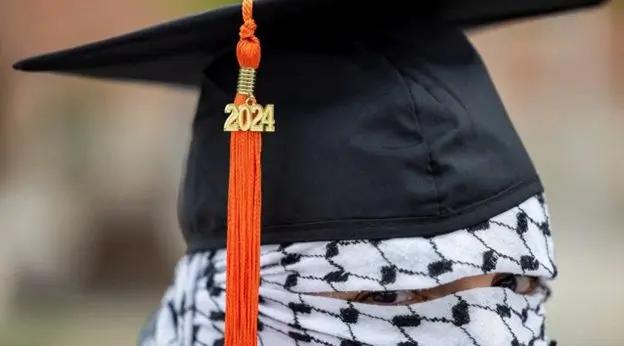
His trembling hands clutched a faded photograph as he rocked gently forward and back, silent tears carving paths down his weathered face. The graduation cap in his lap belonged to someone who would never wear it. He and I both knew that ceremony would remain forever incomplete—a celebration permanently silenced.
That moment has never left me—a man older than my grandfather, bearing the unbearable weight of an absence, alone on a campus emptying for summer break. With no consoling words to ease his pain. With no one stopping to notice.
Like once during a class lecture, my professor, Poornima ma’am, said:
“This world has failed to see private griefs. This generation has failed to honour the silent sufferers among us. We have failed to acknowledge the invisible burdens. We have failed to witness the quiet devastation hiding in plain sight.”
Remembering this thought made my chest constrict. I saw him. I caught his gaze for the briefest moment and witnessed the abyss of loss that lives on still, in what remains of his shattered heart. I paused as he pressed the graduation tassel between his fingers, a tangible remnant of dreams extinguished too soon.
I remember approaching him near the exit gate of my university, where he sat immobile as students streamed past with laughter and relief. I wish I had rehearsed what to say, but words abandoned me. All I could feel was my breath—it felt like an ache, a heavy burden that was making my lungs too heavy with each gasp.
“Are you alright, sir?” I finally managed. “Is there anything I can do?”
He paused, looked at me with eyes that had cried oceans for a very long time, and asked,
“Son, what troubles your heart? Let me listen to your burdens.”
And so I sat down beside him, under the environment and atmosphere and the sad shadows of that evening. The blisters on his hands were forcing me to cry every moment. It felt like these hands had also endured a lot of suffering.
“Mein apni graduation se sirf teen haftay door tha aur thak chukka tha
Mujhe apne mustaqbil ke baare mein pur aitmaad mehsoos karna yaad aata tha
Talimi qarz ka bojh meri rooh ko kuchal raha tha
Mere rishte taleemi dabao ke neeche toot chuke thay
Mera zehan is uljhan se dhundla gaya tha ke ab agla qadam kya hoga”
I told him I was afraid. That university was supposed to prepare me for life, but I was struggling to see my path forward. That my pursued education couldn’t guarantee me purpose or peace. He nodded as I spoke, with a wisdom earned through suffering. He kept calling me “son,” offering his perspective when words failed me.
“Don’t fear tomorrow, young man,” he said, his voice steadying as he spoke.
“My son would have been just like you—questioning, searching.”
In that moment—and in the hour that followed—I was seen. By a stranger carrying a grief I could barely comprehend.
He told me about his son. His only son. A brilliant student who would have walked across the graduation stage tomorrow if he had not lost his battle with depression three months earlier. The father had come to campus to sit where his son once sat, to breathe the air his son once breathed, to collect the degree his son had earned but would never receive.
This winter, I have now decided that I will volunteer at the campus crisis centre instead of taking the internship I had planned. As I prepare for this work, I am reflecting on what it means to truly see people—to create space for their stories, to listen without the urgency to solve or fix. During these next months, I will honour his son’s memory by being present for others who struggle in silence.
That evening changed me in ways I am still discovering. From that bench to the counselling centre, I learned that behind every face on campus—professors rushing to meetings, cafeteria workers serving with tired smiles, students projecting confidence—there are stories of triumph and devastation we rarely glimpse.
People often romanticise acts of compassion, calling them heroic, but every person who chooses to witness another’s pain eventually comes to understand that it is we who are transformed. In these sacred exchanges, we learn what it means to have nothing and everything at the same time. We meet people who are, quite literally, surviving the unlivable situations of life. Who understands the fragility of life more than we could ever comprehend? It is their resilience, their continued breathing despite it all, that teaches us the meaning of courage.
From this time forward, I hope to listen more deeply. I hope to create more space for the untold stories that surround us daily. I will remember that behind every composed face might lie an ocean of grief—or joy. And perhaps the weight we carry becomes lighter when shared.
The writer is a 1st-Year Master’s student at Jain University, Bangalore
Kamran Hamid Bhat
ka************@***il.com