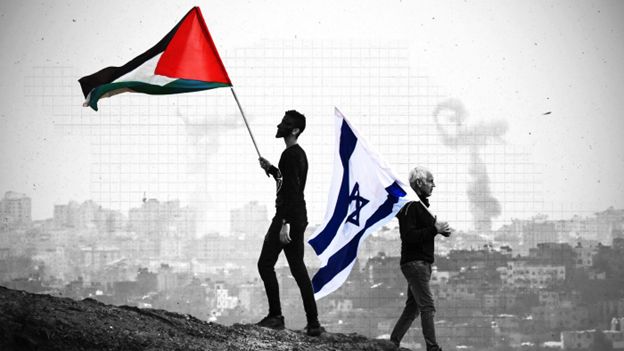


This in-depth article unveils the multifaceted history of the Israel-Palestine conflict, tracing its roots from ancient Canaan to contemporary challenges, highlighting key events, shifting power dynamics and the enduring quest for identity and justice amid centuries of turmoil and strife
The region known today as Israel and Palestine has a long and complex history that begins with the ancient land of Canaan. Situated at the crossroads of major civilizations, Canaan was home to various peoples, including the Canaanites, Philistines, and early Hebrews. By the 12th century BCE, the Israelites emerged as a distinct group, establishing a loose confederation of tribes that eventually united under a monarchy. The reigns of King David and King Solomon marked the peak of ancient Israel’s power, with Jerusalem becoming the political and religious center. Solomon’s construction of the First Temple in Jerusalem solidified the city’s role as a sacred site, but internal divisions and external pressures weakened the kingdom. After Solomon’s death, the kingdom split into Israel in the north and Judah in the south, leaving both vulnerable to invasion.
In 722 BCE, the Assyrians conquered the northern kingdom of Israel, while Judah managed to survive for another century. However, in 586 BCE, the Babylonian Empire, under King Nebuchadnezzar, captured Jerusalem, destroyed the First Temple, and exiled much of the Jewish population to Babylon. This period of exile, known as the Babylonian Captivity, profoundly shaped Jewish identity and religious practices. When the Persian Empire, led by Cyrus the Great, conquered Babylon in 539 BCE, he allowed the Jews to return to their homeland and rebuild the Temple, ushering in the Second Temple period.
The region eventually fell under Roman control in 63 BCE, with increasing unrest culminating in a series of Jewish revolts. The most significant, the Great Jewish Revolt of 66–70 CE, led to the destruction of the Second Temple and the dispersal of Jews across the Roman Empire. This dispersion, known as the Jewish Diaspora, scattered Jewish communities throughout the Mediterranean and beyond, profoundly shaping Jewish life and identity for centuries to come.
The arrival of Islam in the 7th century marked a transformative era for the region. In 638 CE, Muslim armies, led by Caliph Umar, captured Jerusalem from the Byzantine Empire. The city became a significant site in Islam, with the construction of the Dome of the Rock and Al-Aqsa Mosque, solidifying its status as the third holiest site in Islam. Under Islamic rule, Jews and Christians were granted protected status as “People of the Book,” allowing them to practice their faiths while paying a special tax. This period brought relative stability and flourishing trade, with Jerusalem becoming a vibrant cultural and religious center.
The Crusades, beginning In 1096, brought a violent clash between Christian and Muslim forces over control of the Holy Land. In 1099, Crusaders captured Jerusalem, massacring much of the local population. The Crusader Kingdom of Jerusalem lasted for nearly a century before Saladin, the Muslim leader, recaptured the city in 1187. The struggle between Crusaders and Muslim forces continued for two centuries, with Jerusalem changing hands multiple times.
Following the Crusades, the Mamluks gained control of the region, followed by the Ottomans in 1517. Ottoman rule lasted for four centuries, during which the region experienced relative stability, with diverse communities coexisting under a system of local governance and religious autonomy.
By the 19th century, European powers had expanded their influence across the Ottoman Empire, which was in a state of decline. The Ottoman Empire, once a dominant force in the region, struggled with internal corruption, economic stagnation, and rising nationalist movements. European powers, particularly Britain and France, began exerting political and economic control, often exploiting the empire’s weaknesses for their own strategic interests. As European ideas of nationalism spread, they inspired movements among both Arabs and Jews, laying the groundwork for future conflict in Palestine.
In the late 19th century, Zionism emerged as a political movement advocating for the establishment of a Jewish homeland in Palestine. Founded by Theodor Herzl, Zionism was a response to rising antisemitism in Europe and the desire for Jewish self-determination. Jewish immigration to Palestine increased significantly, particularly after waves of pogroms in Eastern Europe. By the early 20th century, Zionist settlers had begun purchasing land and establishing agricultural communities, often displacing local Arab farmers. At the same time, Arab nationalism was also on the rise, driven by opposition to European colonialism and a growing desire for Arab independence. Palestinian Arabs, who had lived in the region for generations, began to view Jewish immigration as a threat to their land and way of life.
The collapse of the Ottoman Empire after World War I left Palestine under British control as part of the League of Nations Mandate system. The British Mandate of Palestine (1920–1948) was marked by conflicting promises and growing tensions. During the war, Britain had made contradictory commitments to both Jews and Arabs. The 1917 Balfour Declaration expressed British support for a “national home for the Jewish people” in Palestine, while the earlier McMahon-Hussein Correspondence had promised Arab independence in exchange for their support against the Ottomans. These conflicting promises sowed distrust and animosity between the two communities.
Under British rule, Jewish immigration increased, leading to further land purchases and displacement of Palestinian peasants. The Arab population, feeling increasingly marginalized, organized revolts and protests, including the Arab Revolt of 1936–1939. British attempts to mediate the conflict failed, and by the end of the mandate period, tensions between Jews and Arabs had reached a breaking point. The British withdrawal in 1948 left the region on the brink of full-scale war, setting the stage for the partition of Palestine and the ensuing conflict.
The Balfour Declaration of 1917 marked a pivotal moment in the history of Palestine, as Britain publicly expressed support for the establishment of a “national home for the Jewish people” in Palestine. Issued during World War I, the declaration aimed to secure Jewish support for the Allied war effort, but it neglected to address the rights and aspirations of the Arab population, which made up the majority of the region’s inhabitants. As Jewish immigration increased under British rule during the 1920s and 1930s, tensions between Jews and Arabs escalated. The influx of Jewish settlers, along with land purchases that displaced Palestinian farmers, fueled resentment and led to violent clashes. By the 1930s, the Palestinian Arab population viewed Zionism as a colonial threat to their homeland, leading to widespread unrest, including the Arab Revolt of 1936–1939.
In response to the growing unrest and international pressure, the United Nations proposed a partition plan in 1947, aiming to divide Palestine into separate Jewish and Arab states, with Jerusalem as an international zone. The plan allocated 55% of the land to the Jewish state and 45% to the Arab state, despite the Jewish population comprising only about one-third of the total population. While Jewish leaders reluctantly accepted the plan, Arab leaders rejected it, viewing the partition as an unjust imposition that violated the rights of the indigenous Palestinian population.
Following the UN’s approval of the partition plan, violence erupted between Jewish and Arab communities. When the British mandate ended in May 1948, David Ben-Gurion declared the establishment of the State of Israel. This declaration triggered a full-scale war between the newly established Israeli state and neighboring Arab nations. During the war, over 700,000 Palestinians were forcibly displaced or fled from their homes, an event Palestinians refer to as the Nakba, meaning “catastrophe.” Many of these refugees were never allowed to return, leading to a lasting legacy of displacement, loss, and unresolved grievances.
The 1948 Arab-Israeli War, also known as the War of Independence to Israelis and the Nakba (“catastrophe”) to Palestinians, erupted after the declaration of the State of Israel on May 14, 1948. Arab nations, including Egypt, Jordan, Syria, Iraq, and Lebanon, invaded Palestine to prevent the establishment of a Jewish state and support Palestinian Arabs. Despite being outnumbered, Israeli forces, bolstered by better organization and arms supplies, emerged victorious. By the end of the war, Israel controlled 78% of historic Palestine, far beyond the boundaries allocated in the 1947 UN Partition Plan. Jordan took control of the West Bank and East Jerusalem, while Egypt administered the Gaza Strip. For Palestinians, the war resulted in the displacement of over 700,000 people, many of whom fled to refugee camps in neighboring countries, where they and their descendants remain to this day.
In June 1967, tensions between Israel and its Arab neighbors escalated into the Six-Day War, a swift and decisive conflict that reshaped the region. Fearing an imminent attack, Israel launched a preemptive strike, destroying the Egyptian Air Force and swiftly defeating Egypt, Jordan, and Syria. As a result, Israel seized the Sinai Peninsula and Gaza Strip from Egypt, the West Bank and East Jerusalem from Jordan, and the Golan Heights from Syria. The occupation of these territories dramatically altered the Israeli-Palestinian dynamic, placing millions of Palestinians under Israeli military rule. The capture of East Jerusalem, home to the Al-Aqsa Mosque, further inflamed tensions, as Palestinians saw their holy sites fall under Israeli control. Israel’s occupation of these territories, deemed illegal under international law, continues to be a core issue in the ongoing conflict.
Following the Six-Day War, Israel began establishing Jewish settlements in the occupied territories, particularly in the West Bank and Gaza. These settlements, viewed by much of the international community as violations of international law, altered the demographic and political landscape of the region. By establishing a Jewish presence in strategic areas, Israel aimed to consolidate control over the territories and prevent the creation of a contiguous Palestinian state. Settlements expanded rapidly, supported by government subsidies and ideological motivations. For Palestinians, the growth of settlements meant the loss of land, restricted movement, and increasing violence, further fueling resentment and resistance.
In December 1987, a popular uprising known as the First Intifada erupted in the occupied territories. Sparked by the killing of four Palestinians in a traffic accident involving an Israeli military vehicle, the Intifada was a grassroots revolt against Israeli occupation. Palestinians engaged in widespread protests, strikes, and civil disobedience, while youth armed with stones clashed with Israeli soldiers. The uprising, which lasted until 1993, highlighted the harsh realities of occupation and brought international attention to the Palestinian cause. Israel responded with military force, resulting in thousands of Palestinian deaths and injuries. The Intifada’s prolonged unrest eventually pressured both sides to seek negotiations, paving the way for the Oslo Accords.
The Oslo Accords, signed In 1993 between Israel and the Palestine Liberation Organization (PLO), marked a historic attempt to achieve peace. The agreements established limited Palestinian self-rule in Gaza and parts of the West Bank and outlined a framework for future negotiations. The PLO, led by Yasser Arafat, recognized Israel’s right to exist, while Israel acknowledged the PLO as the representative of the Palestinian people. Despite initial optimism, the Oslo process faced significant challenges. Israeli settlement expansion continued, while extremist elements on both sides undermined the peace efforts. The assassination of Israeli Prime Minister Yitzhak Rabin in 1995 further derailed the peace process, leading to growing disillusionment among Palestinians.
In 2000, the failure of peace talks at Camp David, coupled with continued Israeli settlement growth and the frustration of Palestinians over unfulfilled promises, led to the eruption of the Second Intifada. This uprising was far more violent than the first, with Palestinian armed groups launching suicide bombings and attacks, while Israel responded with heavy military force, including airstrikes and incursions into Palestinian cities. The violence resulted in thousands of deaths on both sides and further eroded any remaining trust. The Second Intifada ended around 2005 but left a legacy of deepened mistrust and hardened positions.
The situation In Gaza further deteriorated after Israel’s unilateral withdrawal from the territory in 2005, followed by the 2006 Palestinian elections, which brought Hamas to power. Israel imposed a blockade on Gaza after Hamas took full control in 2007, citing security concerns. The blockade severely restricted the movement of goods and people, leading to deteriorating living conditions for Gaza’s population. Periodic conflicts between Israel and Hamas, including devastating wars in 2008, 2012, and 2014, resulted in widespread destruction and civilian casualties. The humanitarian crisis in Gaza remains dire, with millions living under blockade, facing poverty, and lacking basic services. Despite numerous peace proposals and international efforts, the conflict continues, with no lasting solution in sight.
Conclusion:
The 21st century has witnessed numerous attempts to revive the Israeli-Palestinian peace process, but all have ended in failure. The 2000 Camp David Summit and the 2001 Taba talks fell apart over unresolved issues such as borders, the status of Jerusalem, and the right of return for Palestinian refugees. Later initiatives, including the 2003 Road Map for Peace and the 2007 Annapolis Conference, also failed to produce lasting results. Meanwhile, shifting alliances in the region have altered the political landscape. The Abraham Accords, signed in 2020 between Israel and several Arab states, normalized relations but sidelined Palestinian concerns, deepening Palestinian disillusionment.
Regional and global powers have played a critical role in shaping the conflict. The United States, historically Israel’s strongest ally, has been the primary broker of peace efforts but has often been accused of favoring Israeli interests. Arab nations, once unified in their support for the Palestinian cause, have shifted their priorities, focusing on their own national interests. Iran’s support for Palestinian militant groups, particularly Hamas, has further complicated the situation, fueling cycles of violence and proxy conflicts. International bodies like the United Nations have repeatedly condemned Israeli settlements and human rights violations but have been largely ineffective in enforcing resolutions.
As realities on the ground change, the quest for justice remains elusive. Expanding settlements, the fragmentation of Palestinian territories, and the deepening humanitarian crisis in Gaza have left Palestinians with diminishing hopes for statehood. The two-state solution, long seen as the most viable path to peace, appears increasingly out of reach. However, alternative approaches, such as a single democratic state with equal rights for all citizens or a confederation model, are gaining traction in some circles.
A lasting peace requires addressing the core grievances of both Israelis and Palestinians. Any future solution must guarantee security for Israelis while ensuring justice, dignity, and self-determination for Palestinians. Without a commitment to equality, human rights, and genuine dialogue, the cycle of violence and mistrust will continue. The international community, regional powers, and civil society must push for a just and sustainable resolution that acknowledges the historical injustices and offers a pathway to coexistence. Only through mutual recognition, compromise, and accountability can a lasting peace be achieved.
In 722 BCE, the Assyrians conquered the northern kingdom of Israel, while Judah managed to survive for another century. However, in 586 BCE, the Babylonian Empire, under King Nebuchadnezzar, captured Jerusalem, destroyed the First Temple, and exiled much of the Jewish population to Babylon. This period of exile, known as the Babylonian Captivity, profoundly shaped Jewish identity and religious practices. When the Persian Empire, led by Cyrus the Great, conquered Babylon in 539 BCE, he allowed the Jews to return to their homeland and rebuild the Temple, ushering in the Second Temple period.
The region eventually fell under Roman control in 63 BCE, with increasing unrest culminating in a series of Jewish revolts. The most significant, the Great Jewish Revolt of 66–70 CE, led to the destruction of the Second Temple and the dispersal of Jews across the Roman Empire. This dispersion, known as the Jewish Diaspora, scattered Jewish communities throughout the Mediterranean and beyond, profoundly shaping Jewish life and identity for centuries to come.
The arrival of Islam in the 7th century marked a transformative era for the region. In 638 CE, Muslim armies, led by Caliph Umar, captured Jerusalem from the Byzantine Empire. The city became a significant site in Islam, with the construction of the Dome of the Rock and Al-Aqsa Mosque, solidifying its status as the third holiest site in Islam. Under Islamic rule, Jews and Christians were granted protected status as “People of the Book,” allowing them to practice their faiths while paying a special tax. This period brought relative stability and flourishing trade, with Jerusalem becoming a vibrant cultural and religious center.
The Crusades, beginning In 1096, brought a violent clash between Christian and Muslim forces over control of the Holy Land. In 1099, Crusaders captured Jerusalem, massacring much of the local population. The Crusader Kingdom of Jerusalem lasted for nearly a century before Saladin, the Muslim leader, recaptured the city in 1187. The struggle between Crusaders and Muslim forces continued for two centuries, with Jerusalem changing hands multiple times.
Following the Crusades, the Mamluks gained control of the region, followed by the Ottomans in 1517. Ottoman rule lasted for four centuries, during which the region experienced relative stability, with diverse communities coexisting under a system of local governance and religious autonomy.
By the 19th century, European powers had expanded their influence across the Ottoman Empire, which was in a state of decline. The Ottoman Empire, once a dominant force in the region, struggled with internal corruption, economic stagnation, and rising nationalist movements. European powers, particularly Britain and France, began exerting political and economic control, often exploiting the empire’s weaknesses for their own strategic interests. As European ideas of nationalism spread, they inspired movements among both Arabs and Jews, laying the groundwork for future conflict in Palestine.
In the late 19th century, Zionism emerged as a political movement advocating for the establishment of a Jewish homeland in Palestine. Founded by Theodor Herzl, Zionism was a response to rising antisemitism in Europe and the desire for Jewish self-determination. Jewish immigration to Palestine increased significantly, particularly after waves of pogroms in Eastern Europe. By the early 20th century, Zionist settlers had begun purchasing land and establishing agricultural communities, often displacing local Arab farmers. At the same time, Arab nationalism was also on the rise, driven by opposition to European colonialism and a growing desire for Arab independence. Palestinian Arabs, who had lived in the region for generations, began to view Jewish immigration as a threat to their land and way of life.
The collapse of the Ottoman Empire after World War I left Palestine under British control as part of the League of Nations Mandate system. The British Mandate of Palestine (1920–1948) was marked by conflicting promises and growing tensions. During the war, Britain had made contradictory commitments to both Jews and Arabs. The 1917 Balfour Declaration expressed British support for a “national home for the Jewish people” in Palestine, while the earlier McMahon-Hussein Correspondence had promised Arab independence in exchange for their support against the Ottomans. These conflicting promises sowed distrust and animosity between the two communities.
Under British rule, Jewish immigration increased, leading to further land purchases and displacement of Palestinian peasants. The Arab population, feeling increasingly marginalized, organized revolts and protests, including the Arab Revolt of 1936–1939. British attempts to mediate the conflict failed, and by the end of the mandate period, tensions between Jews and Arabs had reached a breaking point. The British withdrawal in 1948 left the region on the brink of full-scale war, setting the stage for the partition of Palestine and the ensuing conflict.
The Balfour Declaration of 1917 marked a pivotal moment in the history of Palestine, as Britain publicly expressed support for the establishment of a “national home for the Jewish people” in Palestine. Issued during World War I, the declaration aimed to secure Jewish support for the Allied war effort, but it neglected to address the rights and aspirations of the Arab population, which made up the majority of the region’s inhabitants. As Jewish immigration increased under British rule during the 1920s and 1930s, tensions between Jews and Arabs escalated. The influx of Jewish settlers, along with land purchases that displaced Palestinian farmers, fueled resentment and led to violent clashes. By the 1930s, the Palestinian Arab population viewed Zionism as a colonial threat to their homeland, leading to widespread unrest, including the Arab Revolt of 1936–1939.
In response to the growing unrest and international pressure, the United Nations proposed a partition plan in 1947, aiming to divide Palestine into separate Jewish and Arab states, with Jerusalem as an international zone. The plan allocated 55% of the land to the Jewish state and 45% to the Arab state, despite the Jewish population comprising only about one-third of the total population. While Jewish leaders reluctantly accepted the plan, Arab leaders rejected it, viewing the partition as an unjust imposition that violated the rights of the indigenous Palestinian population.
Following the UN’s approval of the partition plan, violence erupted between Jewish and Arab communities. When the British mandate ended in May 1948, David Ben-Gurion declared the establishment of the State of Israel. This declaration triggered a full-scale war between the newly established Israeli state and neighboring Arab nations. During the war, over 700,000 Palestinians were forcibly displaced or fled from their homes, an event Palestinians refer to as the Nakba, meaning “catastrophe.” Many of these refugees were never allowed to return, leading to a lasting legacy of displacement, loss, and unresolved grievances.
The 1948 Arab-Israeli War, also known as the War of Independence to Israelis and the Nakba (“catastrophe”) to Palestinians, erupted after the declaration of the State of Israel on May 14, 1948. Arab nations, including Egypt, Jordan, Syria, Iraq, and Lebanon, invaded Palestine to prevent the establishment of a Jewish state and support Palestinian Arabs. Despite being outnumbered, Israeli forces, bolstered by better organization and arms supplies, emerged victorious. By the end of the war, Israel controlled 78% of historic Palestine, far beyond the boundaries allocated in the 1947 UN Partition Plan. Jordan took control of the West Bank and East Jerusalem, while Egypt administered the Gaza Strip. For Palestinians, the war resulted in the displacement of over 700,000 people, many of whom fled to refugee camps in neighboring countries, where they and their descendants remain to this day.
In June 1967, tensions between Israel and its Arab neighbors escalated into the Six-Day War, a swift and decisive conflict that reshaped the region. Fearing an imminent attack, Israel launched a preemptive strike, destroying the Egyptian Air Force and swiftly defeating Egypt, Jordan, and Syria. As a result, Israel seized the Sinai Peninsula and Gaza Strip from Egypt, the West Bank and East Jerusalem from Jordan, and the Golan Heights from Syria. The occupation of these territories dramatically altered the Israeli-Palestinian dynamic, placing millions of Palestinians under Israeli military rule. The capture of East Jerusalem, home to the Al-Aqsa Mosque, further inflamed tensions, as Palestinians saw their holy sites fall under Israeli control. Israel’s occupation of these territories, deemed illegal under international law, continues to be a core issue in the ongoing conflict.
Following the Six-Day War, Israel began establishing Jewish settlements in the occupied territories, particularly in the West Bank and Gaza. These settlements, viewed by much of the international community as violations of international law, altered the demographic and political landscape of the region. By establishing a Jewish presence in strategic areas, Israel aimed to consolidate control over the territories and prevent the creation of a contiguous Palestinian state. Settlements expanded rapidly, supported by government subsidies and ideological motivations. For Palestinians, the growth of settlements meant the loss of land, restricted movement, and increasing violence, further fueling resentment and resistance.
In December 1987, a popular uprising known as the First Intifada erupted in the occupied territories. Sparked by the killing of four Palestinians in a traffic accident involving an Israeli military vehicle, the Intifada was a grassroots revolt against Israeli occupation. Palestinians engaged in widespread protests, strikes, and civil disobedience, while youth armed with stones clashed with Israeli soldiers. The uprising, which lasted until 1993, highlighted the harsh realities of occupation and brought international attention to the Palestinian cause. Israel responded with military force, resulting in thousands of Palestinian deaths and injuries. The Intifada’s prolonged unrest eventually pressured both sides to seek negotiations, paving the way for the Oslo Accords.
The Oslo Accords, signed In 1993 between Israel and the Palestine Liberation Organization (PLO), marked a historic attempt to achieve peace. The agreements established limited Palestinian self-rule in Gaza and parts of the West Bank and outlined a framework for future negotiations. The PLO, led by Yasser Arafat, recognized Israel’s right to exist, while Israel acknowledged the PLO as the representative of the Palestinian people. Despite initial optimism, the Oslo process faced significant challenges. Israeli settlement expansion continued, while extremist elements on both sides undermined the peace efforts. The assassination of Israeli Prime Minister Yitzhak Rabin in 1995 further derailed the peace process, leading to growing disillusionment among Palestinians.
In 2000, the failure of peace talks at Camp David, coupled with continued Israeli settlement growth and the frustration of Palestinians over unfulfilled promises, led to the eruption of the Second Intifada. This uprising was far more violent than the first, with Palestinian armed groups launching suicide bombings and attacks, while Israel responded with heavy military force, including airstrikes and incursions into Palestinian cities. The violence resulted in thousands of deaths on both sides and further eroded any remaining trust. The Second Intifada ended around 2005 but left a legacy of deepened mistrust and hardened positions.
The situation In Gaza further deteriorated after Israel’s unilateral withdrawal from the territory in 2005, followed by the 2006 Palestinian elections, which brought Hamas to power. Israel imposed a blockade on Gaza after Hamas took full control in 2007, citing security concerns. The blockade severely restricted the movement of goods and people, leading to deteriorating living conditions for Gaza’s population. Periodic conflicts between Israel and Hamas, including devastating wars in 2008, 2012, and 2014, resulted in widespread destruction and civilian casualties. The humanitarian crisis in Gaza remains dire, with millions living under blockade, facing poverty, and lacking basic services. Despite numerous peace proposals and international efforts, the conflict continues, with no lasting solution in sight.
Conclusion:
The 21st century has witnessed numerous attempts to revive the Israeli-Palestinian peace process, but all have ended in failure. The 2000 Camp David Summit and the 2001 Taba talks fell apart over unresolved issues such as borders, the status of Jerusalem, and the right of return for Palestinian refugees. Later initiatives, including the 2003 Road Map for Peace and the 2007 Annapolis Conference, also failed to produce lasting results. Meanwhile, shifting alliances in the region have altered the political landscape. The Abraham Accords, signed in 2020 between Israel and several Arab states, normalized relations but sidelined Palestinian concerns, deepening Palestinian disillusionment.
Regional and global powers have played a critical role in shaping the conflict. The United States, historically Israel’s strongest ally, has been the primary broker of peace efforts but has often been accused of favoring Israeli interests. Arab nations, once unified in their support for the Palestinian cause, have shifted their priorities, focusing on their own national interests. Iran’s support for Palestinian militant groups, particularly Hamas, has further complicated the situation, fueling cycles of violence and proxy conflicts. International bodies like the United Nations have repeatedly condemned Israeli settlements and human rights violations but have been largely ineffective in enforcing resolutions.
As realities on the ground change, the quest for justice remains elusive. Expanding settlements, the fragmentation of Palestinian territories, and the deepening humanitarian crisis in Gaza have left Palestinians with diminishing hopes for statehood. The two-state solution, long seen as the most viable path to peace, appears increasingly out of reach. However, alternative approaches, such as a single democratic state with equal rights for all citizens or a confederation model, are gaining traction in some circles.
A lasting peace requires addressing the core grievances of both Israelis and Palestinians. Any future solution must guarantee security for Israelis while ensuring justice, dignity, and self-determination for Palestinians. Without a commitment to equality, human rights, and genuine dialogue, the cycle of violence and mistrust will continue. The international community, regional powers, and civil society must push for a just and sustainable resolution that acknowledges the historical injustices and offers a pathway to coexistence. Only through mutual recognition, compromise, and accountability can a lasting peace be achieved.
Malik Firdous
fi**************@***il.com
fi**************@***il.com