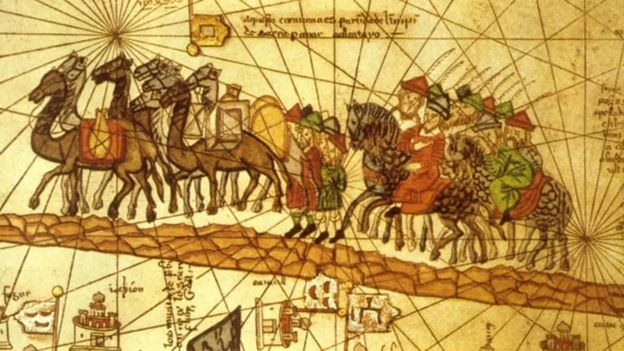


Beyond the romanticised imagery lies a complex narrative, revealing the term’s true origins, historical misperceptions and its contemporary implications in a globalised world
The term “Silk Road” normally evokes quaint imagery of ancient caravans laden with silk, spices, and other commodities transcending barriers like vast deserts, barren lands, isolated tracts, rugged mountains, diverse people, etc., connecting Far East, East and West. However, the history of the term is far more modern than the convoluted routes it has been made to represent. Contrary to how it has been bequeathed to it over generations, in my part of the world it has been wrought in stone, the name Silk Road (or Silk Route) is not an ancient term but a relatively recent construct, coined less than 150 years ago. The origins of the term, its history, and the context in which it attained popularity offer fascinating insights into how modern scholarship, populistic agendas and historical narratives have shaped our understanding of ancient trade networks.
Origins of the Term “Silk Road”
The term Silk Road was first introduced in 1877 by Ferdinand von Richthofen, a Prussian geographer and traveller, in his work ‘China: The Results of My Travels and the Studies Based Thereon’. Richthofen used the term Seidenstraße (German for “Silk Road”) to describe the overland trade routes that connected China to the Mediterranean world. The term was not meant to refer to some definitive unilineal path, but to a network of intertwined routes that supported a substantial exchange of goods, migrations, ideas, cultures, and technologies across Eurasia.
Richthofen’s use of the term coincided with a period in the second half of the 19th century when there was a surge in interest in knowing, exploring and documenting the connections between distant regions. It was also a time of immense flux, when industrialisation and railways were being built to bridge vast distances between empires and colonies. In that context, the notion of a “Silk Road” found a cord with the European imagination, generating romanticised visions of ancient trade and cultural exchange and the term gained traction, particularly in German academic circles.
Historical Context and Development
The routes that Richthofen labelled as the Silk Road had existed for centuries, long before they were given this name. Yet it is important to note that there is no historical mention or evidence of the term Silk Road—or any semblance of a unified name for these routes—before the 13th century. Prior to the Mongol invasions of the 13th century, which are often credited with fostering connectivity between East and West under the Pax Mongolica, there was no seamless trade network linking China and the rest of the world in any significant or organised way. While trade undoubtedly occurred, it was sporadic and localised, lacking the structured and symbolic resonance associated with the later concept of the Silk Road. Even Marco Polo, whose travels in the 13th century are often romanticised in modern narratives of the Silk Road, makes no mention of the term in his accounts. His descriptions of trade routes, interactions with Mongols, and the exotic goods of Asia were focused on specific exchanges rather than any overarching concept of a “Silk Road.”
Similarly, whatever trade existed between China and the Roman Empire prior to this period was largely incidental and peripheral. The Roman Empire’s trade was far more centred on the Indian subcontinent, with Indian ports, quays, and bazaars playing a dominant role in the exchange of spices, textiles, and luxury goods. China’s trade with the Roman Empire was exotic and supplemental rather than central to the larger narrative of global trade. Silk from China did reach Roman markets, but it represented only a small fraction of the overall trade volume, which was heavily dominated by goods flowing through India and other parts of Asia.
Modern Popularity and Usage
Despite its historical basis, the term Silk Road remained relatively obscure outside German-speaking academic circles for several decades after Richthofen introduced it. It was not until 1938 that the term gained the requisite traction in the English-speaking world, when Swedish geographer Sven Hedin’s book The Silk Road brought it front and centre of the discourse. Hedin popularised the term by describing the historic trade routes in a highly accessible manner. His work emphasised the sociocultural, economic, intellectual and historical significance of the routes, framing them as a symbol of sustained intercultural dialogue and exchange. By the mid-20th century, the term had become more widely used, particularly in the context of academic studies, archaeology, and popular history. Here it is necessary to recognise that much of the narrative is shaped by modern reinterpretations rather than brass-tacks of history.
India’s Role in the Silk Road
India’s involvement in the trade routes associated with the Silk Road has been the subject of debate and interpretation. While India was doubtlessly a highly significant player in ancient trade networks, its role in the overland Silk Road was rather peripheral compared to regions like China, Central Asia, and the Mediterranean. The primary overland routes of the Silk Road passed through Central Asia, connecting cities like Samarkand, Kashgar, and Merv before reaching the Mediterranean. India’s contributions to the networks were primarily through maritime trade routes in the Indian Ocean, rather than overland connections.
Cartographic representations of the Silk Road often show a small southward arrow pointing from Kashgar (in modern-day Xinjiang, China) toward India, symbolizing limited overland connections. India played a pivotal role in facilitating the exchange of goods and ideas through its bustling ports, bazaars, quays, and maritime trade. Indian spices, textiles, and gemstones were highly valued commodities. Indian cultural and religious influences, particularly Buddhism, spread along these routes.
Modern Resonance: The Belt and Road Initiative
The legacy of the Silk Road continues to influence modern-day geopolitics and economic policies having pushed out into the cauldron as part of China’s Belt and Road Initiative (BRI). The ambitious infrastructure project aims to create new trade corridors and strengthen economic ties between Asia, Europe, and Africa, on the eponymous lines of silk road of yore. One of the key components of the BRI is the Yuxinou Railway, which connects Chongqing in southern China to the German port city of Duisburg. The railway symbolises the revival, rather a rebirth, of overland trade routes between East and West, echoing the historical Silk Road.
Conclusion
The Silk Road is more than just a historical term; it is a modern construct that encapsulates the complex and dynamic networks of trade, culture, and exchange that have shaped human history. It is cardinally important to demystify and declutter the romanticised, and often unreal, notions surrounding the Silk Road. There was no mention of the term before the 13th century, nor was there any seamless connection between China and the rest of the world prior to the Mongol Empire’s consolidation of power. Even during its peak, trade between China and the Roman Empire was supplemental to the larger narrative of trade dominated by India and other regions. Its modern origins and evolving interpretations reflect the ways in which history is constructed, remembered, and reimagined.
The writer is a teacher
Uzair Qadri
mo*************@***il.com