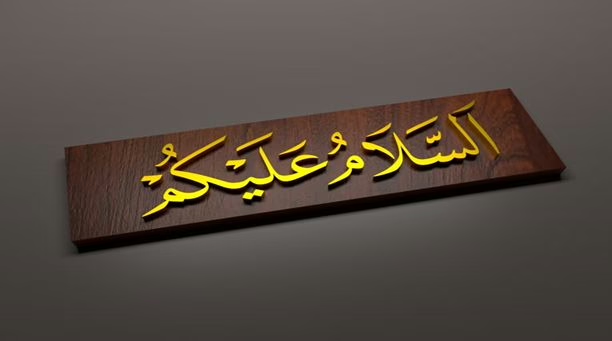


More than just a salutation, ‘Assalamu Alaikum’ unites hearts and embodies peace, brotherhood and the essence of Islamic values
The Islamic greeting, “Assalamu Alaikum”, translates to “Peace be upon you.” It is a fundamental part of Islamic culture and practice, carrying significant meaning beyond a simple salutation. This greeting is used in various situations, such as when meeting someone, leaving someone, or answering the phone. It promotes peace, unity, and brotherhood. It is a sunnah of Prophet Muhammad (peace be upon him) and an act of worship. It is also a way to earn the blessings of Allah.
The word “Salam” itself means peace—both inner peace and peace with others. It signifies a desire for tranquility and well-being for the person being greeted.
The phrase “Alaikum” means “upon you.” When combined, the greeting expresses a wish that God’s peace be bestowed upon the recipient. This reflects the Islamic belief in surrendering to God’s will.
The Quran directly addresses the etiquette of greetings in Surah An-Nisa (Chapter 4), Verse 86: “And when you are greeted with a greeting, greet [in return] with one better than it or [at least] return it [in a like manner]. Indeed, Allah is ever, over all things, an Accountant.”
This verse instructs Muslims to respond to greetings with kindness and respect, emphasizing the importance of good manners and social interaction.
While the Quran does not explicitly mention the specific phrase “Assalamu Alaikum,” this verse encourages a positive and courteous response to any greeting received.
The Prophet Muhammad (peace be upon him) emphasized the importance of greeting others with “Assalamu Alaikum” in numerous hadiths. Here are a few examples:
- “The best of you are those who greet others with peace.” (Sunan Tirmidhi)
- “When two Muslims meet and greet each other with peace, they are forgiven before they part.” (Abu Dawud)
- “The first to greet is the most virtuous.” (Tirmidhi) – This encourages proactive and generous displays of goodwill by prioritizing the initiation of greetings.
- “Whoever greets with peace, the mercy of Allah, and His blessings, thirty good deeds are recorded for him.” (Al-Mu’jam al-Kabīr) – This further emphasizes the significant spiritual rewards of offering greetings.
- “A young person should offer greetings to an older one, a walking person to one seated, and a smaller group to a larger one.” (Al-Bukhari and Al-Tirmidhi) – This highlights the importance of showing respect and consideration when greeting others.
- “The greeting of Islam is ‘As-Salamu Alaikum.’ ” (Sahih Muslim)
These hadiths highlight the significance of the Islamic greeting as an act of worship, a means of fostering brotherhood, and a way to earn forgiveness from God.
The greeting fosters a sense of brotherhood and unity among Muslims. It serves as a reminder that all believers are connected and should treat each other with kindness and respect. The Prophet Muhammad (peace be upon him) emphasized the importance of greeting others with “Assalamu Alaikum.” Following his example is considered a virtuous act.
Greeting others with “Assalamu Alaikum” is considered an act of worship and a way to earn blessings from God. Greeting is a powerful tool for spreading peace and goodwill. It is a simple yet meaningful way to promote harmony and understanding among people.
The response to this greeting is: Wa Alaikumussalam – “And upon you be peace.” This is the most common response, acknowledging the greeting and returning the wish for peace.
– Wa Alaikumussalam Wa Rahmatullahi Wa Barakatuh – “And upon you be peace, and the mercy and blessings of God.” This response adds a deeper level of blessing and goodwill.
In essence, the Islamic greeting is more than just a polite formality. It is a profound expression of faith, a symbol of unity, and a powerful tool for spreading peace and kindness.
The writer is a teacher at Higher Secondary School Nehalpora, Pattan
Kousar Ahmad Rather
ko************@***il.com