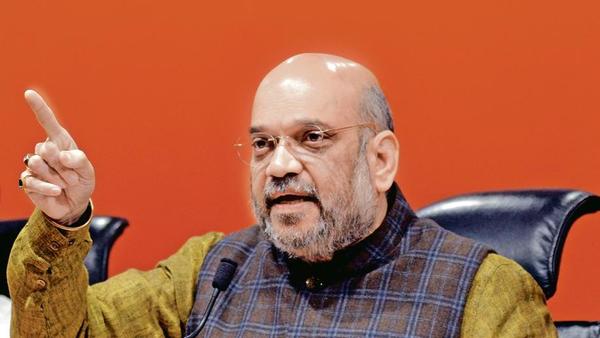


New Delhi: Union Home Minister and Minister of Cooperation, Amit Shah, violence in three hotspots— Northeast, Left-Wing Extremism and Kashmir— has reduced by more than 72%.
He addressed the IGF Annual Investment Summit-NXT10 in Mumbai, Maharashtra today. On this occasion, many dignitaries, including Maharashtra Chief Minister Eknath Shinde, were present.
In his address, Amit Shah said that upcoming months will witness elections in India, where democracy marked its beginning. He stated that the upcoming elections in India will shape the destiny of the country for the next 25 years. Home Minister emphasized the significant transformations took place in every sector in the last 10 years under the leadership of Prime Minister Narendra Modi. Shah pointed out that the decisions made in the next 5 years will determine where India will stand in the centenary year of independence in 2047. He highlighted that these elections are not only about democracy but also a celebration of synergy between democracy and security, ensuring the well-being of the poor, public welfare, tradition, and technology.
The Union Home Minister, Amit Shah stated that under the leadership of Prime Minister Modi, India is progressing towards being self-confident, self-reliant. He added that India now has a dynamic government from a dormant one, having a progressive growth, and moving towards becoming a top economy from its earlier fragile state.
He mentioned that this journey will continue for decades, and the goals set by Prime Minister Modi for India, to be fully developed, self-reliant, and counted among the top economies by 2047, will certainly be achieved. He emphasized that we have the performance of the past 10 years and a roadmap for the next 25 years to attain these goals.
Amit Shah emphasized that to understand the changes in the past 10 years, we have to compare these transformations against those of the previous regime. This would be the best parameter to evaluate the performance of the present government led by Prime Minister Narendra Modi. He pointed out that in 2014, the economy was deteriorating, investor confidence was low, corruption scandals worth 12 lakh crore had shaken the nation’s confidence, crony capitalism was at its peak, inflation was soaring, fiscal deficit was out of control, and ease of doing business ranking was significantly low. The country’s security system was also weak. He explained that the people’s decision to give a decisive mandate to Narendra Modi in 2014 led to the formation of this government. Shah mentioned that before this, the country experienced 30 years of political instability, and after a long time, a full mandate was achieved by any political party. He stated that from there, the growth story of India began with development in security, education, innovation, and the economy. Shah mentioned that the average inflation rate between 2004 and 2014 was 8.2 percent, reaching double digits in 2010, 2011, and 2013. However, today, it has been consistently maintained below 5 percent. He highlighted the Modi government’s efforts in correcting banking and forex mismanagement, gave way for new type of politics in the country.
Union Home Minister and Minister of Cooperation stated that for a long time, our country’s politics was plagued by four evils – dynastic politics, casteism, corruption, and appeasement – with no place for merit. He mentioned that in the last 10 years, under the leadership of Prime Minister Modi, not only in parliament, but in all elections across the country, the politics of direct performance has been established. He said that now governments that perform will come to power, and for the first time, our government has worked to create an atmosphere separate from dynastic politics and casteism. Shri Shah said that during the previous government’s tenure, the country experienced policy paralysis, where every minister considered themselves as the Prime Minister, and the actual Prime Minister was not acknowledged. He mentioned that in the last 10 years of the previous government, not a single policy was formulated. In contrast, Prime Minister Modi, in 10 years, has crafted over 40 policies, shaping the country’s economy and presenting the best example of a policy-driven state.
The Union Home Minister, Amit Shah said that the Modi government has taken more than 50 transformative decisions in its 10-year tenure, recognized globally for changing the direction and destiny of India. He highlighted key decisions, such as demonetization in 2016 to curb corruption and counterfeit currency, the implementation of the Goods and Services Tax (GST) in 2017, significant steps to address the issues of Non-Performing Assets (NPA), and the expansion of the digital landscape through Jan Dhan, Aadhar, Mobile (JAM) trinity. Shah stated that the surgical and air strikes sent a strong message to the World that no one can challenge India’s army and borders. He emphasized that Prime Minister Modi has ended the practice of triple talaq, granting rights to millions of Muslim mothers and sisters. The Citizenship Amendment Act (CAA) provided citizenship rights to persecuted refugees, and the abrogation of Article 370 and 35A, permanently integrated Kashmir with India. Regarding education, Shah mentioned the introduction of the New Education Policy, which reflects the fragrance of India’s future and our values. He highlighted the Nari Shakti Vandan Act, which brought 33% reservation for women in legislative assemblies and parliament, empowering women in policy-making. He highlighted the government’s efforts to replace the criminal justice system created by the British with three new laws, ensuring that justice is delivered in any case within three years of the trial, eliminating delays and outdated practices.
Amit Shah stated that neither did anyone understand India’s pride, nor did anyone worry about enhancing it. He emphasized that with the development of the country, every citizen has a direct connection. He said that Prime Minister Modi has built the collective self-confidence of the nation by respecting all our ideals. Shri Shah mentioned that our new Parliament building is the vision of Prime Minister Narendra Modi, representing the world’s most modern and grand democratic system. He stated that Modi ji has transformed Rajpath into Kartavya Path, symbolizing a path of duty. Shri Shah highlighted Prime Minister Narendra Modi’s efforts in cracking down terrorism, left-wing extremism, and armed groups to establish peace in the country. He mentioned that there were three hotspots in the country- Northeast, Left-Wing Extremism affected areas, and Kashmir. He stated that violence in these three hotspots has reduced by more than 72%, over 10,000 extremists have surrendered, and a significant transformation has occurred.