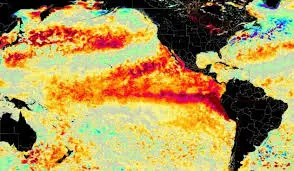
NEW DELHI: The Pacific Ocean is running a temperature. And this time, scientists have confirmed it. On July 3, the World Meteorological Organization (WMO) announced that El Nino conditions have developed in the tropical Pacific and are forecast to strengthen rapidly over the coming months.
The United Nations weather agency warned that the event increases the likelihood of heatwaves, droughts, heavy rainfall and flooding in many parts of the world.
But alongside the official announcement, a far scarier number has been racing across social media. Posts claim the Pacific is about to warm by a staggering 4 degrees Celsius. That claim needs a closer look, because it is not what official forecasts say.
WHAT IS EL NINO, AND WHY DOES IT MATTER?
El Nino is a natural climate pattern in which the surface of the central and eastern Pacific Ocean becomes unusually warm. Normally, trade winds push warm water towards Indonesia, from east to west.
During El Nino, those winds weaken, warm water sloshes eastwards, and the atmosphere above reorganises itself. That is why a patch of warm ocean near Peru can shift rainfall in India, Australia and Africa.
WMO Secretary-General Celeste Saulo said the event is “forecast to strengthen rapidly into a strong event”, intensifying the chances of drought, heavy rainfall and heatwaves worldwide.
WHAT IS THE NINO 3.4 INDEX?
Scientists track El Nino using a patch of the equatorial Pacific called the Nino 3.4 region. They measure how much warmer its surface is compared to the long-term average. This difference is called an anomaly.
The United States weather agency, Noaa, declares an El Nino when this anomaly stays at 0.5 degrees Celsius or more for several consecutive months. The latest weekly reading has already climbed to 1.7 degrees Celsius, showing how quickly the event is intensifying.
IS THE 4 DEGREE EL NINO CLAIM TRUE?
No official agency forecasts a 4 degree El Nino. The WMO expects seasonal anomalies to exceed 2 degrees Celsius in key monitoring regions.
NOAA gives a 63 per cent chance of the event crossing 2 degrees, which would make it very strong by its classification.
Scientists monitor El Nino through the Nino 3.4 region of the equatorial Pacific, where the weekly temperature anomaly has climbed to 1.7 degrees Celsius.
Scientists monitor El Nino through the Nino 3.4 region of the equatorial Pacific, where the weekly temperature anomaly has climbed to 1.7 degrees Celsius.
Even the individual forecast models with the warmest predictions, such as those run by the European Centre for Medium-Range Weather Forecasts, have ranged between roughly 1.7 and 3.3 degrees Celsius.
The viral 4 degree figure appears to stem from misread or cherry-picked model charts, not from any official outlook. A 2 degree event is alarming enough. It does not need exaggeration.
WILL EL NINO AFFECT INDIA’S MONSOON?
For India, El Nino usually means trouble for the southwest monsoon, which delivers about 70 per cent of the country’s annual rainfall.
The India Meteorological Department expects this season’s rainfall to be around 90 per cent of the long-period average, with a 35 per cent chance of a deficient monsoon.
The link, however, is probabilistic, not guaranteed.
Ocean patterns closer to home, such as the Indian Ocean Dipole, can soften El Nino’s blow. Scientists are watching. So should we.
Agencies
El Nino declared in Pacific Ocean by WMO, warns it will become powerful