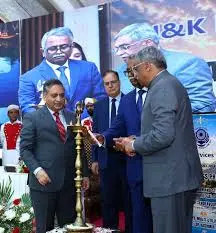


Justice Vikram Nath calls for institutional coordination, vernacular outreach for women’s legal empowerment
SRINAGAR: The Jammu and Kashmir Legal Services Authority, under the guidance of the National Legal Services Authority, on Saturday organised a mega awareness programme on “Empowering Women and Strengthening Institutional Legal Support” at SKICC, Srinagar, with Supreme Court Judge and NALSA Executive Chairman Justice Vikram Nath emphasising that the effectiveness of Legal Services Institutions must be judged by whether a person in distress is able to approach the system without fear, be heard with dignity, and receive competent assistance without avoidable delay.
The programme was conceived as a common institutional platform to strengthen awareness of the legal rights of women and girl children and to improve coordination among Legal Services Institutions, Police, Health, Education, Social Welfare, One Stop Centres, Child Welfare Committees, and other authorities responsible for protection, legal assistance, compensation, rehabilitation, and follow-up support.
In his presidential address, Justice Vikram Nath called upon all stakeholders to strengthen legal literacy, institutional coordination, and grassroots outreach so that constitutional and statutory safeguards become a practical reality for women and girl children. He further stressed that the proceedings and key deliberations of this conference should be translated into vernacular languages and circulated among all concerned stakeholders for effective grassroots-level implementation.
Justice S.V.N. Bhatti, Judge, Supreme Court of India and Supervising Judge for the J&K Legal Services Authority, highlighted the need for functional grievance mechanisms, trained stakeholders, and victim-sensitive procedures. He observed that women and children should not be compelled to navigate a fragmented institutional system or repeatedly recount traumatic experiences before different authorities, emphasising that clear referral pathways, confidentiality, and accountability are necessary for meaningful legal empowerment.
Justice Sanjeev Kumar, Chief Justice (Acting), High Court of J&K and Ladakh and Executive Chairman, J&K Legal Services Authority, underscored that access to justice cannot be measured merely by the availability of laws and institutions. He called for stronger grassroots outreach and effective functioning of Front Offices, Legal Aid Clinics, Panel Lawyers, and Para-Legal Volunteers, and stressed the importance of convergence among all stakeholder institutions dealing with women in distress.
Recalling the distinguished tradition of humanitarian and justice-oriented intervention by the J&K Legal Services Authority, Justice Sanjeev Kumar highlighted its exemplary response after the devastating earthquake of 2005, when Judicial Officers conducted Lok Adalats in the open, closer to affected communities, enabling victims to receive compensation on the spot.
Justice Sanjay Dhar, Judge, High Court of J&K and Ladakh and Chairperson, High Court Legal Services Committee, observed that recognition of a right in law is only the beginning and that the real test of justice lies in whether the right can be understood, approached, and effectively enforced. He emphasised that the constitutional character of the justice system is reflected in the manner in which a woman is received by the first institution she approaches, and that prompt assistance, confidentiality, sensitivity, and institutional follow-up are essential to prevent secondary victimisation.
The programme unfolded through two technical sessions. The first session, on “Women’s Rights, Legal Empowerment and Access to Justice,” chaired by Justice Vikram Nath and co-chaired by Justice S.V.N. Bhatti, focused on the Sexual Harassment of Women at Workplace Act, 2013, the POCSO Act, 2012, and the Medical Termination of Pregnancy Act, 1971.
The second session, on “Institutional Support, Victim Assistance and Convergence Mechanisms for Women in Distress,” was chaired by Justice Sindhu Sharma and co-chaired by Justice Moksha Khajuria Kazmi, discussing cyberstalking, online blackmail, technology-enabled abuse, and the need for a coordinated and compassionate institutional response.
The dignitaries released “ENDEAVOUR-2025,” the Annual Newsletter-cum-Compendium reflecting legal services activities during 2025, and flagged off Multi-Utility Vehicles for District Legal Services Authorities of Kashmir Province to extend mobile legal services to remote and underserved areas. The programme was attended by several High Court Judges, former Chief Justice, former Judges, Judicial Officers, representatives of Civil and Police Administration, academicians, and various government departments. Welcome address was presented by Member Secretary Shazia Tabasum, and vote of thanks by Principal District & Sessions Judge and Chairperson DLSA Srinagar Haq Nawaz Zargar.