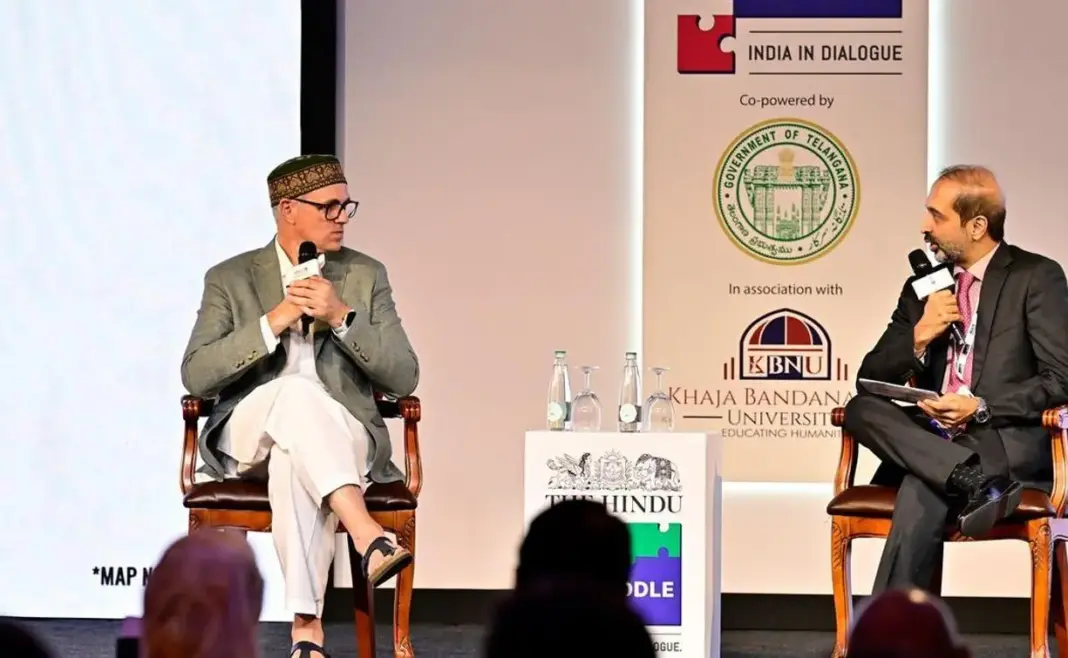


Bengaluru: Jammu and Kashmir Chief Minister Omar Abdullah on Friday questioned the Centre over the delay in restoring statehood to the Union territory, asserting that he is running an elected government with “one-and-a-half hands tied behind its back”.
Speaking at ‘The Hindu Huddle’ here, Abdullah demanded that the BJP-led Centre define the “yardstick” it uses to measure the “appropriate time” for restoring statehood.
He also alleged that the region’s rights are being held to ransom over factors outside the local government’s control.
Terming the 2019 revocation of Article 370 as the “biggest policy mistake”, Abdullah said the Centre should now stand behind its commitment to restoring statehood to J&K.
“We are told that it will be done at the ‘appropriate time’, which is fine… I am ready to listen to that, provided somebody tells me how I am supposed to gauge what the appropriate time is,” Abdullah said.
“What is the yardstick? Is it the levels of violence? If it is, that is unfair on me because I am not responsible for security. The government of India is directly responsible through the office of the lieutenant governor. Essentially, you are holding my statehood to ransom over something that I do not get to control,” he added.
Underlining that the Centre had said that the road to statehood is three-phased, the chief minister said, “We had the delimitation… We had elections in which the people of J&K participated in record numbers. And then the third step, which is statehood, is nowhere to be seen. And nobody is explaining to us as to why not,” Abdullah said.
Criticising the structural limits placed on his administration as a Union territory, the chief minister asked how any state leader could govern effectively under such conditions.
“Ask any chief minister, how would they feel being a chief minister without getting to choose who the chief secretary is? Without getting to choose who their DGP is… Without getting to choose who their finance secretary is. What sort of government is that?” Abdullah said.
The National Conference (NC) leader firmly rejected the narrative that the now-abrogated Article 370 had hindered the region’s progress, calling it a piece of “propaganda” used by the BJP and argued that the lack of private investment was a direct fallout of 30 to 35 years of militancy, not special status granted to the erstwhile state of J&K under the Article.
“People will not invest money in a part of the country that they deem to be unsafe,” he said, adding that similar land protections and entry permits exist in Lakshadweep and large parts of the Northeast, yet Jammu and Kashmir was uniquely targeted.
Abdullah also pointed toward neighbouring Ladakh, claiming that the region is experiencing severe “buyer’s remorse” after initially celebrating its separation from J&K in 2019.
“Large numbers of them are saying, look, we were better off actually where we were in 2019,” he added.
Abdullah also made a strong tourism pitch to South India and urged the southern film industries, which he noted currently boast superior budgets and box-office performances compared to Bollywood, to choose the Kashmir Valley for film shoots.
Recalling Mani Ratnam’s 1992 classic ‘Roja’, Abdullah said that while the story was based in Kashmir, the crew could not shoot there due to the onset of peak militancy.
On India-Pakistan relations, Abdullah said that while J&K does not directly determine the bilateral dialogue between New Delhi and Islamabad, its status remains the core friction point between the two neighbours.
“I wouldn’t call us a key player because neither side talks to us about talking to each other, but we are, for want of a better phrase, the elephant in the room,” Abdullah said, adding that while his region is a part of India, the neighbouring country is still unable to accept that “and that has shadowed our relationship ever since 1947”.
He added that while local leaders do not control the diplomatic trajectory, the region remains “the actual reason why our two countries haven’t been able to see eye to eye with each other”.
On internal security dynamics, the chief minister admitted that a sense of complacency had previously set in regarding the containment of militancy, which was disrupted by the security incidents in Pahalgam and subsequent security operations.
“We took our eye off the ball. Look at what happened to us in Pahalgam last year. We were complacent,” Abdullah said.
“We became complacent about the security situation. We thought that the dark days of militancy, where innocent people would be killed, were far behind us and we won’t see them again. But we did see them last year,” he added.
Abdullah emphasised that the broader relationship with Pakistan continuously impacts daily life, security conditions, and resource management in the region, including river water utilisation.
He also pointed out the changes in J&K and said that after Pahalgam, people of the region overwhelmingly rejected terror.
PTI