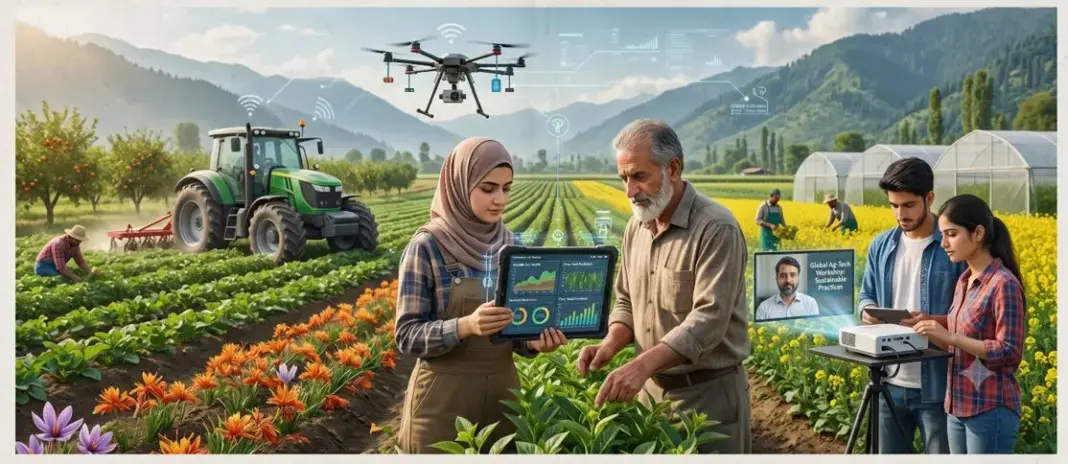


The crisis facing modern agriculture is not solely technological but relational. True agricultural wisdom emerges through dialogue between empirical research and inherited ecological memory. A farmer confronting fungal disease in a remote Himalayan orchard can access knowledge previously confined to research institutions. A student can learn directly from indigenous agricultural practices preserved through generations. Knowledge becomes reciprocal rather than hierarchical. Learning becomes dynamic rather than merely instructional.
Shabeer Ahamd Lone
The deepest crises of humanity often begin not with spectacular collapse, but with subtle forms of forgetfulness. Civilisations decline when they lose the capacity to perceive relationships: between consumption and consequence, technology and ethics, prosperity and ecology, knowledge and wisdom. Modern agriculture, despite its astonishing scientific achievements, increasingly reveals this paradox. Humanity has learned to produce more food than at any previous point in history, yet millions remain food insecure; yields have increased, yet soils are exhausted; chemical interventions have multiplied, yet ecosystems grow fragile; technological sophistication has expanded, yet farmers across many regions experience despair, indebtedness, displacement, and uncertainty. Against this troubled background, the idea of a Hybrid Learning Course on Crop Protection emerges not merely as an educational innovation, but as a profound civilizational intervention seeking to restore fractured relationships between humans and the living earth.
The phrase “crop protection” itself demands deeper philosophical scrutiny. Protection from what, and for whom? At one level, the answer appears straightforward: crops must be protected from diseases, pests, invasive species, climatic stress, and economic loss. Yet beneath this practical necessity lies a far larger reality. Crops themselves are inseparable from ecological webs involving microorganisms, pollinators, forests, rivers, climate systems, biodiversity, markets, public health systems, and human communities. The health of agriculture cannot ultimately be separated from the health of civilisation itself. A diseased field is often also the symptom of deeper disequilibrium-ecological imbalance, unsustainable extraction, weakened biodiversity, exploitative economic structures, monocultural dependency, disrupted water systems, inequitable land distribution, or agricultural policies rewarding short-term productivity over long-term stewardship. Therefore, the deepest form of crop protection is not merely defensive intervention against visible threats, but the cultivation of resilient ecological harmony, social justice, and ethical responsibility.
This insight marks one of the most significant transformations in contemporary agricultural thought. For much of the twentieth century, dominant agricultural paradigms were shaped by industrial assumptions inherited from mechanistic production models. Nature was increasingly viewed as a system to be controlled, optimised, and intensified. Chemical pesticides, synthetic fertilisers, monocultures, and mechanisation produced undeniable increases in productivity and helped avert famines in many regions. The achievements associated with the Green Revolution, linked historically with figures such as Norman Borlaug, transformed food production globally and prevented catastrophic hunger in several countries. Yet these achievements carried hidden ecological, social, and psychological costs that became progressively visible through research and lived experience. Soil fertility declined under excessive chemical dependency; pesticide resistance intensified; beneficial insects disappeared; groundwater contamination spread; biodiversity diminished; rural inequalities deepened; traditional seed diversity weakened; climate vulnerability increased; and many small farmers became trapped in debt-dependent input systems shaped by volatile markets and corporate agricultural monopolies. The agricultural question, therefore, evolved from “How do we produce more?” to “How do we produce sustainably, equitably, and meaningfully without undermining the ecological and human foundations upon which agriculture depends?”
It is precisely here that hybrid learning acquires transformative importance. Unlike traditional educational models that often isolate theoretical knowledge from lived realities, hybrid learning possesses the potential to reconnect abstraction with experience. Through the integration of digital accessibility, participatory dialogue, local observation, field practice, scientific research, emotional intelligence, and community engagement, learning becomes dynamic rather than merely instructional. A farmer confronting fungal disease in a remote Himalayan orchard can engage knowledge previously confined to research institutions. A student studying plant pathology can learn directly from indigenous agricultural practices preserved through generations. Scientists can receive feedback from real-world farming experiences rather than operating within detached theoretical frameworks. Knowledge becomes reciprocal rather than hierarchical.
Yet the promise of hybrid learning cannot be romanticised uncritically. Its transformative potential depends upon confronting structural inequalities that shape educational access itself. Millions of rural learners continue to face digital exclusion due to inadequate internet connectivity, limited electricity, economic precarity, language barriers, low digital literacy, and technological inaccessibility. A genuinely inclusive hybrid learning system must therefore move beyond technological enthusiasm toward technological justice. Educational materials must be multilingual, culturally rooted, participatory, visually accessible, and adaptable to oral traditions of learning. Storytelling, community-based demonstrations, farmer-to-farmer exchanges, local ecological narratives, and experiential pedagogy remain indispensable alongside digital innovation. Otherwise, hybrid learning risks reproducing the very inequalities it seeks to overcome.
The ethical implications of democratized learning are profound. Historically, agricultural expertise often flowed vertically, from institutions to farmers, from laboratories to fields, from experts to communities. While scientific expertise remains indispensable, contemporary scholarship increasingly recognises that sustainable agricultural transformation requires horizontal dialogue as well. Indigenous and local farming traditions frequently contain ecological intelligence refined over centuries through careful observation of seasons, biodiversity, soil behaviour, and climatic rhythms. Across Asia, Africa, Latin America, and indigenous communities elsewhere, practices such as crop rotation, mixed farming, biological pest deterrence, water conservation, seed preservation, and ecological adaptation often emerged not from formal scientific laboratories, but from sustained intimacy with land and landscape.
The most visionary hybrid learning models, therefore, do not romanticise tradition nor blindly glorify technological modernity. Instead, they cultivate synthesis. They recognise that science without humility can become ecologically destructive, while tradition without adaptation may prove insufficient before unprecedented climate realities. True agricultural wisdom emerges through dialogue between empirical research and inherited ecological memory. This balanced synthesis represents one of the defining intellectual tasks of our era.
Current research increasingly reinforces this integrative perspective. Studies associated with the Food and Agriculture Organization, CGIAR, and leading agroecological research networks indicate that regenerative and integrated farming systems often enhance long-term resilience, biodiversity, and soil health while reducing dependency on harmful chemical inputs. Climate scientists associated with the Intergovernmental Panel on Climate Change warn that rising temperatures, erratic rainfall, desertification, and ecological instability are altering pest migration, disease emergence, pollinator behaviour, and crop vulnerability globally. Agriculture today is simultaneously a victim of climate change and a contributor to it through carbon-intensive industrial practices, deforestation, excessive fertiliser use, and methane emissions. In this context, crop protection can no longer rely solely upon reactive chemical intervention. It requires anticipatory intelligence, climate resilience, biodiversity restoration, agroforestry, regenerative soil practices, ecological literacy, and adaptive resilience rooted in long-term planetary responsibility.
Hybrid learning enables precisely this form of adaptive intelligence. Artificial intelligence-driven disease diagnostics, satellite imaging, drone surveillance, sensor-based irrigation systems, precision agriculture, climate modelling, and mobile advisory platforms are reshaping crop protection globally. Yet technology alone cannot solve agricultural crises. The deeper issue concerns the consciousness guiding technological use. Consciousness here does not merely signify awareness in a vague moral sense; it refers to an integrated mode of perception combining ecological literacy, ethical responsibility, systems thinking, emotional sensitivity, spiritual humility, and civilizational foresight. The same technologies capable of supporting sustainability may also intensify ecological exploitation if governed solely by profit-driven logic detached from human and ecological well-being. Thus, the central educational challenge is not merely technological competence, but moral discernment.
One of the most overlooked dimensions of agricultural education is the psychology of farming communities themselves. Public discourse frequently treats agriculture in statistical language-yield, productivity, GDP contribution, export value-while neglecting the emotional and existential realities experienced by cultivators. Farmers do not merely manage crops; they live within uncertainty shaped by weather, debt, fluctuating markets, pests, social expectations, inheritance, and intergenerational responsibilities. Crop failure is rarely just economic loss; it can fracture family stability, educational aspirations for children, mental health, and communal confidence. Across several countries, agrarian distress has contributed to alarming levels of psychological suffering and social fragmentation. Contemporary discussions around ecological grief, climate anxiety, and “solastalgia”-the emotional distress caused by environmental degradation-reveal that ecological crises are simultaneously psychological crises.
A truly transformative Hybrid Learning Course on Crop Protection must therefore humanise agricultural education. It must acknowledge farmers not merely as economic actors but as bearers of memory, resilience, dignity, and cultural continuity. Women farmers, indigenous cultivators, landless labourers, and small-scale producers-often marginalised within policy and educational systems-must occupy central rather than peripheral positions within agricultural discourse. In many societies, women sustain seed preservation, biodiversity protection, household nutrition, and localised ecological knowledge, yet remain excluded from land ownership, technological access, financial support, and institutional recognition. Ecological transformation without social justice remains incomplete.
The emotional dimension of ecological restoration is often underestimated. Many farmers trapped in cycles of chemical dependency experience not only financial exhaustion but psychological alienation from the land itself. They inherit fields once alive with biodiversity and gradually witness ecological depletion without always possessing viable alternatives. Educational transformation becomes meaningful when it restores not merely productivity but hope, agency, and ecological belonging.
There are deeply moving examples from around the world illustrating this possibility. In parts of India, farmers shifting toward integrated pest management reported that the most significant change was not simply reduced pesticide costs, but the return of birds, earthworms, pollinators, and soil vitality to their fields. In East Africa, community-based agroecological training improved resilience not only through technical knowledge but through collective cooperation and shared learning. In Latin America, farmer-to-farmer ecological education movements demonstrated that sustainable agriculture flourishes most powerfully when communities themselves become active participants in knowledge creation rather than passive recipients of external instruction. Similar initiatives in Japan, inspired by Masanobu Fukuoka, emphasised farming as a philosophy of humility and ecological participation rather than domination.
Such stories illuminate an essential truth: the crisis facing modern agriculture is not solely technological but relational. Humanity increasingly behaves as though it stands outside nature rather than within it. Modern industrial culture often fragments reality into disconnected categories-economics separate from ecology, technology separate from ethics, productivity separate from wellbeing. Yet ecological systems do not recognise such divisions. Soil degradation eventually becomes economic instability; biodiversity loss becomes food insecurity; polluted water becomes a public health crisis; climate disruption becomes migration pressure and geopolitical instability. The COVID-19 pandemic, international conflicts, and disruptions in global supply chains further exposed the fragility of food systems and the dangerous illusion that food security can be permanently outsourced to global markets detached from ecological sustainability.
Many of the world’s great visionaries perceived this interconnectedness long before contemporary ecological science articulated it formally. Mahatma Gandhi emphasised restraint, ethical responsibility, and harmony with natural systems. Rabindranath Tagore envisioned education as a process reconnecting humans with nature and holistic consciousness. Wendell Berry described farming as fundamentally an act of cultural and moral imagination rather than merely industrial production. Vandana Shiva has argued consistently for biodiversity-centred agriculture and seed sovereignty. Spiritual and religious traditions across civilisations have similarly emphasised stewardship and interconnectedness: Islamic notions of khalifah view humanity as trustees of creation; Buddhist teachings stress interdependence; Indigenous cosmologies often regard land as sacred inheritance rather than private commodity; Hindu ecological thought links nature with cosmic balance. Contemporary ecological scholarship increasingly converges with these older intuitions, suggesting that sustainability ultimately depends not merely upon policy reform or technological innovation, but upon a transformation of consciousness itself.
The hybrid learning model becomes especially significant because it can cultivate ecological citizenship across generations. Younger generations increasingly distance themselves from agriculture due to economic insecurity, social stigma, climate instability, and urban aspirations. The future of sustainable food systems depends upon making agriculture intellectually meaningful, technologically creative, economically viable, and ethically dignified for youth. Hybrid learning can reconnect young people with ecological imagination by integrating scientific innovation with cultural rootedness, entrepreneurship with sustainability, and technological creativity with community wellbeing.
At its deepest level, such education transforms perception itself. Learners gradually recognise that soil is not inert matter but a living ecosystem containing immense microbial complexity. Water is not merely a consumable resource but a shared ecological trust. Seeds embody biological memory accumulated over millennia. Pollinators sustain food systems. Forests regulate climatic conditions essential for agriculture. Biodiversity is not ornamental luxury but an ecological necessity. Consumers, too, become participants in agricultural ethics. Excessive food waste, unrealistic cosmetic expectations for produce, unsustainable consumption patterns, and demand for artificially cheap food contribute indirectly to destructive agricultural systems. Thus, crop protection ultimately concerns entire societies rather than farmers alone.
The future of civilisation may depend less upon humanity’s capacity for domination and more upon its capacity for intelligent restraint, ecological humility, regenerative imagination, and collective responsibility. Technological innovation remains indispensable, but without ethical vision it risks deepening the crises it seeks to solve. Governments, universities, civil society organisations, local communities, and international institutions must therefore collaborate to redesign agricultural curricula, support agroecological transitions, strengthen farmer-centred research, democratise technological access, protect biodiversity, regulate harmful chemical excesses, and integrate sustainability deeply into educational systems.
The deepest success of a Hybrid Learning Course on Crop Protection, therefore, lies in nurturing not only skilled professionals but ecologically conscious human beings capable of integrating science with wisdom, productivity with sustainability, technology with justice, and innovation with compassion. Ultimately, the greatest harvest produced by such education is invisible. It is the emergence of a new consciousness capable of seeing the earth not as an object of exploitation but as a living community to which humanity belongs. When learners begin to understand that protecting crops also means protecting soils, insects, rivers, climates, cultures, communities, mental well-being, future generations, and the moral continuity of civilisation itself, agriculture is transformed from a narrow economic activity into an ethical participation in the continuity of life. In that moment, crop protection ceases to be merely a technical discipline and becomes an act of civilizational care, ecological wisdom, and shared planetary stewardship.
sh*****************@***il.com