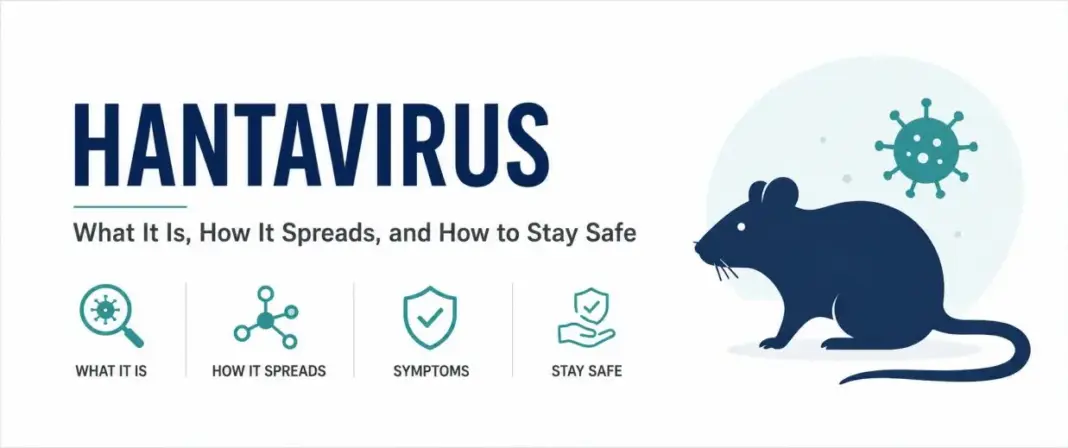


No vaccine, no cure, but not the next pandemic. The transmission window is extremely short—only about one day. It does not spread through the air like COVID or flu. Seal your home so rodents cannot enter. Wear N95 masks and gloves in storage rooms, warehouses, or old closed rooms. Don’t leave food exposed. Dispose of garbage properly.
Dr Mir Aaliya
On April 1, 2026, a cruise ship leaves the Argentine city of Ushuaia. Around 150 people from 23 countries, including passengers and crew, are on board, and the ship is headed for Antarctica and the remote islands of the South Atlantic. Everything goes fine for the first few days. People mingle, enjoy themselves, and parties are held. None of them had any idea that this trip was soon going to turn into a nightmare.
About five days after the trip begins, a 70-year-old Dutch passenger suddenly develops a fever and headache, along with mild diarrhoea. He goes to the ship’s doctor. But within a day or two, he also starts having difficulty breathing. His condition deteriorates so rapidly that on April 11, he dies on the ship itself. No one knew what had caused the death. The passengers paid it little attention, and people continued socialising and enjoying themselves.
On April 24, the ship docks at the island of Saint Helena near Africa. There, the dead passenger’s wife disembarks with his body. From there, she travels to South Africa, and on April 25, just as she is about to board a flight from South Africa to Amsterdam, her condition suddenly worsens so much that she is removed from the flight. She collapses right at the airport and dies on April 26.
Meanwhile, people on board the ship also begin falling ill. On April 28, a German woman becomes sick, and just four days later, on May 2, she too dies. Once again, nobody knew why passengers on this ship were dying one after another.
On May 2 itself, the entire crisis was reported to the World Health Organization (WHO). Tests are conducted, and then the diagnosis comes out: Hantavirus.
“Hantavirus… deadly hantavirus…”
This is a virus for which there is no vaccine. No cure. And its death rate is so high that it can kill half of the infected humans. Today, this virus is spreading on a ship that has been stranded in the middle of the sea for days. It is making headlines all over the world, and no country wants to allow this ship to dock.
“Health officials around the world remain deeply worried about hantavirus.”
The scariest thing is that Hantavirus is not a new virus. Scientists have known about it for almost 70 years, ever since it first appeared during a war where thousands of soldiers fell ill. Yet even now, no cure has been found.
Hantavirus is not actually a single virus. It is an entire family of viruses, and they are found in rodents, from where they spread. Different kinds of rodents carry different types of Hantaviruses, and in humans, these viruses cause two types of diseases. The first is Haemorrhagic Fever with Renal Syndrome (HFRS), which mainly occurs in Asia and Europe. In this disease, the kidneys fail, and internal bleeding begins in the body.
The second disease is Hantavirus Pulmonary Syndrome (HPS), which spreads in North and South America. In this disease, fluid fills the lungs, people have difficulty breathing, and eventually the person dies from suffocation. Its mortality rate is said to be up to 50%, and the most disturbing thing is that despite being such a deadly virus, no FDA- or WHO-approved vaccine has been developed to this day. Forget vaccines — there isn’t even any proven antiviral treatment. If you become infected, doctors can only provide supportive care. It may give some relief, but your immune system itself has to fight the virus.
The first time this virus became known in modern history was during the Korean War in the 1950s. American soldiers were fighting in South Korea, and suddenly, more than 3,000 soldiers fell victim to a strange disease. First, they got high fever, headache, and vomiting, and then their kidneys stopped functioning. Around 15% of the soldiers died. Doctors named it Korean Haemorrhagic Fever, but they could not understand whether it was a disease or some kind of chemical weapon.
It took nearly 30 years to solve this mystery. Around 1980, a South Korean virologist, Dr Ho Wang Lee, identified that this disease was caused by a virus found in rodents, and he named the virus after the Hantan River, which flows between North and South Korea. But the most dramatic Hantavirus story came in 1993.
In May 1993, ten people from the Navajo Native American tribe died within a few weeks in the United States.
“The mysterious epidemic in the south-western United States has U.S. medical investigators puzzled. The disease killed ten people.
The surprising thing was that all these people were young and healthy, but suddenly became ill. Their symptoms were similar: first flu-like fever, then sudden fluid build-up in the lungs, and then death. Initially, the mortality rate was 75% — meaning three out of every four infected people died.
Despite many attempts, scientists could not crack the disease. Then, tribal elders told scientists that they already knew about this illness. In the oral history of the Navajo people, it was recorded that when there is heavy rainfall, there is a bumper crop of pinyon pine nuts, which are food for mice. After eating them, the rodent population increases, and because of this overpopulation, the disease spreads among rodents.
This information proved extremely important for scientists. When they examined the rodents, on June 16, they found the same virus in them. They concluded that it was a new type of Hantavirus. The reason for the 1993 outbreak was El Niño — the same El Niño I discussed in the heat wave video. A major El Niño occurred in 1991–92, causing increased rainfall there, larger nut crops, and an explosion in the rodent population. The more rodents there are, the greater the chance of a viral outbreak and the greater the chance that the virus will come into contact with humans and begin spreading.
For a long time, scientists believed that India did not have Hantavirus disease. But between 2005 and 2008, a multi-institutional study found 28 confirmed cases in Tamil Nadu’s Vellore district. These cases were found among chronic kidney disease patients, warehouse workers, and members of the Irula tribe who catch rats for a living. When researchers checked 661 people from different risk groups for hantavirus-specific antibodies, about 4% of the general population also had antibodies. This was evidence that some people in India had already been infected earlier. And the rate was even higher among people who lived or worked around rodents.
But the interesting thing was that until this point, scientists still believed Hantavirus spread directly from rodents to humans and could not spread from one human to another. Then, in 1996, an outbreak in southern Argentina shattered this assumption. The outbreak was caused by the Andes virus — a strain from the Hantavirus family with a very dangerous ability: it could spread from human to human. To this day, in the entire Hantavirus family, this is the only strain in which confirmed human-to-human transmission has been documented.
But the good news is that it does not spread through the air like COVID or the flu. It requires very close and prolonged physical contact. That means spending a long time very close to another person, sharing a bed, or coming into contact with their bodily fluids. That’s why it usually spreads among family members or when someone is caring for an infected person very closely.
And there’s another twist. Scientists in Argentina documented that some infected people behave like super spreaders — some infect significantly more people than others. But even here, there’s good news: the transmission window of this virus is very short. It spreads only for about one day at the beginning of the illness. So by now, friends, you’ve probably understood that the same Andes strain had spread on the cruise ship I mentioned at the beginning — the strain where human-to-human transmission is possible.
But the question is: how did the virus get onto the ship?
According to the information available so far, in March 2026, a Dutch couple had gone on a bird-watching tour in Ushuaia. During the tour, they ended up at a landfill where many rodents lived. Now look at the role of chance: if they had returned to the ship two or three days later, the virus might not have spread because its transmission window is only about one day on average. But they returned to the ship immediately after the tour, and that is where the infection spread to other people.
By the way, this was the same Dutch couple whose deaths from Hantavirus occurred first.
By May 10, a total of 10 cases had emerged on the ship, and three people had already died. In addition, several passengers had to be medically evacuated, and four patients remained hospitalised — one in an ICU in Johannesburg, South Africa; two in separate hospitals in the Netherlands; and one in Switzerland.
For several days, the ship remained stationed near the coast of the West African country, Cape Verde, but the country refused permission for it to dock. Then Spain allowed it to dock at the Canary Islands, which are under Spanish administration, and on May 10, the ship finally docked at Tenerife Island. Now the ship is being evacuated from there, and it remains to be seen how many passengers test positive.
Two Indians were also among the ship’s crew, and they went to the Netherlands with the ship and are now in quarantine there. However, no symptoms have been observed in them. But amid all this, the biggest question in your mind — and mine too — is whether Hantavirus could become the next pandemic. Anything is possible, but the chances are very low, and there are two reasons for that.
First, its transmission window is extremely short — only about one day. So unlike COVID, there is no need for 14-day quarantines. If an infected person avoids contact with others for just two days, the chances of spread become extremely low.
Second, unlike COVID or flu, it does not spread through the air, making transmission much less likely. It spreads only through close human-to-human contact.
So far, no human-to-human cases have been seen in Europe or Asia. The WHO has also stated that the overall risk to the global population is low. But this incident is still a major wake-up call because the mortality rate can reach up to 50%. For those who become infected, it can be extremely deadly.
On top of that, it is also connected to El Niño, and there is a possibility of a very major El Niño event this year.
So the question becomes: how can you protect yourself from this virus?
First of all, you need to seal your home so rodents cannot enter. This virus spreads through rodents. It’s best not to leave any gaps or openings through which rodents can get inside. If you are going somewhere with many rodents — such as storage rooms, warehouses, or old closed rooms — then wear an N95 mask and gloves. If you see rodent droppings anywhere, you need to be even more careful. But the most basic point here is hygiene. Don’t leave food exposed around you. Dispose of garbage properly, and remove anything that attracts rodents.
Hantavirus is a silent threat. It only makes headlines when several people suddenly die. But the truth is that this virus has been quietly infecting people around the world for decades, every single day. The only difference is that earlier, you didn’t know about it. But now you do.
Without a vaccine or cure, your best weapon right now is awareness and prevention.
dr************@***il.com