

A poignant journey through his life, poetry, and enduring legacy as a tragic hero of India’s colonial history
Tallat ul Sideeqa
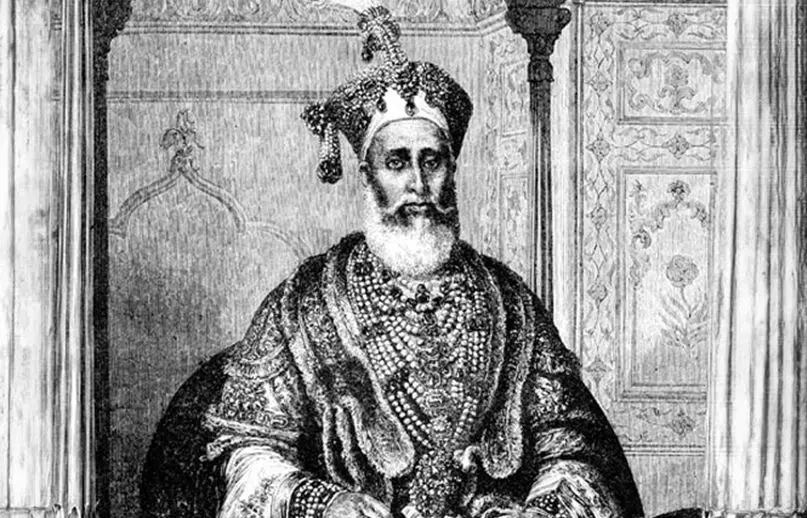
Abu Zafar Siraj ud-Din Muhammad Bahadur Shah, also known as Bahadur Shah Zafar, was the twentieth and last emperor of the Mughal dynasty. By the time he became emperor, after the death of his father Akbar Shah, the Mughal Empire had weakened significantly. Thus, the British East India Company controlled most of India, and Zafar’s authority was largely confined to Delhi. He was paid a pension by the British East India Company.
Unlike his ancestors like Babur and Shah Jahan, who were known for their administrative skills and military strength, Zafar was more interested in spirituality, literature, and architecture. He was well educated in Persian, Urdu, and Arabic and developed a great love for poetry.
During his rule, he played a significant role in promoting culture and aesthetics. His court became a centre of art and Urdu poetry, including famous poets like Mirza Ghalib, Sheikh Mohammad Ibrahim Zauq, and the entire city of Delhi became a hub of literary activities under the rule of Bahadur Shah Zafar.
Zafar believed in unity, respected all religions, and maintained harmony between Hindus and Muslims. However, on May 10, 1857, Indian soldiers (sepoys) rebelled against the British in Meerut. The sepoys marched towards Delhi and declared Bahadur Shah Zafar as the Emperor of Hindustan, making him the symbolic leader of the war. Though he didn’t plan the war, Zafar took responsibility for all the actions of the mutineers. This event is considered the First War of Independence.
The war failed miserably, and the British took control of Delhi after months of brutal killings, mass destruction, and chaos inflicted upon civilians. Meanwhile, Zafar fled and sought refuge in the tomb of Humayun, a large and protected Mughal monument, but it did not save him. He was eventually captured there by William Hodson. His two sons, Mirza Mughal and Mirza Khizr Sultan, and his grandson, Mirza Abu Bakht, were killed near a gate later known as Khooni Darwaza.
Zafar was arrested and brought back to the Red Fort, his own palace, where he was put on trial by the British on charges of supporting the rebellion and being responsible for the killing of Europeans. He was found guilty and exiled to Yangon (then Rangoon) with a few of his surviving family members. That marked the end of more than 300 years of the Mughal Empire.
Bahadur Shah Zafar passed away in 1862 in Yangon. He was buried in an unmarked grave, fearing that his grave might become a symbol of resistance. Years later, his grave was identified. During his exile, he wrote:
Kitna Hai Badnaseeb Zafar, Dafan Ke Liye,
Do Gaz Zameen Bhi Na Mili, Ku-E Yaar Mein
and
Lagta Nahi Dil Mera Ujdey Dayar Mein,
Kis Ki Bani Hai Aalam-E-Napaydaar Mein
These lines reflect the sorrow and hopelessness of the last Mughal emperor.
Bahadur Shah Zafar was officially a Sufi and genuinely accepted murids. The newspaper Delhi Urdu Akhbaar described him as “one of the leading saints of the age, approved of by the divine court.” He was also a believer in the mystical and superstitious aspects of orthodox Sufism. Like many of his followers, he believed that his position as both a Sufi pir and an emperor gave him spiritual powers.
Today, Zafar is remembered not as a powerful conqueror but as a tragic hero and a symbol of quiet resistance against colonial rule. His legacy lives on powerfully through his poetry, which is still widely read and sung across India and Pakistan. In 1975, the Indian government also released a postal stamp in his honour.
Some of his other famous couplets are:
Zafar Aadmi Usko Na Jaaniyega, Wo Ho Kaisa B Sahib-E-Fahm Wa-Zaka,
Jisse Aish Mein Yaad-E-Khuda Na Rahi, Jisse Taish Mein Khauf-E-Khud Anaa Raha
and
Umar-E-Daraaz Maang Laaye The Char Din,
Do Arzu Mein Kat Gaye, Do Intezaar Mein
The writer is a student of Islamic jurisprudence at the International Islamic University, Malaysia. Her areas of interest include Islamic history, Fiqh, Usul al-Fiqh, and the intellectual heritage of Muslim civilisation.
ta*************@***il.com