

New amendments narrow legal protections, risking marginalisation and reinforcing outdated biological definitions
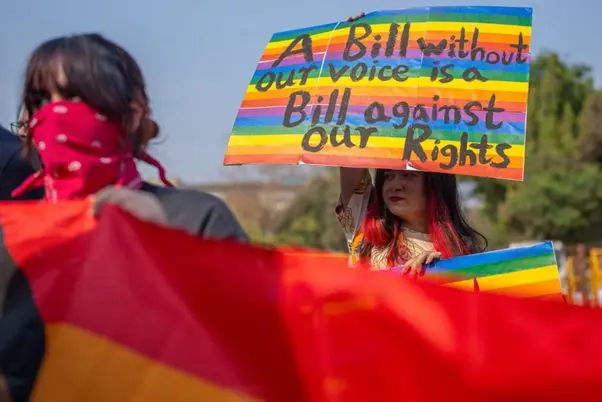
A protest against the transgender rights bill passed in Parliament, in Mumbai, India, March 25, 2026. © 2026 AP Photo/Rafiq Maqbool
Suhail Farooq Khan
India’s Supreme Court, in National Legal Services Authority v. Union of India (2014), established gender self-determination as a core right tied to dignity and constitutional protection. The ruling positioned India as a global leader in transgender jurisprudence, recognising identity as a lived reality rather than biological determinism.
Yet the recent amendment to the Transgender Persons (Protection of Rights) Act, 2019, marks a sharp departure from that vision.
The original law adopted a broad and inclusive definition, encompassing trans-men, trans- women, gender-queer persons, and socio-cultural identities such as hijras and kinners, without mandating medical procedures. The amended framework significantly narrows this scope. By privileging intersex conditions and limiting recognition to select “traditional” categories, it sidelines individuals whose identities rest on self-perception rather than medical certification.
This is not merely a semantic shift. It reflects a deeper transformation – from respecting identity as an internal truth to requiring external validation.
Equally troubling is the amendment’s characterisation of gender-affirming care. By framing voluntary procedures in terms associated with “mutilation” or abuse, it risks stigmatising individuals who seek to align their bodies with their identities. Such language does not safeguard; it delegitimises. It may also push vulnerable individuals toward unsafe, unregulated alternatives, undermining the law’s stated protective intent.
Supporters of the amendment have pointed to concerns about misuse of identity-based protections. While such concerns merit attention, they do not justify sweeping exclusions. Existing administrative mechanisms already allow for verification without imposing rigid biological criteria. Strengthening these safeguards would be a more proportionate response than redefining eligibility in ways that marginalise large sections of the community.
The amendment also fails to account for India’s socio-economic realities. Access to medical diagnostics and gender-affirming healthcare remains uneven, particularly for those already facing economic and social marginalisation. Conditioning legal recognition on such access risks creating a hierarchy of rights, where only those with resources can secure official acknowledgement. For many, this would mean exclusion not only from welfare entitlements but from legal identity itself.
India’s transgender communities have long existed beyond narrow biological classifications. Hijra and kinner traditions, among others, reflect complex social identities shaped by history, kinship, and cultural practice. Attempts to confine these identities within rigid categories echo the legacy of colonial governance, which sought to classify and control gender variance rather than understand it. Reintroducing such rigidity risks flattening the diversity that has historically defined these communities.
Global developments, from the UK’s Cass Review to policy debates in the United States, are often cited to justify stricter frameworks. However, India’s constitutional ethos remains distinct. The right to life and personal liberty under Article 21 of the Indian Constitution has consistently been interpreted to include autonomy, privacy, and dignity. Any restriction on identity must be measured against these guarantees.
At its core, the amendment poses a fundamental question: should the state recognise identity as lived and experienced, or constrain it within biological parameters?
If reform was the goal, more constructive avenues were available, streamlining certification processes, expanding access to healthcare, enforcing anti-discrimination protections, and engaging meaningfully with transgender communities. Such measures would have strengthened, rather than diluted, the framework established by NALSA.
India’s constitutional journey has been marked by an expanding vision of rights. This amendment risks reversing that trajectory. Its consequences extend beyond one community, raising a broader concern: whether dignity in India remains inherent or becomes conditional.
The writer is an Assistant Editor at Review of Democracy, CEU Democracy Institute and LLM Graduate in Comparative Constitutional Law, Central European University
su************@***il.com