

Can New Delhi sustain its historic commitment to the Palestinian cause while embracing modern geopolitical realities
Mohammad Kafeel Qasmi
Diplomacy often tests nations not in moments of comfort but in periods of global tension, when every gesture is interpreted as a signal of alignment. India’s renewed engagement with Israel amid continuing conflict in Gaza has revived an enduring debate: can New Delhi sustain its strategic partnership with Israel while remaining faithful to its historic and moral commitment to the Palestinian cause? The question is neither new nor merely ideological; it lies at the heart of India’s foreign policy identity since independence.
India’s association with Palestine predates formal diplomatic calculations and is deeply intertwined with its own anti-colonial experience. In the early decades after independence, Indian leadership viewed global struggles through the lens of national liberation and self-determination. Under Jawaharlal Nehru, India consistently supported Palestinian political rights, arguing that peace in West Asia required justice alongside security. India opposed the partition of Palestine at the United Nations in 1947 and later became one of the strongest non-Arab advocates of Palestinian statehood in international forums. Recognition of the Palestine Liberation Organization and support for Palestinian representation reflected not only diplomatic positioning but also ideological solidarity shaped by shared histories of colonial resistance.
For decades, this support formed a central pillar of India’s engagement with the Arab world. Economic cooperation, energy dependence, and the welfare of millions of Indian workers in Gulf countries reinforced the importance of maintaining trust across the region. India’s credibility rested on being perceived as a country that understood historical grievances and valued multilateral consensus.
Yet history did not prevent change. The end of the Cold War transformed geopolitical realities, compelling India to recalibrate foreign relations in accordance with emerging economic and security priorities. The establishment of full diplomatic relations with Israel in 1992 marked a decisive turning point. Cooperation expanded steadily in areas where Israel possessed advanced capabilities — agriculture innovation, water management, intelligence sharing, and defence technology.
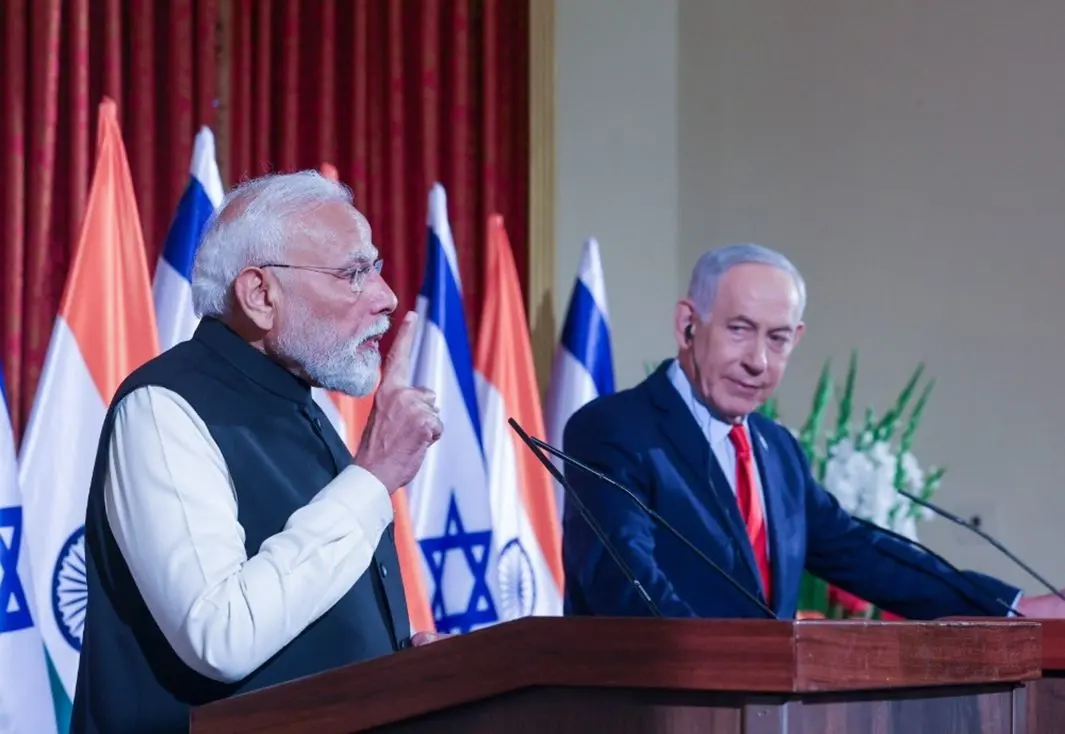
The transformation reached symbolic maturity when Narendra Modi visited Israel in 2017, becoming the first Indian Prime Minister to do so. The visit openly acknowledged a partnership that had previously operated with caution. Defence cooperation intensified, joint technological ventures expanded, and political engagement became increasingly visible. For India, Israel represented not merely a partner but a source of strategic innovation aligned with national development and security goals.
However, India’s policymakers sought to avoid replacing one alignment with another. Instead, they adopted what diplomats termed a policy of “de-hyphenation,” treating Israel and Palestine as separate relationships rather than opposing choices. India simultaneously deepened ties with Israel while continuing developmental assistance to Palestine and reiterating support for a negotiated two-state solution. This balancing act allowed India to preserve continuity with its historical stance while adapting to contemporary geopolitical realities.
Recent developments in Gaza have made this balance more difficult to maintain. Escalating violence, civilian casualties, and global polarisation have narrowed diplomatic space for nuanced positions. India’s official responses — condemning terrorism while calling for humanitarian protection and dialogue — reflect an attempt to navigate competing expectations from domestic audiences, international partners, and regional allies.
The complexity arises because India’s interests in West Asia are multidimensional. Energy security remains closely tied to Arab economies; remittances from Indian expatriates contribute significantly to the national economy; maritime trade routes depend upon regional stability; and strategic competition among global powers increasingly intersects with Middle Eastern geopolitics. In such a landscape, foreign policy cannot rely solely on historical sentiment nor exclusively on strategic calculation — it must reconcile both.
Equally important is India’s aspiration to present itself as a voice of the Global South. Countries across Asia and Africa often view India as a nation capable of bridging moral advocacy with pragmatic diplomacy. Maintaining credibility in this role requires consistency: support for international law, concern for civilian lives, and commitment to the peaceful resolution of conflicts irrespective of political alignments.
Domestic perception also plays a subtle yet significant role. India’s plural social fabric has historically enabled empathy toward diverse global causes. Public discourse surrounding West Asia frequently reflects broader questions about coexistence, identity, and justice. Foreign policy decisions, therefore, resonate beyond diplomatic corridors, influencing how citizens interpret India’s moral standing in world affairs.
Critics argue that balancing both sides risks appearing ambiguous, while supporters contend that such an equilibrium represents diplomatic maturity. In reality, India’s approach reflects a long-standing tradition of strategic autonomy — the effort to engage multiple partners without surrendering independent judgment. This tradition, once expressed through non-alignment, now manifests as multi-alignment in a complex multipolar world.
The deeper challenge is not choosing between Israel and Palestine but ensuring that engagement with one does not imply indifference toward the legitimate aspirations of the other. Supporting Israel’s security concerns and advocating Palestinian statehood are not inherently contradictory if framed within international law and humanitarian principles. The credibility of this position, however, depends on sustained diplomatic engagement rather than episodic statements during crises.
As global politics becomes increasingly binary, India’s attempt to sustain balance may appear difficult, even fragile. Yet it is precisely this effort that defines its distinctive foreign policy character. India’s historical ties with Palestine remind it of the moral language of freedom and justice, while its partnership with Israel reflects the realities of technological cooperation and strategic necessity.
In the final analysis, India’s role in West Asia will be judged not by symbolic gestures alone but by whether it can contribute meaningfully to peace, dialogue, and reconstruction. A rising power is expected not merely to choose sides but to help create conditions where conflicts move toward resolution.
India today stands between memory and modernity, between the legacy of solidarity and the demands of strategy. Managing this delicate equilibrium is not simply a diplomatic exercise; it is a test of whether a nation shaped by its own struggle for freedom can uphold both principle and pragmatism in an increasingly divided world.
The writer is an Islamic scholar, columnist, political and academic strategist
ka*************@***il.com