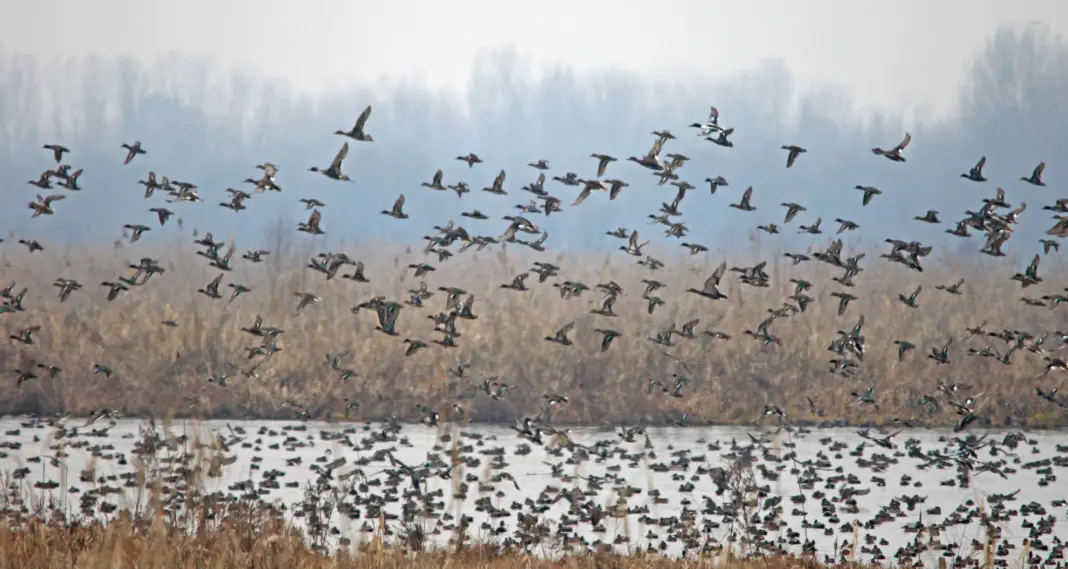


The annual population estimation of migratory birds will cover major sites like Hokersar, Wular and Shallabugh, with students and Wetland Mitras actively participating in the Central Asian Flyway monitoring exercise.
John Mohamad Mir
The Wetlands Division Kashmir of the Wildlife Protection Department, J&K, is set to conduct the Asian Waterfowl Population Estimation (AWPE) 2026 on February 12, 2026 (Thursday) across the wetlands and water bodies of the Kashmir Division. This annual scientific exercise will cover protected areas as well as wetlands outside protected areas, ensuring a comprehensive understanding of wintering migratory bird populations in the Valley.
The estimation forms part of the larger Asian Waterbird Census conducted along the Central Asian Flyway, one of the world’s major migratory bird routes. Kashmir’s wetlands serve as crucial wintering and stopover habitats for thousands of migratory waterfowl arriving from Central Asia, Siberia, China and beyond. The exercise aims to assess population trends, species diversity and habitat conditions, which in turn guide conservation planning and policy decisions.
In a significant step toward community-based conservation, the exercise will witness the participation of a wide spectrum of stakeholders. Students and faculty members from the University of Kashmir, SKUAST-K, various colleges and schools, along with NGOs, Wetland Mitras, bird enthusiasts and local volunteers, will actively assist the field teams.
Their involvement not only strengthens the data collection process but also promotes awareness about wetlands and migratory birds among the younger generation. Such collaborative initiatives build a sense of stewardship and encourage citizens to contribute to biodiversity conservation.
Field teams comprising wildlife officials, researchers٫students and trained volunteers from different NGOs will be deployed across major wetlands, including Hokersar, Wular, Haigam, Chatlam, Mirgund, Shallabugh, Pampore wetlands and other water bodies.
Each wetland will be divided into sectors to ensure accuracy and avoid duplication of counts. Teams will conduct the exercise simultaneously in the early morning hours when waterfowl activity is at its peak.
The Asian Waterfowl Population Estimation plays a crucial role in monitoring population trends of migratory and resident waterfowl٫assessing the health and ecological status of wetlands٫identifying emerging threats such as habitat loss, pollution or disturbance٫supporting policy decisions and conservation planning٫strengthening India’s commitments under international conventions like the Ramsar Convention and Central Asian Flyway Action Plan
Kashmir’s wetlands are among the most important wintering grounds for migratory birds in the Indian subcontinent. Regular monitoring ensures timely conservation interventions and helps maintain ecological balance.
The Wildlife Protection Department, J&K, through its Wetlands Division, continues to play a pivotal role in safeguarding these fragile ecosystems. From habitat management and anti-poaching measures to awareness programmes and scientific monitoring, the department remains committed to conserving migratory birds and their habitats.
The department has also been actively promoting community participation through initiatives like Wetland Mitras, ensuring that local communities become partners in conservation.
The upcoming estimation on 12 February 2026 symbolises a collective commitment toward protecting Kashmir’s wetlands and migratory bird heritage. The participation of students, researchers, NGOs and volunteers reflects a growing awareness that conservation is a shared responsibility.
Such exercises not only generate valuable scientific data but also inspire a culture of environmental stewardship. As teams fan out across the Valley’s wetlands, the effort will stand as a testament to the region’s dedication to preserving its rich biodiversity for future generations.
The Asian Waterfowl Population Estimation 2026 is therefore not merely a counting exercise; it is a celebration of Kashmir’s wetlands, its migratory visitors and the people working tirelessly to protect them.
The writer is a Block Officer at Pampore Wetlands
jo*************@***il.com