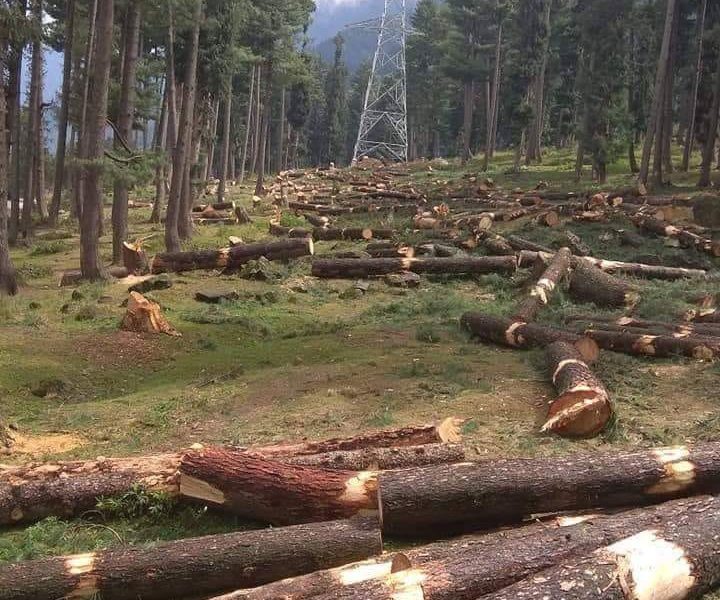


For farming families, trees are raised, not grown. They pay fees, arrange marriages, and hold futures. Now, seven lakh of these lives are slated to fall, for a railway line.
Dr Towseef Bhat
These trees are not wooden logs.
They are not numbers on a government file.
They are not obstacles to development.
They are our hope.
They are our dignity.
They are our future, standing quietly on the soil.
In farming families, trees are not grown—they are raised. They are nurtured with more care than children, watched over with the same anxiety, prayed for with the same sincerity. From the moment a sapling is planted, it becomes part of the family. Every season is counted. Every leaf is noticed. Every storm is feared. Because a farmer does not look at a tree as wood, he looks at it as tomorrow.
These trees pay school fees.
They arrange marriages.
They feed families during lean years.
They stand between survival and starvation.
A farmer’s life is a long conversation with patience. He invests years without any immediate return, trusting the soil, trusting time, trusting God. While the world moves fast, the farmer waits. While cities grow overnight, a tree grows silently, inch by inch, year by year, absorbing sweat, hope, and countless prayers.
I remember my childhood clearly. I remember how my grandmother would scold me if I hit a tree while playing, or if I broke a branch unknowingly. Her voice carried fear, not anger. To her, a tree was alive—not just biologically, but emotionally. “Don’t hurt it,” she would say, as if the tree could feel pain. And perhaps it could. Or perhaps she knew that hurting a tree was like hurting the hands that fed us. She belonged to a generation that understood something modern policies often forget: land is not just land, and trees are not just trees. They are memory. They are security. They are inheritance.
As a farmer myself, I understand this truth in my bones. People talk about agriculture as an occupation. It is not. It is a way of living under constant uncertainty. It is waking up every morning unsure of rain, prices, pests, or policies. It is standing in the field, looking at trees, and calculating futures: Will this be enough? Will this last? Will my children live better than me?
Every farmer ties his dreams to his trees. When a daughter is born, he counts years in harvests. When a son starts school, he measures fees in timber prices. When illness strikes, he looks at his land not with greed, but with desperation. Trees are not luxury assets; they are survival tools.
And now, we are told that nearly seven lakh trees will be cut down for a railway line.
Seven lakh. A number that sounds manageable in an office room. A number that fits neatly into reports and presentations. But behind each tree stands a story. A family. A future. A lifetime of waiting.
We are not cutting trees—we are cutting hope.
We are not removing obstacles—we are removing livelihoods.
We are not displacing land—we are displacing dignity.
Hundreds of families will be left without land. Thousands will lose their only source of income. Entire generations will be forced into uncertainty, migration, or debt. And for what? Development that does not ask whom it leaves behind?
I watched a video recently that refuses to leave my mind. A father stood there, his face lined with exhaustion and fear. He has five daughters. Five futures he is responsible for. Five lives he has promised to protect. And he owns only two kanals of land—land that falls directly under the proposed railway line. Those trees on his land were not decoration. They were not surplus. They were his daughters’ education. Their marriages. Their security in a society that already makes survival harder for girls. Every year he waited, thinking: One more harvest, one more season, and I will manage. Now he stands with empty hands.
Tell me: How does compensation replace certainty?
How does money replace land that fed generations?
How does development answer a father when he asks, What will I do now?
We often hear, “Development is necessary.” Yes, it is. Roads, railways, connectivity—these matter. But development without compassion is violence in slow motion. Progress that ignores emotional and social costs is not growth; it is erasure.
A farmer does not protest because he hates progress. He protests because progress is being built on his silence, his sacrifice, his disappearance. He protests because nobody asked him. Because nobody explained alternatives. Because nobody acknowledged that his loss is not temporary—it is permanent. When a factory shuts down, it can reopen. When a shop closes, it can relocate. When a tree is cut, decades of life vanish in minutes.
What hurts most is not just the loss of income—it is the loss of identity. Land gives a farmer self-respect. Trees give him stability. When they are taken away, he is not just unemployed; he is uprooted. We are told to think nationally, strategically, statistically. But nations are built from households. Strategies are executed on human lives. Statistics bleed when applied without empathy.
If development must come—and yes, it must—then let it come with dialogue, with alternatives, with respect. Let it spare fertile lands where possible. Let it offer genuine rehabilitation, not paperwork. Let it see farmers not as hurdles, but as stakeholders. Because when you cut a farmer’s trees, you do not just remove shade from the land. You remove shade from his future. You expose his family to uncertainty, debt, and despair.
These trees stood through winters, summers, storms, and droughts. They waited quietly while governments changed, prices fluctuated, and promises shifted. They never protested. They only gave.
And now, they are being taken away without a word.
If we cannot feel the pain of a farmer losing his trees, then we have lost something far more dangerous: we have lost our humanity. Development should connect cities, yes. But it should never disconnect people from their roots. Because a country that grows by cutting down the hope of its farmers may move forward—but it will move forward hollow, fractured, and unjust.
And that is not progress.
um******************@***il.com