

Why farming is a cultural identity, and what must change to preserve it
Dr Nisar Farhad
India honours the spirit, sacrifice and strength of the farmers who silently serve the nation by observing Kisan Diwas every year on December 23rd. This day marks the birthday of former Prime Minister Chaudhary Charan Singh, a great advocate for farmers’ rights. His policies laid the foundation for defending the dignity and economic betterment of farming communities across the country.
Kisan Diwas holds special cultural significance in Jammu and Kashmir. Here, farming is more than a profession—it is a status, a tradition, and a heritage preserved like a diamond in this Himalayan region. The land is not only cultivated; it is revered, treasured, and passed down through generations with deep respect.
The Kashmiri Farmer: A Tradition Rooted In Soil
The Kashmiri farmer has shaped the land, culture, and identity of this region—from the terraced paddy fields of Budgam and Bandipora to the famed apple orchards of Shopian, Sopore, and Pulwama. The agricultural cycle here moves with the seasons: wandeh (winter) to endure, soent (spring) to renew, reh (summer) to work, and harud (autumn) to harvest—each phase filled with expectation and uncertainty.
The wisdom of the Kashmiri proverb, taught and reiterated by the revered saint Sheikh-ul-Alam (RA), resonates deeply: “Ann poshi teli yeli wan poshi”—Food will survive only if forests survive. This adage reflects profound ecological awareness, rooted long before environmental science entered school curricula. Tools like the shovel, kaanch, and kraal, crafted by local carpenters (chhan) and blacksmiths (khaar), symbolise a traditional economy where human activity, nature, and community existed in harmony. This connection remains visible today in the way elders still observe the sky, the snowline, and the first almond blossoms to forecast the coming harvest.
The Realities And Struggles Beneath The Beauty
Beyond Kashmir’s scenic beauty lies another narrative—that of the Kashmiri farmer. Thousands work quietly in apple and saffron fields, and in paddy farms nurtured by fertile Karewas and generations of care. Yet, despite the region’s natural abundance and the high reputation of its produce, farming here is growing harder and more uncertain.
Rising input costs and declining profits have pushed farmers into difficulty, exacerbated by land fragmentation. Increased reliance on pesticides, insecticides, fertilisers, and fungicides—driven by growing pest and disease outbreaks—has added financial and emotional strain. Most continue to toil on the land not because it guarantees stability, but because it is their culture, a legacy they cannot abandon.
This vulnerability has been starkly highlighted in recent years. Orchards have been ruined by repeated hailstorms; floods and highway closures have delayed transport, leading to enormous post-harvest losses. This year’s landslide in Ramban blocked the vital Srinagar-Jammu highway for days, paralysing markets and pushing apple prices to record lows. Cold stores filled beyond capacity, and desperate farmers, unable to access markets in Delhi, watched their produce rot—sometimes discarding apples into canals, not because of poor quality, but because there was no way to sell them.
Through all this, the Kashmiri farmer remains resilient. Their bond with the land is emotional, not transactional—the soil holds memories, honour, and heritage. They work day and night amid uncertainty, often unheard and overlooked, preserving a tradition rooted in pride, not just survival.
A Personal Reflection, Shared By Countless Farmers’ Children
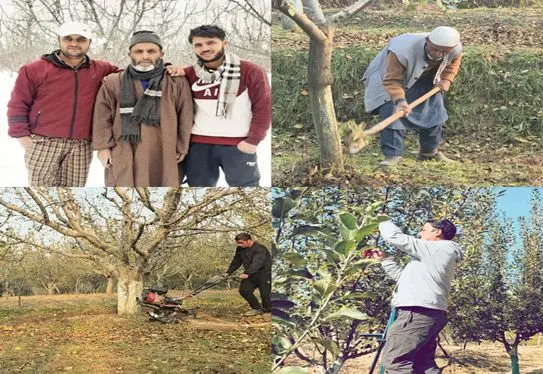
As the child of a farming family, I do not speak of agriculture as a distant observer, but as someone who has lived it, breathed it, and grown through its struggles and dignity. Farming has been more than our occupation—it is our tradition, our identity, and our personal covenant with the land.
In 1974, my father completed his matriculation, a significant achievement at the time. Yet he chose not to pursue a government job or move to the city. He stayed with the earth not for lack of opportunity or ambition, but because the soil called to him in a way only farmers understand. For him, farming was not an option; it was a commitment.
I still recall him leaving home before dawn, long before the sun touched the fields. His steps were sure, his hands calloused, his will unbroken. I watched him sow not just seeds, but faith, patience, and silent prayer. Every season tested him—drought, frost, pests, and market challenges were harder than any exam he ever took. Yet he never complained. Every spring bloom, every apple picked, every sack of rice stored filled him with quiet gratitude and relief.
His relationship with the land taught me what no book ever could: a farmer’s true wealth is not in the land he owns, the tools he uses, or the harvest he gathers. It lies in the hope that the clouds will show mercy, that the soil will yield, and that tomorrow will be better than today.
The Road Ahead: From Appreciation to Action
In recent years, India has launched several initiatives to modernise agriculture, including models for high-density plantation, irrigation support, mechanisation subsidies, FPOs, and digital platforms like e-NAM. Schemes such as PM-DDKY and the Aatmanirbhar Pulses Mission focus on food security, crop diversification, and better storage infrastructure. Ongoing programmes like SMAM and the Gramin Bhandaran Yojana continue to support mechanisation and warehousing.
In Jammu & Kashmir, given the importance of horticulture to the rural economy, schemes such as MIDH, the High-Density Apple Plantation Programme, PM-Kisan, PMFME, and RKVY have emphasised orchard improvement, training, and farmer mechanisation. The ₹5,000 crore Holistic Agriculture Development Programme (HADP) has further advanced precision farming, GI tagging, branding, cold storage expansion, and post-harvest support. Recently, the Centre noted that Jammu & Kashmir has received horticulture relief through SDRF, NDRF, and the PMDP package, with revised compensation norms ranging from ₹8,500 to ₹22,500 per hectare. Under the PMDP scheme, ₹460.33 crore of the allocated ₹500 crore has been released.
To promote high-density apple cultivation, the government has increased support for quality planting material, modern trellis systems, drip irrigation, fertigation, and anti-hail nets. Through cluster-based horticulture programmes and HADP, farmers are encouraged to use disease-free certified planting material, maintain better canopies, and adopt climate-resilient varieties. New facilities—pack houses, grading units, and cold storage—are also being developed to help high-density growers secure better prices and reduce post-harvest losses.
Despite this progress, challenges remain: administrative delays, lack of awareness, poor implementation of insurance schemes, insufficient cold storage, and high upfront costs for modern systems continue to hamper growth. Climate risks, volatile markets, and weak value-added infrastructure add further pressure.
Alongside modern methods, it is essential to appreciate the wisdom of ancient organic farming practices that have sustained agriculture in this region for centuries. In Jammu & Kashmir, traditional methods involved the use of natural manures, crop rotation, mixed cropping, and respect for seasonal cycles—practices that conserved soil fertility and biodiversity. These approaches were cost-effective, environmentally gentle, and finely attuned to local geography and culture. Today, amid concerns over soil degradation, chemical residues, and climate change, blending this traditional knowledge with modern technology could create a more resilient and sustainable farming system. Reviving organic and natural farming, especially in horticulture, could improve soil health and produce quality while opening new markets for premium, residue-free Kashmiri produce.
The path forward depends not only on policy but on fair, timely, and accessible implementation. Farmers need sustained support in storage, processing, insurance, digital literacy, and market linkages. Only then can agriculture shift from struggle to sustainability—making Kisan Diwas not a ceremonial gesture, but a genuine symbol of empowerment.
Conclusion: Let Kisan Diwas Be A Promise, Not Just a Tribute
As Kisan Diwas is observed in Jammu and Kashmir, we must appreciate not only the idea of farming but the lives and sacrifices it entails. Every basket of apples from Shopian, every strand of saffron from Pampore, every walnut and grain of rice tells a story of patience, hardship, and perseverance.
The farmer faces unpredictable weather, market uncertainty, rising input costs, and silent struggles that often go unseen. Farmers are not merely economic agents; they are cultural anchors and emotional stewards of our identity.
Long-overdue reforms are needed to secure their future—one that is comfortable, dignified, and sustainable. These include timely compensation for climate-related damages, quality cold storage and processing units in every district, global branding and export support for Kashmiri products, easy access to modern machinery through farmer-friendly rental centres, specialised healthcare and insurance for farming families, improved housing for orchard farmers, and training centres that help farmers evolve into agri-entrepreneurs, not just producers.
We must also upgrade irrigation, promote organic farming, enable mechanisation, and adopt eco-friendly systems—all while honouring the traditional knowledge handed down through generations. Only by thoughtfully combining tradition and modernity can we ensure sustainable farming that safeguards both our food security and Kashmir’s fragile ecosystem.
In horticulture, especially apples, large harvests coupled with inadequate storage and market links lead to gluts and price crashes. Warehouse receipt financing and better infrastructure can help farmers sell produce strategically, reduce distress sales, and stabilise incomes. Similarly, in crafts and small-scale production, seasonal cycles and low collateral often leave artisans with unsold stock that ties up capital. Innovative solutions like inventory-based lending, peer-to-peer financing, or revenue-based models could turn “dead stock” into working capital while preserving artisanal heritage.
In short, even partial steps to unlock trapped inventory through tailored, tech-enabled financing could spur growth, enhance resilience, and better connect Kashmir’s traditional economy to national and global markets.
Let this day be more than a ritual or symbolic tribute. Let it represent our collective commitment to ensuring farmers receive fairness, support, technology, climate resilience, and respect equal to their contribution. A nation’s prosperity will always rest on the dignity of those who feed it.
Today, we honour those who nourish us—the stewards of our soil and the quiet strength behind every meal and harvest.
Personal Acknowledgement
I wish to express my heartfelt gratitude to my brother-in-law, Mr Manzoor Ahmad Dar, who has served the Horticulture Department with dedication and integrity for over twenty years. His extensive experience, patient guidance, and unwavering support have helped me understand the practical realities of farming and the various horticulture schemes available to growers. Much of what I have written here is shaped by his real-world knowledge and his selfless commitment to supporting farmers—a dedication that is truly inspiring.
Dr Nisar Farhad is an educator, currently serving as a Lecturer in Chemistry with the School Education Department of Jammu and Kashmir. He writes about education, values, and the quiet strength of rural families whose sacrifices continue to inspire generations. Beyond the classroom, he is a keen traveller and adventurer who finds stories in every journey.
dr*************@***il.com