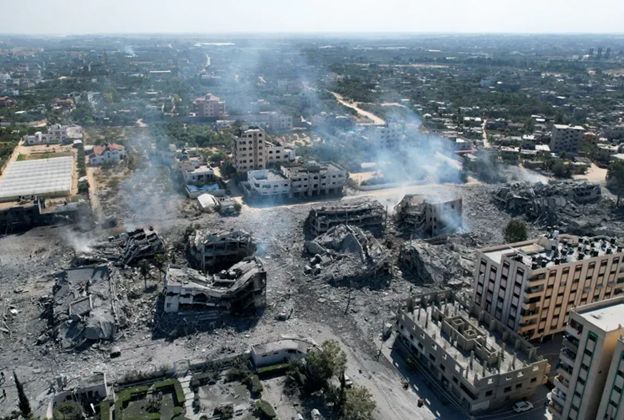


As Gaza bleeds, the Muslim world’s muted response reveals a crisis not just of aid, but of conscience, unity, and spiritual accountability
By Prof Hamid Naseem Rafiabadi
The cries of Gaza echo across the Muslim world, but they fall on ears that have grown accustomed to the sound of suffering. Amid relentless bombardments, siege, starvation, and the systematic erasure of a people, the moral burden on the global Muslim community has never been heavier. Yet, as the dust rises from the ruins of homes and hospitals, and as the funeral prayers of martyrs grow longer each day, something even more devastating is revealed: Gaza’s agony has been met not only with the hostility of its enemies but with the silence, hesitation, and neglect of many of its so-called Muslim brothers. This is not mere apathy—it is betrayal.
In 2022, the United States, a nation with deep political and military ties to Israel, gave almost $344 million to the United Nations Relief and Works Agency for Palestinian Refugees (UNRWA). Germany gave approximately $202 million. The European Union pledged over €261 million for 2022 to 2024. These are not Muslim nations. Their foreign policies are not rooted in concern for the ummah or reverence for al-Aqsa. Yet they acted—fast, decisively, and with significant sums. In contrast, among Muslim-majority countries, only a few even appear on the list of the top 20 donors. Saudi Arabia, home of Islam’s two holiest mosques, gave around $27 million in 2022 and later added $40 million in 2024 after intense international scrutiny. Turkey, often vocal in defence of Palestine, gave just over $25 million. Qatar, a wealthy state with a record of humanitarian diplomacy, contributed a mere $10.5 million. Malaysia pledged about $5.2 million since late 2023. These are crumbs in the face of catastrophe.
The glaring exception is the United Arab Emirates, which in 2024 donated over $204 million to humanitarian aid in Gaza—one of the few Muslim nations to meet the moment with scale and speed. But this act of generosity stands in stark contrast to the broader failure. In sum, the collective contributions of Muslim-majority states are dwarfed by individual non-Muslim countries. This is not due to poverty or incapacity. It is due to political calculus, regional rivalries, misplaced priorities, and a deep erosion of moral clarity.
What does it mean when those outside the fold of Islam give more to the wounded heart of the Muslim world than those within it? What does it say about the spiritual condition of our nations, that the house is burning and we argue over who lit the match—while refusing to pour water on the flames?
The Prophet Muhammad (SAW) taught, “The believers are like a single body; if one part of it complains of pain, the rest of the body responds with sleeplessness and fever.” Yet Gaza screams in pain, and the rest of the body is sedated—lulled into complacency by geopolitics, comfort, and the illusion that someone else will act. Allah says in the Qur’an, “Indeed, this nation of yours is one nation, and I am your Lord, so worship Me” (Surah Al-Anbiya, 21:92). Where is this unity when the ummah’s wounded limb is left to rot? Where is the brotherhood when coffins outnumber blankets and aid is counted in dollars instead of duty?
It is not enough to pray for Gaza, to weep at images, to post verses and slogans. The Qur’an warns us: “Do you order righteousness to the people and forget yourselves while you recite the Scripture? Will you not reason?” (Surah Al-Baqarah, 2:44). Hypocrisy is not just saying one thing and doing another; it is grieving publicly while withholding privately. The gold lies idle in vaults. The oil flows freely across borders. The palaces shine under chandeliers paid for by natural bounty, yet Gaza’s hospitals operate by candlelight and its orphans sleep under tarpaulins.
The Prophet (SAW) swore that he would stand with the oppressed even if they were not Muslim. What then of our silence when the oppressed are our own? Our qiblah was once theirs. The Prophet (SAW) ascended to the heavens from their land. The Qur’an speaks of the land that Allah has blessed. And still, we allow the caretakers of that sacred land to be slaughtered in our time.
The betrayal is not only in the palaces but in the pulpits, in the halls of power, in the fatwas of convenience, in the summits full of speeches but empty of substance. The betrayal is when the call for a ceasefire is met with diplomacy but not decisive aid. It is when budgets for weapons expand while budgets for widows are forgotten. It is when Muslims say “Labbaik ya Aqsa” with their tongues but turn their backs with their wallets.
Gaza has not fallen. It refuses to. It teaches the world sabr, resistance, and dignity. But in the mirror of Gaza’s steadfastness, we must see our own collapse. For every child buried, every breadline stretching into the rubble, every father digging graves with bare hands, there is a ledger in the unseen—a divine accountability that no media campaign can erase.
When the scrolls are unrolled on the Day of Judgment, the question will not be what the enemies of Islam did to Gaza. That is written. The question will be: what did you do when your brothers and sisters cried for help? Did you answer the call of the Prophet (SAW) who said, “Help your brother, whether he is the oppressor or the oppressed”? When asked by his companions how to help an oppressor, he explained that help would be “by preventing him from oppressing others”.
The betrayal of Gaza is not an accident of history. It is a moral choice made by leaders who have sold silence for security, comfort for compliance, faith for fear. And unless the Muslim world wakes from this slumber, the betrayal will be written not only in the blood of Gaza’s children but in the spiritual bankruptcy of a generation that watched—and did nothing.
Gaza has not betrayed us. It has reminded us of who we were meant to be. But until we answer that reminder with real action—sacrificial, strategic, sustained action—then we will continue to fail them. And worse, we will continue to fail ourselves before our Lord.
—Dr Hamidullah Marazi (also known as Hamid Naseem Rafiabadi) is a distinguished contemporary Islamic scholar whose work significantly contributes to the dialogue between Islamic philosophy and modern Western thought. He is the author of several books. Through a rigorous comparative methodology and an emphasis on epistemological integrity grounded in Tawhid (the oneness of God), Marazi critiques secular paradigms and advocates for an integrative intellectual tradition. His scholarship not only critiques Western thought but also calls for mutual enrichment between traditions, emphasising Islamic metaphysics, ethics, and educational reform as central to contemporary challenges.
ha*********@***il.com