

Explore the profound ways Urdu captures the complexities of loss, offering solace and understanding beyond words
By Hibban Showkat
Everyone has lost something – perhaps a dream, a love, or a person. And sometimes this loss arrives so abruptly that we are left stunned, unsure how to react, how to move, how to breathe in this new world. We often hear of grief as a journey in stages – five, some say seven, others. But can grief truly be contained within such neat boundaries? Can something so devastating ever follow such a delicate order?
A friend of mine, who always comes up with apt poetry for any situation, once recited a beautiful verse by Faiz Ahmad Faiz. He assumed his signature “shayari pose”, subtly raising one hand and smiling just enough, before saying:
“Zindagi Kisi Muflis Ki Qaba Hai Jis Mein
Har Ghadi Dard Ke Paivand Lage Jaate Hain.”
I am not sure whether this poetry aligns with my realisation, but after this, I somehow understood that grief is a weird thing, unless you start reading Urdu. And then, it is not weird at all. It is human. Any other language may teach us to heal, to move on, or to file it away in some private drawer, but in Urdu, you learn that grief does not obey any instructions. In Urdu, grief is not a problem to solve but a guest to host. It is not supposed to make sense, no matter how hard you try, especially not when you are trying in English.
“Gham Aur Khushi Mein Farq Na Mehsoos Ho Jahaan
Main Dil Ko Us Maqaam Pe Laata Chala Gaya.”
When my friend again took his signature pose and delicately said this poetry by Sahir Ludhianvi, apt for our situation, he made me realise that if one is to believe in the stages of grief, then a stage of unison between “ghum” and “khushi” is the only understandable stage of grief. I understood that the very word “ghum” carries a weight softer than “sadness”, yet it is somehow deeper than “pain”. For a ninth-grader like me, “Huzn” and “Ghum” would have only been mutaradif alfaz (synonyms), but it is only with life that I realise even words like “ranj” and “dard” unfold like secret rooms.
Another friend of mine, who has no signature poetry pose, yet when the moment calls for it, knows exactly what to recite. Once, after a rough day, he sat in quiet calm, a gentle smile on his face, and remembered Ghalib: “Meri kismat mein hum gham gar itna, dil bhi ya Rab, kai dete.”
Do you see? He was not asking God to remove his grief; rather, he was saying that if his fate was destined to be filled with sorrow, then God should have also given him a heart strong enough to endure it. Urdu poetry does not tell you to be strong in times of grief. It hands you metaphors to think about your grief instead. Every poem in Urdu tells you to make grief a companion that you can walk beside.
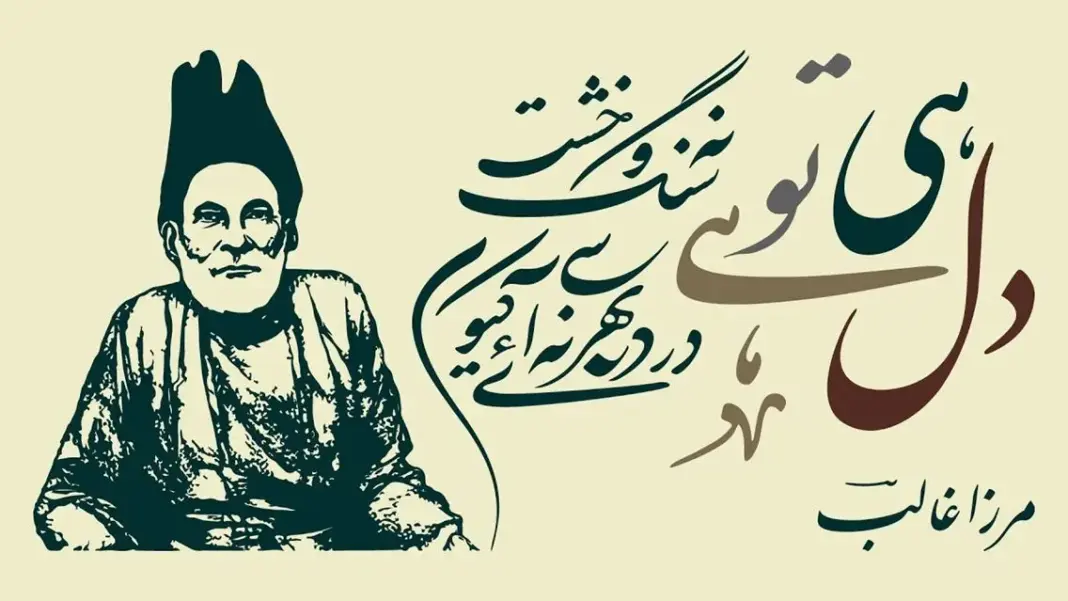
“Dil Hi To Hai Na Sang-o-Khisht, Dard Se Bhar Na Aaye Kyun
Royenge Hum Hazaar Baar, Koi Hume Sataaye Kyun”
When I once tried to make sense of the mere existence of grief – how it is always looming around, ready to attack one way or another – I stumbled upon this poetry by Mirza Ghalib and realised that pain often has to exist without a cure. The very fact that the heart is not made of stone or brick suggests why it should not overflow with pain. It stands as a strong testament that there are no solutions for something so deep.
I remember that months after this realisation, and a dive into the world of Urdu grief poetry, I met a friend who would always be in the mood to joke. He sat across from me and my two “shayari” friends, laughing, and said, “Urdu or English, all you need is a strong heart”. It quickly reminded me of this poem by Bashir Badr:
“Pathar Ke Jigar Waalo, Gham Mein Vo Rawaani Hai,
Khud Raah Bana Lega, Behta Huwa Paani Hai.”
I immediately adopted my signature pose, and the two friends in unison exclaimed, “Oh ho, wah wah,” and we all laughed over a ghamshayari.
So yes, grief remains weird, but Urdu equips you with a vocabulary and melody that makes this weirdness more navigable.
The writer is a student
hi***********@***il.com