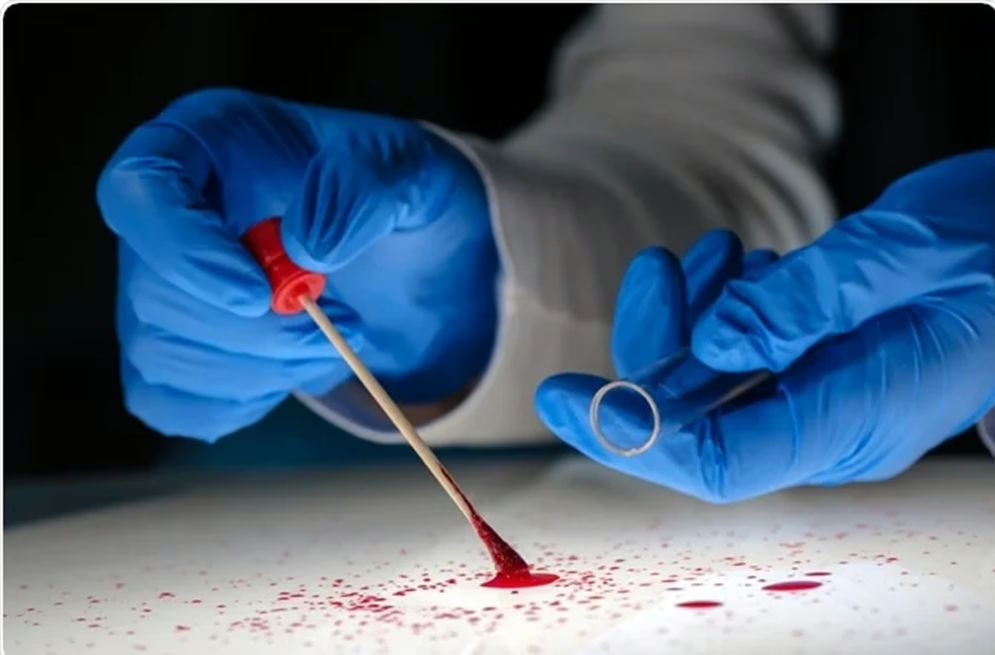


As institutions crumble, forensic science must evolve from crime labs to democracy guardians. National Forensic Integrity Authority is crucial to combat evidence suppression and political interference.
In today’s hyper-politicised and ethically fragile global landscape, the erosion of institutional integrity is no longer subtle but reflects a deeper alignment with systemic decay. The once-distinct boundaries between justice and political power are dissolving, and institutions that were built upon to uphold fairness and transparency now operate under increasing duress. Corruption scandals involving high-ranking officials have become so routine that they no longer provoke outrage, as they are increasingly seen as the cost of doing business in power.
Simultaneously, mechanisms meant to uphold transparency, such as the Right to Information (RTI) Act, are being systematically hollowed out, while investigative agencies slide further into politicisation and selective enforcement. Even internal inquiries into public servant misconduct often collapse into irrelevance, ending not with accountability but with procedural evasions like “warnings” or “compulsory retirements.” These bureaucratic gestures mock both public expectation and the very idea of justice. In cases of medical negligence, action is typically triggered only after widespread public backlash. When inquiries are finally initiated, they are frequently cloaked in bias, shrouded in secrecy, and resolved in ways that protect institutional reputations rather than uncover the truth. The language of “due process,” “privilege,” and “professional hierarchy” is routinely weaponised to suppress transparency. More troubling still are the rising instances in which institutions tasked with combating corruption, vizanti-corruption bureaus, internal vigilance units, and even segments of the judiciary, are themselves implicated in bribery, evidence suppression, or procedural manipulation. This does not merely indicate a governance failure; it reflects the collapse of the very architecture meant to safeguard public trust.
Notably, across the globe, from politically influenced prosecutions in established democracies to the dismantling of oversight institutions in developing ones, these signs are consistent: investigative overreach, bureaucratic impunity, and state interference are no longer occasional but are being made embedded features of the governance. Whistle-blowers are punished rather than protected. Public grievances vanish into bureaucratic black holes. Truth, so often invoked in rhetoric, is not merely delayed but is systematically buried. In such a climate, urgent questions emerge—questions that strike at the very heart of democratic integrity:
Who safeguards the truth when justice systems are bent to serve power, not principle?
Who intervenes when legal inquiries are steered by political agendas rather than constitutional duty?
What becomes of evidence when it is never tested on time, or is made worse, or when it is manipulated to shield the powerful?
Why do inquiries only begin after public outrage, and why do their outcomes so often follow a script of bias, favouritism, or opaque compromise?
In this institutional vacuum, forensic professionals stand as uniquely positioned actors of consequence. Their mandate is not rhetorical but, in essence, an evidentiary one. Grounded in the objective preservation, analysis, and interpretation of facts, their role transcends speculation and narrative. Unlike political statements, facts do not bend so long as they are shielded from interference. When those facts are at risk of distortion or erasure, forensic science must not remain confined to retrospective reporting. It must intervene at real times, not only out of scientific duty, but from an ethical obligation to defend truth where it is most vulnerable.
Across the globe, a growing number of nations are beginning to recognise the expanded civic and institutional role of forensic science. In the United Kingdom, the Forensic Science Regulator Act (2021) established statutory oversight and enforceable quality standards, cementing the principle that scientific independence is not optional, but essential. In Canada, the National Forensic Laboratory Services operates with structured autonomy under the Royal Canadian Mounted Police, ensuring operational impartiality in politically sensitive inquiries. These models affirm a critical insight: forensic science can serve as a stabilising force against institutional decay but only when it is protected by legal autonomy, empowered with authority, and anchored in public trust.
This article issues a call for bold reimagining: forensic science must no longer be confined to a reactive, post-facto role in the justice system. It must be repositioned as a proactive public watchdog, capable of real-time intervention, early identification of institutional malpractice, and the protection of factual integrity precisely when truth is most vulnerable. This is not a matter of procedural refinement. It is an ethical, legal, and democratic imperative, especially at a time when facts are increasingly fragile, and the institutions meant to uphold them are buckling under the weight of politicisation, opacity, and public distrust. With this urgency in view, the article proposes a new course for the forensic field, structured around the following core themes.
- Forensics as an Instrument of Public Intervention
Long regarded as a technical adjunct to the criminal justice system, forensic science or forensics has historically functioned within narrowly defined parameters, primarily verifying or contesting claims within legal proceedings. However, in an age marked by systemic opacity, the erosion of institutional ethics, and the strategic manipulation of information, this constrained role is no longer sufficient. There is now an urgent imperative to reconceptualise forensic science not merely as a reactive discipline but as a proactive, autonomous instrument of public intervention.
In this expanded role, forensic professionals are not just laboratory experts but are custodians of factual integrity, positioned at the interface of science, law, and civil society. Their expertise can and must function as a structural counterweight to state-sponsored disinformation, evidentiary suppression, and bureaucratic obfuscation. Rather than being confined to post hoc validation in judicial forums, forensic science must be deployed in real time to inform public discourse, support democratic oversight, and intercept institutional wrongdoing before narratives are irreversibly shaped. This expanded vision is not simply a matter of professional scope—it is a normative responsibility. In conditions where institutional will is absent and democratic safeguards are eroding, forensic science must serve as a technically grounded, ethically driven check on power. It must act transparently, assertively, and independently in the public interest with these ideas.
Core Proposition: Forensic science must be institutionalised as a mechanism of public intervention that shall be integral to democratic accountability and protection of civil liberties.
Operational Goal: Reposition forensic professionals as civic actors with a formal mandate to confront institutional misrepresentation and uphold evidentiary truth in contested public arenas.
Underlying Justification: In environments where fact is routinely subordinated to political convenience, silence from the forensic community becomes a form of complicity. Structural empowerment to act independently is no longer optional, but is most essential.
- Intervention in Practice: Beyond Postmortem Analysis
In many legal and administrative systems, forensic involvement is activated only after the damage is done, notably after crucial evidence has degraded, timelines have been compromised, and dominant narratives have already taken hold. This retrospective model restricts forensic science to the margins of accountability, reducing it to a reactive rather than preventive force. What is urgently needed is a structural and procedural shift: forensic science must be embedded in the earliest phases of investigative and administrative processes. Its involvement must coincide with, not follow, the emergence of high-risk events, such as custodial deaths, manipulated environmental clearances, public procurement fraud, recruitment scams, or unexplained industrial disasters. Such an early intervention can serve as a powerful deterrent against data tampering, evidence suppression, and institutional whitewashing.
Timely forensic engagement not only safeguards the chain of custody but also preserves public confidence in the legitimacy of investigative procedures. This is not an abstract ideal; global practice validates its feasibility. In Norway, integrated crime scene investigation units are deployed rapidly to preserve evidentiary integrity. New Zealand employs dynamic forensic monitoring systems that engage with real-time developments, reinforcing transparency from the outset. As such, the vision is to have:
Core Proposition: Forensic science must be structurally positioned for anticipatory, real-time engagement and not relegated alone to post-crisis verification.
Operational Goal: Develop and enforce protocols that ensure early-stage forensic access in instances of suspected state overreach, institutional malpractice, or complex public interest litigation.
Underlying Justification: Preemptive forensic intervention preserves the integrity of investigations, reduces opportunities for narrative manipulation, and fosters procedural trust, both within institutions and among the public they serve.
- Institutional Autonomy and Public Trust
The functional autonomy of forensic institutions is not a peripheral concern but is rather a foundational one. If forensic science is to operate as a credible, impartial arbiter in politically charged or bureaucratically sensitive contexts, its institutional structure must be insulated from external interference. Subordination to executive authority, partisan influence, or procedural opacity undermines not only the scientific integrity of forensic outputs but also erodes public confidence in the justice system itself.
To protect this independence, there is a compelling need to establish a statutorily constituted, independent forensic oversight body, analogous in structure and mandate to election commissions or anti-corruption ombudsman offices. Such a body must have the authority and operational autonomy to oversee forensic standards, initiate audits of active investigations, flag procedural lapses, and deliver binding scientific assessments in matters of significant public interest. This proposed entity, tentatively envisioned as a National Forensic Integrity Authority (NFIA), must be granted legal protection and policy insulation, enabling it to function without fear of reprisal or manipulation. Its legitimacy must be rooted not in executive appointment alone but in broad-based public trust and multi-institutional accountability. The reliability will be:
Core Proposition: For forensic science to serve as a reliable instrument of democratic accountability, its institutions must be structurally autonomous, legally empowered, and publicly accountable.
Operational Goal: Establish a National Forensic Integrity Authority (NFIA) with statutory authority to conduct independent audits, intervene in sensitive cases, and issue unencumbered scientific advisories.
Underlying Justification: In the absence of formal independence and procedural safeguards, forensic findings become vulnerable to suppression, reinterpretation, or outright erasure, thereby compromising both truth and justice.
- Rebuilding Ethics and Professional Purpose
Technical expertise may establish credibility, but it is ethical clarity that sustains public trust. In the evolving landscape of forensic science, where practitioners are increasingly called to operate in high-stakes, politically sensitive, and ethically complex environments, scientific proficiency alone is no longer sufficient. A durable forensic culture must be grounded in an unwavering commitment to civic responsibility, transparency, and institutional integrity. The profession must therefore go beyond laboratory competence and cultivate a code of conduct anchored in ethical resilience. Training programs at both foundational and advanced levels must be redesigned to incorporate civic ethics, frameworks for whistleblower protection, and strategies for principled resistance to coercion or manipulation.
Forensic professionals should not only understand the science they practice butalso the systems they serve and shall always be prepared to confront those systems when they compromise truth or public welfare. In an era where silence can enable injustice, ethical literacy becomes a defining criterion for legitimacy. Forensic institutions must build and reinforce a culture where practitioners are supported in making independent, principled decisions, even in the face of institutional pressure. Following narration suffice this
Core Proposition: Ethical literacy is not an accessory to forensic competence but is rather its foundational pillar.
Operational Goal: Integrate civic ethics, whistleblower protections, and integrity-based decision-making into all levels of forensic education, certification, and continuous professional development.
Underlying Justification: The long-term credibility and societal value of forensic institutions depend as much on the moral clarity of their practitioners as on the precision of their science.
- Toward a Culture of Scientific Vigilance
Reimagining forensic science as a pillar of democratic integrity requires more than institutional reform or procedural refinement. It demands a cultural transformation. At its core, this transformation must foster a culture of scientific vigilance consisting of sustained readiness to act in the public interest, resist institutional distortion, and uphold evidence-based truth in spaces where it is most vulnerable. Forensic professionals must no longer be seen as isolated technicians working behind closed doors. They must be recognised and supported as public sentinels, equipped to confront misrepresentation, defend evidentiary integrity, and intervene when facts are suppressed or manipulated. This role does not seek media visibility or political leverage. Rather, it calls for quiet but unyielding allegiance to democratic accountability.
Such a culture requires continuous investment in ethical reinforcement, institutional protection, and public education. Forensic scientists must be prepared not only to interpret complex data but to explain its civic significance, thereby aiding in bridging the gap between scientific clarity and societal understanding. The idea remains
Core Proposition: Forensic science must evolve into a vigilant, civic-facing culture that shall be proactively defending the public’s right to truth.
Operational Goal: Promote a public-oriented role for forensic professionals, enabling their engagement in advocacy, education, independent oversight, and crisis response.
Underlying Justification: In democratic societies, citizens are entitled to truthful information that is not only scientifically sound but also safeguarded from institutional erasure or distortion. So forensic science must claim its rightful place at the frontlines of factual defence.
Together, these five pillars form a comprehensive and globally relevant blueprint for the transformation of forensic science, specifically from a reactive, procedural utility to a proactive, ethically grounded civic force.
Thus, from the foregoing literature and revelations, it is evident that forensic science can no longer remain a reactive, post-facto discipline. In a world where institutional evasion is normalised and public truth is under siege, forensics must evolve into a proactive, ethically anchored force for intervention. Empowered with autonomy, guided by civic responsibility, and protected by law, it has the potential to serve not just justice, but democracy itself.
About the writer
Dr Sami Ullah is a forensic practitioner and anthropologist with an MSc and PhD in Forensic Science and an MA in Anthropology. As Co-Founder and Chairman of the RADISAT Foundation, he leads initiatives in forensic education, justice reform, and evidence-based investigation. His expertise spans DNA forensics, toxicology, investigative forensics, and interventional forensics, with a committed focus on advancing forensic research and academic integration in Jammu & Kashmir.
Dr Sami Ullah
sa********@***il.com