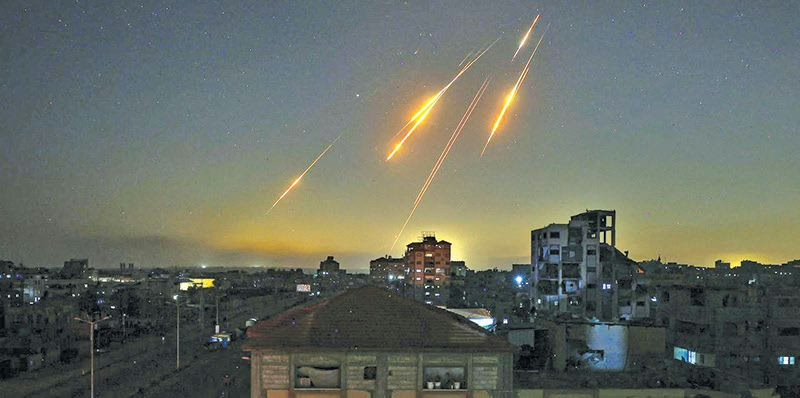
Tehran: Explosions and air raid sirens are being heard again in Iran and Israel as the two nations continue to exchange missiles and drones, a day after the Israeli military killed top Iranian generals and nuclear scientists in the worst such escalation in decades.
Iran’s retaliatory strikes have killed at least four people and wounded more than 200 others in Israel since Friday, as a barrage of dozens of Iranian missiles lit up the skies over Jerusalem and Tel Aviv overnight.
On the Iranian side, at least 80 people, including women and children, have been killed and more than 320 others injured, as the Israeli army targeted residential areas in capital Tehran, military sites and nuclear facilities, killing at least nine nuclear scientists so far.
Accusing Israel of initiating a war, Iran’s Supreme Leader Ayatollah Ali Khamenei said it “must expect severe punishment” for killing several top-level military commanders and scientists.
In a message on state TV, he said Israel “should not think that it is over because they attacked and it is finished”
Meanwhile, Anger mixed with worry as Iranians in the capital of Tehran woke up Saturday to images of their country’s retaliatory attacks on Israel.
Iranian state television, long controlled by hard-line supporters of the country’s theocracy, repeatedly aired footage of missile strikes on Tel Aviv throughout the morning. The broadcaster also showed people cheering in front of a large screen set up in Tehran to follow the strikes as if they were watching a soccer match.
Traffic was lighter than normal on the capital’s streets. The change was due in part to the Shiite holiday of Eid al-Ghadir commemorating the Prophet Muhammad picking his successor, Ali, who is beloved as the first Shiite imam and whose assassination set in motion the splintering of Sunni and Shiite Islam.
Even before the attacks began, many Iranians had travelled outside the city to enjoy days off in places along the nearby Caspian Sea.
The holiday mood made news of the assaults that much more shocking, particularly when the strikes killed many ranking members of Iran’s military and paramilitary Revolutionary Guard, something unseen since Iran’s war with Iraq in the 1980s.
It’s a new experience for many of Iran’s 80 million people who weren’t alive for that devastating conflict, which included a period known as the “War of the Cities,” in which Iraq rained ballistic missiles, artillery fire and airstrikes on Iranian cities.
“Israel killed our commanders and what they expect in return? A kiss?” said Mahmoud Dorri, a 29-year-old taxi driver. “We will go after them to punish them: an eye for an eye.”
In downtown Tehran, 31-year-old teacher and mother of two Pari Pourghazi expressed her joy over Iran’s attack, linking it to Israel’s devastating war against Hamas in the Gaza Strip.
“Someone should stop Israelis. They think they can do anything they want at any time,” she said. “Iran showed Israelis are wrong though they could suppress people of Gaza or Lebanon by heavy bombing.”
Auto mechanic Houshang Ebadi, 61, also backed the Iranian strike but said he opposed a full-fledged war between Iran and Israel.
“I support my country. The Israelis made mistake in launching attacks on Iran but I hope this comes to end,” Ebadi said. “War will not bear fruit for any side.”
Others expressed concerns, verbally or through their actions. At one Tehran gas station, some 300 vehicles waited to fill up, with drivers growing frustrated.
“Sometime there is a queue because people fear that the refineries may be targeted, sometimes there is a line because of a power outage,” said Nahid Rostami, a 43-year-old stylist. “When is this emergency situation going to end?”
Fruit seller Hamid Hasanlu, 41, said his twins couldn’t sleep Friday night with the sounds of explosions and anti-aircraft batteries firing.
“Leaders of both countries should know that people are suffering,” he said.
Iran-Israel War Escalates; Missiles, Drones Exchanged