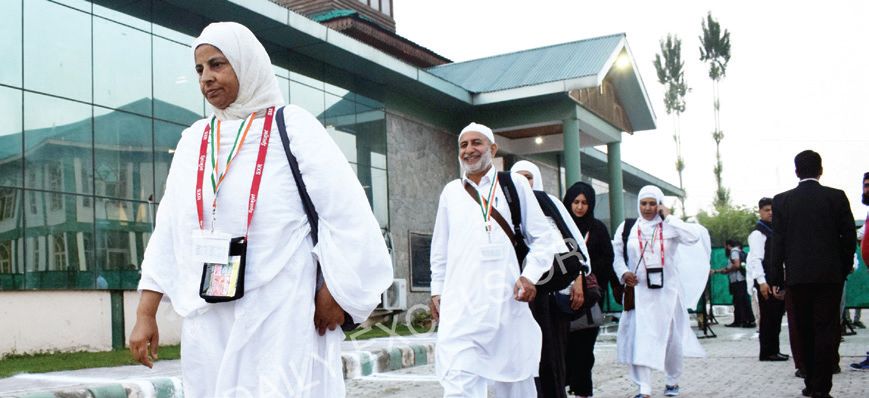


As female representation in Hajj inspector roles remains minimal, stakeholders call for urgent policy reforms to enhance inclusivity, support for women pilgrims
Srinagar: As thousands of Indian Muslims prepare for the sacred journey of Hajj each year, the Hajj Committee of India (HCoI) plays a vital role in facilitating this pilgrimage. Each state and Union Territory, including Jammu and Kashmir, operates its own Hajj Committee under the HCoI, responsible for organizing and assisting pilgrims. Among the key roles in this process is the State Hajj Inspector (formerly known as Khadim-ul-Hujjaj), whose duty is to guide, assist, and support pilgrims throughout their journey to Mecca and Medina.
In a progressive move, recent recruitment policies have opened the doors for women to apply for the position of State Hajj Inspector. This development has come as a sigh of relief for many female pilgrims, highlighting the necessity of having female inspectors available to attend to women’s needs, especially in personal matters. With the introduction of a new room-sharing policy, accommodations will now be arranged separately for male and female pilgrims, making it evident that female inspectors are crucial to ensuring comfort and security for women during their pilgrimage.
However, the implementation of these policies has raised concerns. Despite being technically eligible, the representation of women in the selection process remains minimal, highlighting a stark gender disparity. This imbalance prompts questions about whether the recruitment system is genuinely committed to inclusivity or merely adhering to formalities.
As one female applicant said, “Last year, it was clear that there was a need for a female inspector. The confusion and chaos that female pilgrims encounter during their visit to places like Riaz-ul-Jannah, Mina, and Arafat is a recognized reality. After the pilgrimage, many pilgrims expressed gratitude for the support provided by female inspectors, which made a real difference.”
Despite the enthusiasm surrounding this year’s recruitment process, many female candidates were disappointed to find their names absent from the final selection list. “We were confident that we excelled in the CBT test,” one hopeful applicant said. “But somehow, the interview process remains unclear. It shocked us that many other well-performing females also didn’t make it to the list. How can someone perform exceptionally well in a computer-based test yet not do well in an interview? This raises questions about the recruitment process itself.”
The concerns voiced by female applicants reflect a larger issue: the gender imbalance in appointments. They lamented, “It feels like they are hiring a minimal number just to fill a quota. Last year, when a few females weren’t initially recruited, they had to escalate their complaints to higher authorities. Why does it take extra effort for women to be included? It feels as though the committee isn’t fully welcoming female candidates, even when their presence is clearly needed.”
Dr Shujaat Ahmad Qureshi, the Executive Officer of the J&K State Hajj Committee, weighed in on the issue and provided clarification on the recruitment process. He said the list released by the state committee is a general merit list that simply displays candidates’ scores and that the final selection is subject to approval by the Hajj Committee of India.
“The selection is based purely on merit,” he said. “There is currently no reservation policy in place. Reservation will only apply if the number of female pilgrims travelling without a non-mahram exceeds 150, at which point appointing a female State Hajj Inspector would become mandatory.”
He acknowledged the need for female SHIs, especially during visits to significant religious sites like Arafat and Mina, saying, “The inclusion of more female SHIs to support them is not within our authority. This requires a well-structured policy decision formulated and implemented by the concerned ministers. Such changes can only be enacted through official policy reforms.”