

The High Court of Jammu and Kashmir has unequivocally directed that Shamilat land, particularly those designated for cattle grazing (Kaacharai) and other public purposes, as well as state land unlawfully occupied in various forms, must be immediately reclaimed.
This land is meant exclusively for the common good and is intended for the development of schools, government institutions, playgrounds, and other essential public infrastructure.
Historical and Legal Background
More than a hundred years ago, during the land settlement process, these lands were recorded under the term “Shri Sarkar Dulatmand”, which translates to “Our Wealthy Government”. This designation signified that the government had ample land to fulfil the collective needs of its people, ensuring that no private ownership claims could arise over these lands.
As per legal and constitutional obligations, it is the responsibility of the state to safeguard and maintain its land assets. If, at any point, it is discovered that government land has been illegally encroached upon, the state holds the undisputed right to reclaim it.
In earlier decades, there was a prevailing sense of fear and caution among the people, as they were aware that any attempt to encroach upon government land would likely result in strict legal action. However, in the past thirty years, this fear has gradually diminished, leading to massive encroachments on these public lands.
Encroachments and Their Growing Scale
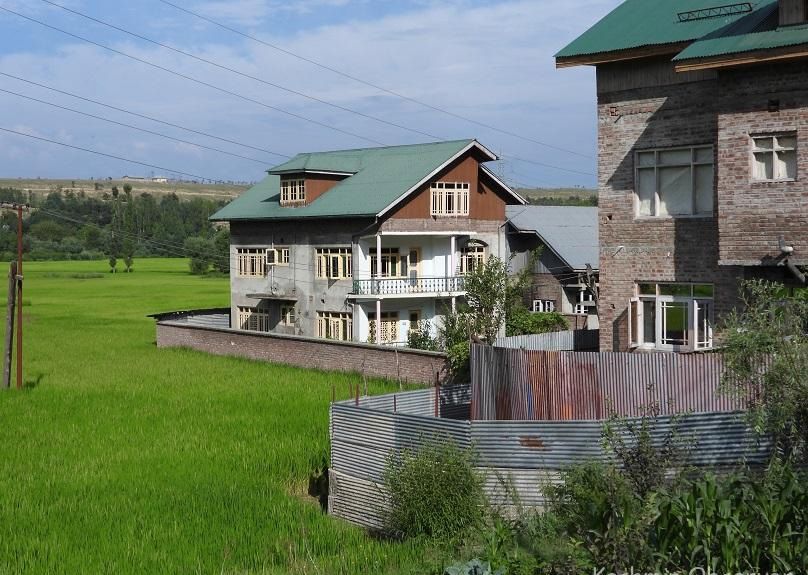
Initially, small-scale illegal occupations took place, where individuals merely fenced off portions of the land, planted trees, or used it for personal agricultural purposes. However, over time, these encroachments escalated into full-scale residential constructions, followed by commercial buildings on these government-designated lands.
This unlawful occupation has not been limited to any one class of society.
Poor and underprivileged individuals have constructed homes on these lands, hoping for eventual legal validation of their possession.
Wealthy and influential people, on the other hand, have taken advantage of legal loopholes and administrative negligence to claim large portions of land for their business ventures, private properties, and other unauthorised purposes.
State’s Response and Legal Provisions
The Revenue Department has been entrusted with the responsibility of monitoring and protecting these lands.
As part of its legal authority, the government has the right to reclaim these lands, regardless of how long they have been occupied.
Although a special provision exists that allows for land exchange (mutation) under certain circumstances, it applies only to specific cases with strict legal scrutiny.
Long-term illegal possession does not, in any way, establish legal ownership rights.
The state is now aggressively working to restore these lands, as the deadline for the retrieval process approaches. Revenue officials have been issuing notices, conducting surveys, and taking action against encroachers at an accelerated pace.
Every day, statements are being released by the authorities, detailing how much land has been retrieved, and how much remains under illegal occupation. Some revenue officials have even assured that all encroachments will be eliminated within the given timeframe.
While this initiative is commendable, it is equally important that the government ensures that its efforts are backed by facts and proper execution, rather than merely issuing statements that do not translate into effective action.
Official Directives and Public Misconceptions
The Revenue Department has repeatedly instructed that all unauthorized entries recorded under Section 4 lands must be removed from land records. Additionally, all relevant survey numbers must be marked with red ink to indicate their legal status as government property.
However, many people continue to believe that their names appearing in old land records or Jamabandis serve as proof of their ownership.
This is a misconception that needs to be addressed urgently.
Even though some official orders have been implemented in land records, many people still falsely assume that their long-standing possession of Shamilat land gives them permanent property rights. Despite several assurances from mid-level revenue officers, these orders have not yet been fully incorporated into digitised records, which has further contributed to confusion among the people.
It is now imperative that the government takes immediate action to ensure that all incorrect land entries are permanently deleted.
Understanding Section 4 and Section 5 of Shamilat Land
One of the primary reasons for the confusion surrounding Shamilat land is the distinction between Section 4 and Section 5 lands.
Section 4 Shamilat Land is considered state land, meant strictly for public use. It cannot be sold, mortgaged, or claimed as private property, even if an individual or family has occupied it for decades.
Section 5 Shamilat Land, on the other hand, is recognized as proprietary land, meaning it can be legally owned, sold, or mortgaged under specific conditions.
Many people falsely assume that all Shamilat lands fall under Section 5, which allows for private ownership. However, most Shamilat lands in villages actually fall under Section 4, making them state property by law.
To resolve this ongoing confusion, it is the responsibility of the Revenue Department to publicly clarify the legal distinction between Section 4 and Section 5 land. This will ensure that people clearly understand which parts of Shamilat land belong to the government and which can be legally owned.
Conclusion: No Private Ownership in Section 4 Shamilat Lands
In summary, an entry in a Shamilat survey number does not confer ownership rights upon an individual.
The government has now launched a serious initiative to eliminate all unauthorized entries from land records and reclaim illegally occupied Shamilat lands.
Simply having one’s name recorded in old Jamabandis does not establish legal ownership.
Unauthorised possession, no matter how long it has lasted, does not grant property rights.
The only legal way to acquire such land is through a formal, government-sanctioned exchange (mutation) process.
The state retains absolute ownership of all Section 4 Shamilat lands and possesses the full authority to repossess them at any time. Those who have illegally occupied these lands, whether rich or poor, should prepare for legal action, as the government is now actively reclaiming what rightfully belongs to the public.
Before making any claim over Shamilat land, people should thoroughly understand the law, their rights, and the consequences of illegal encroachment.
Think before you act. The law is clear—Shamilat land under Section 4 is, and always will be, government property.
Mohd Amin Mir
mi********@***il.com