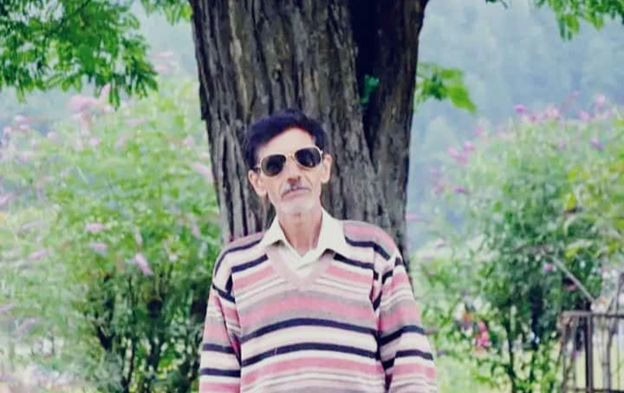


Reflecting on the profound impact of an unparalleled educator, whose dedication, wisdom and compassion for students embodied the true essence of teaching
Hum Tau Mayal Ba-Karam Hain, Koi Sayal Hi Nahin
Rah Dikhlaen Kise Rahraw-e-Manzil Hi Nahin (Allama Iqbal)
(We are inclined to Mercy, but there is no one to implore
Whom can we show the way when there is no traveller?)
This verse from Allama Iqbal’s Jawab-e-Shikwah would often reverberate in the morn wind of our high school – Hanfia Islamic Educational Institute Seer Hamdan, after our beloved teacher – Ghulam Hassan Hakeem, would appear on the podium behind the wired microphone. Then knowledge-filled, intellectually rich lectures and invaluable advice would follow. His articulation, eloquence, and knowledge would captivate every listener. The profuse use of English proverbs and phrases, along with Urdu and Persian poetry, and citation of events from Islamic literature distinctly reflected his erudition.
Ghulam Hassan Hakeem, our English teacher served to impart knowledge for decades with the utmost sincerity and integrity. Belonging to a humble background, Mr Hakeem was a versatile personality. In the 90s, he had been into journalism and calligraphy, which is now a craze among youngsters. Because of unknown circumstances, he couldn’t continue in the field he had a penchant for and joined the teaching profession. Interestingly, his teaching superseded all his other talents, and he received recognition as a well-known grammarian in our town. His hold on the English language would put intellectuals in awe. His vocabulary, pronunciation, and grammar had no peers in those times. Today, even after using gadgets and technology to solve any problem, we still struggle to quell our confusion in most cases. Nevertheless, Mr Hakeem was quick to answer any literature-related query without external help. In some situations, he would be a ‘teacher of teachers’ - guiding them on a variety of matters. If any teacher would get stuck somewhere in the course of academia, Mr Hakeem would always be an ultimate hope.
He deeply valued and nurtured the student-teacher bond. In my estimation, no teacher can ever reproduce the affection he had for his students. Jolliness, amicable attitude, and the habit of cracking jokes were his unique attributes. Off of the class, he was a best friend to everyone. Inside the classroom, he was a teacher of merit, with every gesture attractive and engaging. Without a second thought, I can claim that he did justice to his profession until bidding it adieu.
Adorned with a myriad of exquisite qualities, he was certainly unequalled. But despite being superior to others in many ways, he lived an austere life, with his attire and outlook always simple. He never considered himself better than the rest. In socio-religious gatherings, he would be one among the unlettered audience. Nothing more, nothing less. But a person would get an idea of his intellectual depth only after meeting him in person, listening to his morning assembly speeches at school, or having experience of his classroom activities.
After leaving his profession, he would engage with his students in different ways and was always concerned about their future. Once he had come across one of my articles. He stopped me in the local bazaar and said, ‘Beta, my chest has swelled with pride’. I asked about the reason; he responded, ‘Today I read your article; it was a good read’. I was able to see the glow of happiness in his eyes as if his own son had conquered the impossible. It was not just with me; he would bless all students with prayers wherever he ran into them. He was the best example of a perfect teacher and custodian of the Student-Teacher relationship.
His personal and social life was imbued with modesty. His much-cherished self-esteem was everything to him. I believe he was a strong adherent of Iqbal’s philosophy of Khudi - especially of his appealing verse – ‘Khudi Na Beych; GareebimeinNaamPaidaKar’ - (Sell not your soul! In a beggar’s rags shine).
He stood tall and strong in the face of life’s trials and never compromised his conscience. For the last few years, he lived in misery, braved many odds, and eventually gave up in an honourable way. As is said, ‘divine plans are mostly incomprehensible’; this perfectly fits into the life of Mr Hakeem. Despite being a great human, he became a kind of ‘Sayil’ towards the end, but in this world couldn’t find the God ‘Mayilba-Karam’ and left for a heavenly abode - indubitably to witness God’s ‘Karam’ in the hereafter.
Asmaan Teri Lehad Par Shabnam Afshaani Kare
Sabza-e-Nourasta Iss Ghar Ki Nighebaani Kare (Allama Iqbal)
(May the sky shed its dew upon your grave!
May the freshly grown verdure watch over your home!
The writer is a columnist and the co-author of the book ‘55- Stories’
Zeeshan Rasool Khan
mo************@***il.com