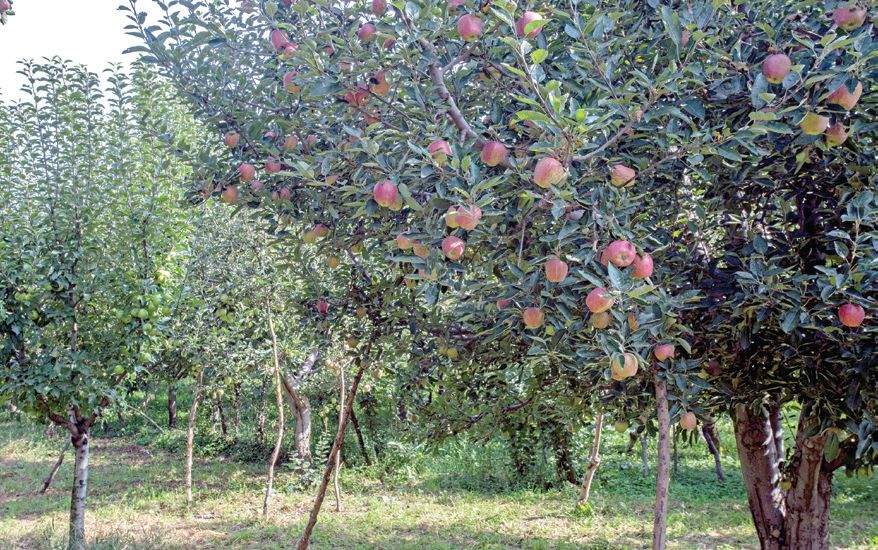


A balanced approach is required that reconciles productivity with environmental integrity and cultural heritage
The growing trend of high-density (HD) apple plantations is transforming the apple industry, offering farmers the allure of quicker returns, higher yields, and more efficient orchard management. In contrast to traditional orchards where trees are spaced widely and require years to reach full productivity, HD systems employ dwarf or semi-dwarf apple trees planted closely together, enabling rapid growth and early harvests. While these HD plantations provide economic and logistical advantages, they also present significant risks that could undermine the long-term health of the apple industry, particularly in regions like Kashmir. These risks encompass environmental degradation, biodiversity loss, and economic instability, potentially threatening the sustainability of apple farming.
A major concern surrounding HD apple plantations is the potential loss of biodiversity. Traditional orchards, with their wider spacing and diverse planting patterns, sustain a variety of plant and animal species. These organisms, from insects and birds to native understory plants, help create a balanced ecosystem that naturally maintains soil health, aids pollination, and controls pests. In contrast, HD plantations, with their close spacing and genetic uniformity, promote monoculture systems where a single apple variety is grown extensively. Although monocultures simplify management and boost productivity, they also become more vulnerable to pests and diseases, often necessitating chemical interventions with pesticides and fertilizers. Such reliance on chemicals increases costs for farmers and contributes to environmental issues as runoff degrades soil quality and pollutes local water sources.
The economic impact of HD apple plantations could also destabilize the market by creating an oversupply if many farmers transition to this model. HD systems yield apples faster and in larger quantities than traditional orchards, leading to potential price drops when supply outstrips demand. This price decline disproportionately affects small farmers, particularly those who may not afford to adopt HD systems, placing them at a disadvantage in competing with high-yield HD plantations. Consequently, smaller farmers may face economic pressure to either adopt HD practices or abandon apple farming, amplifying the risk of market consolidation where only larger-scale producers survive.In Kashmir, where apple farming serves as an economic backbone for numerous families and ancillary industries, the challenges posed by HD systems are especially pronounced. Traditional apple farming not only supports farmers but also a network of associated industries, including wooden cart manufacturing, weeping rice grass for packaging, and seasonal labour for pruning, grading, and harvesting apples. These industries generate employment and contribute significantly to Kashmir’s local economy. However, HD systems, with their streamlined management practices and increased use of chemicals, bypass many of these interrelated sectors, diminishing local job opportunities and affecting the broader socio-economic landscape of traditional apple-growing regions.
Traditional orchards also use fewer chemicals, have a lower incidence of diseases, and foster a naturally resilient ecosystem. The reduced resilience of HD systems, combined with a dependency on specific apple varieties, increases the vulnerability of the entire crop to pests or diseases. Such a shift could undermine not only the traditional economic model but also Kashmir’s social structure by eroding job opportunities for workers who rely on the traditional apple industry.HD plantations also threaten the preservation of cultural heritage. Kashmir’s traditional orchards are home to heritage apple varieties that have been cultivated over generations and cherished for their unique flavours and cultural value. In HD systems, commercial apple varieties are often prioritized to meet retail market demands, which may gradually edge out these unique, region-specific apples. The resulting loss of genetic diversity can weaken the crop’s ability to resist diseases, adapt to environmental changes, and withstand climatic shifts, posing a further threat to the sustainability of the industry.
Another significant concern with HD systems is the storage limitation of many of the apple varieties they produce, which generally have shorter storage lives than traditional apples. This forces farmers to sell their produce quickly, often resulting in a market oversupply during harvest seasons and, consequently, further price drops. Small farmers who lack access to advanced storage facilities are particularly susceptible to these price fluctuations, which compromise their income stability and competitive position in the market. The increasing adoption of HD apple plantations in Kashmir is further fuelled by aggressive commercial advertising that promotes high yields and quick profits. Often, these advertisements present an overly optimistic picture, leaving out the long-term economic and environmental risks. Farmers, attracted by promises of immediate returns, may adopt HD systems without being fully aware of the potential downsides, such as storage challenges and economic volatility. The gap in awareness can lead to unsustainable practices, jeopardizing not only individual farmers’ financial stability but also the broader industry’s future.
To address these challenges, a balanced approach integrating both HD and traditional systems could allow farmers to enjoy the productivity benefits of HD orchards while preserving the ecological and cultural strengths of traditional methods. By retaining some biodiversity and heritage apple varieties, the industry could safeguard against the vulnerabilities associated with monoculture systems and market fluctuations. Support from agricultural organizations and local authorities to create niche markets for heritage apples could also provide economic opportunities for traditional farmers and help them remain competitive. Implementing sustainability practices, such as integrated pest management, organic fertilizers, and efficient irrigation, can help reduce the environmental impact of HD orchards. By investing in sustainable methods and improved storage infrastructure, the Apple industry can mitigate the risks of overproduction, price instability, and environmental harm, fostering a balance between productivity and ecological responsibility.
While HD apple plantations bring clear benefits, their widespread adoption could pose serious risks to traditional apple farming communities, especially in Kashmir. To ensure the region’s economic, cultural, and environmental well-being, a thoughtful approach that honours both innovation and heritage is crucial. Embracing sustainable practices, supporting a diversity of apple varieties, and fostering a balanced industry structure will be vital for the long-term resilience of apple farming. This balanced strategy will enable the industry to meet modern market demands while safeguarding the cultural legacy and livelihoods of traditional farming communities.
The writer is an Assistant Professor (Contractual), Department of Business Administration, School of Business Studies, Islamic University of Science and Technology, Awantipora
Dr Syed Irfan Shafi
dr**************@***il.com