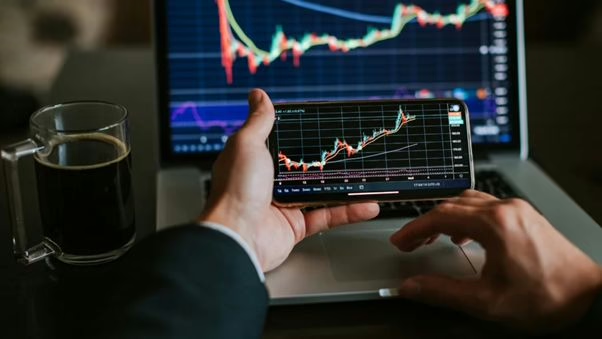


Every day for newcomers in the stock market can bring a new learning experience. But even seasoned players occasionally stumble upon concepts that feel brand new, like tick trading. While tick trading may seem to be a little confusing, a closer look may make it a valuable tool. It can help you understand the market sentiments in a better way. Read on to learn more about tick trading, after all, it’s never too late to learn something new!
Securities Trading
If you are into trading, you would know that as compared to investing, trading lays more focus on short-term buying and selling. The primary aim here is to make the most of the movements in the market. And here, different traders use different kinds of strategies. Tick trading is one such strategy that has been gaining popularity. If you already have one or are planning to open demat account, knowing about tick trading can come in handy.
Tick in Securities Trading
Ticks act as a standard unit for tracking price changes, enabling traders to measure even minor fluctuations in value. They provide a clear way to interpret market trends and evaluate price shifts effectively. Tick size plays a crucial role in entry and exit decisions.
In the US, ticks are measured in dollars or cents, with stock prices often changing in one-cent increments. In India, ticks are measured in rupees and paisa, for example, ₹1, ₹0.5, or ₹0.05.
In securities trading, therefore, a tick refers to the smallest movement/ change in a security’s price, which could be an increase or a decrease. Tick trading, therefore, is a high-risk, high-reward strategy that requires quick decisions. As a trader, you need to watch tick movements closely because they show changes in market trends and trading patterns. These movements impact how trades are executed, price discovery, and the market’s order depth.
Tick Trading: Characteristics
Let us take a quick look at some of the highlighting features of tick trading:
- Smallest movement in price
Tick trading represents the smallest possible change in the price of a financial security. - Important for high-priced securities
When it comes to securities that are higher priced, the tick size becomes important. This is because even a small price change can bring significant implications. - Impacts profitability
While a small tick size presents more trading options and enhances market liquidity; a size too small can disrupt the market. - Ticks are regulated
SEBI, the Securities and Exchange Board of India, sets the tick sizes. - Ticks can vary
Every market can have its own tick sizes and tick rules. Tickets can vary for securities such as futures, stocks and forex. - Affects the mood of the market
When a tick moves, it may make people buy or sell, thus affecting how the market behaves. Tick size is therefore considered to affect the way people perceive the market.
Tick Trading: Working
As mentioned above, it is the SEBI that determines the tick size. Let’s how how tick sizes are typically categories:
- ₹1 Tick Size is applicable to companies with a market cap above ₹10,000 crore.
- ₹5 Tick Size is assigned to companies with a market cap between ₹4,000 crore and Rs 10,000 crore.
- ₹05 Tick Size is reserved for companies with a market cap below ₹4,000 crore.
Here’s an example to understand how tick trading works. Let’s suppose an NSE stock has a tick size of ₹0.10 and is trading at ₹1,000, the next possible price changes would be ₹1,000.10 or ₹999.90, based on the tick size increment.
In Conclusion
Useful for measuring market trends and price movements, tick trading plays a key role as it offers traders several insights. It comes with the benefits of tighter spreads, quicker execution and more liquidity. Another key advantage is that tick trading allows prices to stay closer to the actual value, thus giving small investors better opportunities to trade.
At Bajaj Broking, we help our clients be aware of the tools and strategies that can help them trade better. Understanding tick trading will help you manage the risks of the market in a better way and thus make well-informed decisions. As all involved follow the same rules set by the apex body,, SEBI, it becomes easier for traders to estimate the transaction costs.