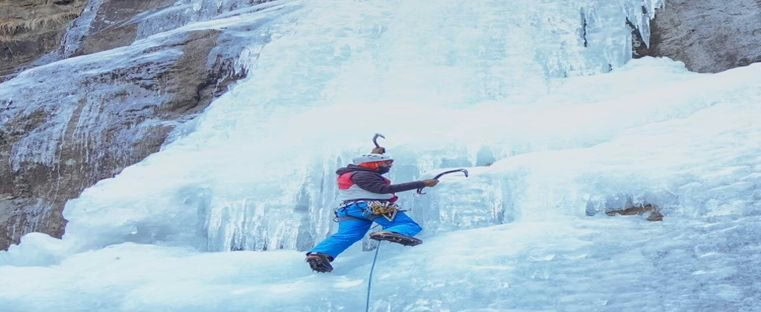


Zeeshan Mushtaq’s historic ascent of Thajiwas peak in 2023 earned him international recognition. He seeks better support for adventure sports in Kashmir
Zeeshan Mushtaq, a young climber and hiker is determined to put Kashmir on the global map for adventure sports, paving a new path for future generations and inspiring others to pursue the thrill of the mountains.
On July 2, 2023, Zeeshan etched his name into the annals of mountaineering history with an ascent that had not been attempted successfully in over seven decades. Accompanied by his close friend Faisal Wani, he took on the formidable Great Couloir of Thajiwas peak in Sonamarg—a route last completed in 1945 by the British climbers Jackson and Buzzard. While Zeeshan and Faisal reached just a hundred meters shy of the summit, their climb was nothing short of historic, marking only the third recorded ascent of the peak and the first by an Indian climber.
For Zeeshan, this climb was deeply personal and marked by a broader purpose. “My main objective was to start a new chapter of alpinism in the valley,” he said. Thajiwas Peak, with its visible prominence from the Sonamarg roadhead, represented a unique symbol for Kashmir’s unexplored potential in mountaineering.
Quoting legendary climber Stephen Venables, he reflected, “For a mountaineer, there is something very exciting about an unclimbed Himalayan peak.” Though the peak had seen climbers before, Zeeshan was drawn to the challenge posed by its ever-shifting conditions and sought to be part of its legacy. This legacy extended beyond Kashmir, as Zeeshan’s climb earned him a coveted place in the American Alpine Journal, one of the world’s most esteemed climbing publications.
For a young mountaineer from Kashmir, this was a dream realized, an acknowledgement that elevated his achievements onto the global stage. “To have our climb and name alongside some of the most respected climbers in the world is an honour beyond words,” he said. Yet, the journey to reach such recognition was not without risk. During the descent, Zeeshan and Faisal encountered perilous conditions as they traversed the narrow chute of the Great Couloir. The snow beneath them gave way, and they tumbled down the icy slope, narrowly missing a deep crevasse. Miraculously, they stopped just short of disaster, but both suffered fractures and hypothermia before a rescue helicopter arrived hours later. It was a test of physical and mental resilience, but also an experience that underscored the dangers—and the thrill—of high-altitude climbing.
Over the years, Zeeshan has invested time in documenting the trails and lakes of the Pir Panjal range, producing a detailed guidebook for fellow adventurers. Through his meticulous work, he mapped routes, explored hidden pathways, and identified over a hundred alpine lakes, nearly half of Kashmir’s estimated total. His guidebook offers insights into the region’s stunning landscapes and stands as both a practical resource and a tribute to the rugged beauty of the valley. The compilation of these lakes, water bodies, and remote trails has brought the beauty of the Pir Panjal closer to aspiring trekkers and hikers, and his guidebook is already gaining traction among the adventurous community.
Driven by a vision to nurture a community of climbers in Kashmir, Zeeshan founded “Kashmir Climb” in 2022. The organization’s mission is to introduce young people to the world of trekking, hiking, and mountaineering, promoting adventure sports as both a source of joy and a way to connect with Kashmir’s incredible natural environment. For Zeeshan, “Kashmir Climb” is a platform to empower youngsters to push boundaries and discover the freedom that comes with the mountains. Through workshops, treks and mentorship, he aims to build a network of climbers capable of transforming the region into a hub for adventure sports.
Despite his success and community efforts, Zeeshan remains critical of the lack of institutional support for adventure sports in Kashmir. He has openly voiced frustration with what he sees as outdated and ineffective tourism policies. In his view, Kashmir’s potential as a destination for climbing and hiking remains largely untapped, and he sees this as a direct result of insufficient backing from local authorities. “The absence of skilled rescue personnel, limited training opportunities, and a general lack of support from the tourism department have made the pursuit of adventure sports unnecessarily risky for enthusiasts,” he said.
Zeeshan believes that with proper resources, such as rescue training programs, infrastructure improvements, and promotional efforts, Kashmir could offer adventure tourism experiences comparable to other global destinations. He hopes that the authorities will recognize the value of these activities and make the changes needed to foster a safe and thriving environment for adventure sports.
By Sarwar Kawoosa
43******@***il.com