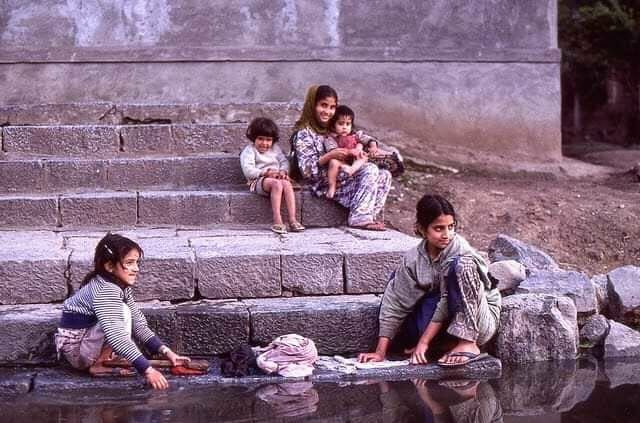


The word Yaarbal, deeply rooted in Kashmiri culture, refers to a common water source or riverside spot where women of the locality would gather every day to fetch drinking water, wash clothes and utensils, and complete other household chores. However, reducing Yaarbal to merely a water collection point would be an injustice to its true significance. It was, in every sense, the social heartbeat of the community.
Waseem Akhter Dar
The word Yaarbal, deeply rooted in Kashmiri culture, refers to a common water source or riverside spot where women of the locality would gather every day to fetch drinking water, wash clothes and utensils, and complete other household chores. However, reducing Yaarbal to merely a water collection point would be an injustice to its true significance. It was, in every sense, the social heartbeat of the community.
Recently, while taking a leisurely walk through my neighbourhood, I came across an old Yaarbal. A few women were standing patiently with their vessels, waiting for their turn to fetch water. As they waited, they were engrossed in cheerful conversations, sharing stories, exchanging laughter, discussing their daily lives, and yes, indulging in a little harmless gossip, just as generations before them had done. That simple scene instantly transported me back to a bygone era, the golden days that I, too, was fortunate enough to witness. It reminded me that the Yaarbal was never merely a place to collect water; it was a place where relationships flourished, friendships were strengthened, hearts found comfort, and the true spirit of community came alive.
There was a time in Kashmir when relationships were not built through mobile phones, social media platforms, or instant messaging applications. They were built face-to-face, through shared conversations, laughter, empathy, and companionship. At the heart of this beautiful social fabric stood a humble yet significant place known as the Yaarbal.
Long before the arrival of the internet, smartphones, and social media, the Yaarbal served as a living communication centre. Women from different households met there daily, not only to perform their routine tasks but also to connect with one another. It was here that they shared their joys and sorrows, celebrated each other’s happiness, discussed family matters, sought advice, exchanged ideas, and found emotional comfort.
A woman burdened by domestic worries would often return home feeling lighter after spending some time at the Yaarbal. Sharing one’s pain was itself a form of healing. Likewise, moments of happiness became even more meaningful when celebrated together. The Yaarbal provided something that modern technology often struggles to offer: genuine human presence and heartfelt companionship.
The Yaarbal was also the centre of neighbourhood news. If a new bride arrived in a family, the women of the locality would soon come to know about it through conversations at the Yaarbal. The bride herself gradually became acquainted with the women of the village there, helping her integrate into the community. Births, weddings, illnesses, festivals, and other important events naturally became topics of discussion, creating a close-knit society where everyone felt connected.
Like any social gathering, the Yaarbal was not entirely free from imperfections. At times, gossip and backbiting also found their way into these conversations. Yet these shortcomings never overshadowed its larger purpose. The bonds of friendship, mutual support, and collective responsibility far outweighed the occasional negativity. The Yaarbal remained a place where relationships were nurtured and communities flourished.
Today, our means of communication have become faster than ever. We can connect with people living thousands of kilometres away with a single click. Ironically, however, many of us have grown distant from the people living next door. In many neighbourhoods, people no longer know the names of their nearest neighbours. Digital connectivity has increased, but emotional connectivity has declined.
The gradual disappearance of Yaarbals has not merely changed our surroundings; it has altered our social lives. Modern lifestyles, piped water supply, urbanisation, and changing living patterns have quietly erased these traditional meeting places. Along with them, an invaluable culture of daily interaction, collective listening, and emotional support has also faded away.
Mental health experts often emphasise the importance of social interaction in preventing loneliness, anxiety, and depression. Without realising it, our ancestors had already created such a support system through institutions like the Yaarbal. Women naturally expressed their emotions, shared their concerns, and found reassurance among their companions. These daily interactions reduced stress and strengthened emotional resilience.
Today, despite having hundreds of contacts on social media, many people struggle with loneliness and isolation. Virtual conversations often lack the warmth, empathy, and sincerity that characterised those simple gatherings at the Yaarbal. While technology has made communication easier, it has not always made relationships stronger.
The Yaarbal teaches us a timeless lesson, communities become stronger not through technology alone but through meaningful human interaction. Its disappearance reminds us that progress should never come at the cost of our social bonds. While we may not be able to recreate the Yaarbals exactly as they once existed, we can certainly revive their spirit by encouraging neighbourly interaction, community gatherings, and genuine conversations.
As Kashmir continues to modernise, preserving the memories of places like the Yaarbal becomes increasingly important. They are not merely relics of the past but symbols of a culture that valued togetherness over isolation, listening over judging, and relationships over routines.
Perhaps the greatest tribute we can pay to the Yaarbal is not simply to remember it, but to bring back the spirit it represented, a spirit where people knew one another, cared for one another, and stood beside one another through every joy and every hardship.
For many Kashmiris, the Yaarbal will forever remain more than a place to fetch water. It was a place where friendships were born, communities were strengthened, hearts found comfort, and life itself flowed as naturally as the water that sustained it. Those were indeed the golden days, a priceless heritage that today’s generation can only imagine, but whose values we can still strive to revive.
The writer is a librarian at the Department of School Education
wa**************@***il.com