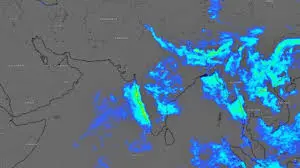


NEW DELHI: India’s southwest monsoon is likely to remain under pressure in July, with the India Meteorological Department (IMD) forecasting below-normal rainfall across most parts of the country as El Nino conditions continue to strengthen over the equatorial Pacific Ocean.
Releasing its monthly outlook on Tuesday, the IMD said rainfall over the country during July 2026 is most likely to be below normal, with precipitation expected to be less than 94% of the Long Period Average (LPA). The long-term average rainfall for July, based on data from 1971 to 2020, stands at 280.4 mm.
The forecast comes after India recorded one of its driest Junes in more than a century, with rainfall ending 39% below normal and June 2026 becoming the fifth-driest June since 1901.
According to the IMD’s probability forecast, below-normal rainfall is likely over most parts of the country, including large areas of central, western and northern India. However, some regions are expected to escape the widespread deficit.
The weather office said parts of northwest India, east-central India and the eastern peninsular region are likely to receive normal to above-normal rainfall, offering some relief after a sluggish start to the monsoon. Northeast India is also expected to remain relatively wetter than the rest of the country.
The subdued rainfall outlook comes as meteorologists closely monitor the evolution of El Nino, the periodic warming of sea surface temperatures over the central and eastern Pacific Ocean. El Nino weakens the monsoon circulation by reducing the temperature contrast between land and ocean, often suppressing cloud formation and rainfall over the Indian subcontinent.
While not every El Nino results in drought, strong events have historically been associated with weaker monsoons and prolonged dry spells across India.
The delayed advance of the southwest monsoon this year has already disrupted agricultural activity. Government data released last week showed kharif sowing has fallen nearly 23% compared to the same period last year, with crops such as rice, pulses, soybean and cotton witnessing significant declines due to inadequate soil moisture.
Despite the pessimistic July forecast, the IMD expects monsoon activity to improve in the coming days as fresh low-pressure systems develop over the Bay of Bengal and the monsoon trough shifts southwards, bringing widespread rainfall to parts of central and northern India.
Australia’s Bureau of Meteorology (BOM) has indicated that a positive Indian Ocean Dipole (IOD) could develop during the second half of the monsoon, usually between August and September, which could help boost the monsoon’s strength.
Meteorologists caution, however, that these individual weather systems may provide only temporary relief if El Nino continues to strengthen through the remainder of the monsoon season.
With July accounting for one of the largest shares of India’s seasonal rainfall, its performance will be crucial for agriculture, reservoir storage, water availability and the overall health of the country’s economy in the months ahead.
Agencies